

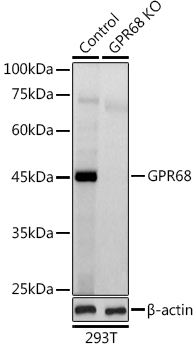

Anti-GPR68 antibody (276-365) (STJ29487)
SPECIFICATIONS
ClonalityPolyclonal
HostRabbit
ConjugationUnconjugated
IsotypeIgG
General Information
| Short Description | Rabbit polyclonal GPR68 (276-365) antibody for use in WB and ELISA in human, mouse and rat samples. Datasheet included with dilution recommendations, and related reagents. |
| Applications | WB/ELISA |
| Host | Rabbit |
| Reactivity | Human/Mouse/Rat |
| Note | STRICTLY FOR FURTHER SCIENTIFIC RESEARCH USE ONLY (RUO). MUST NOT TO BE USED IN DIAGNOSTIC OR THERAPEUTIC APPLICATIONS. |
Product Properties
| Clonality | Polyclonal |
| Isotype | IgG |
| Conjugation | Unconjugated |
| Concentration | Lot specific |
| Purification | Affinity purification |
| Dilution Range | WB:1:500-1:1000ELISA:Recommended starting concentration is 1 Mu g/mL. Please optimize the concentration based on your specific assay requirements. |
| Formulation | PBS with 0.02% Sodium Azide, 50% Glycerol, pH 7.3. |
| Storage Instruction | Store at-20°C for up to 1 year from the date of receipt, and avoid repeat freeze-thaw cycles. |
Target Information
| Gene Symbol | GPR68 |
| Gene ID | 8111 |
| Uniprot ID | GPR68_HUMAN |
| Immunogen Region | 276-365 |
| Immunogen Sequence | SFNCVADPVLYCFVSETTHR DLARLRGACLAFLTCSRTGR AREAYPLGAPEASGKSGAQG EEPELLTKLHPAFQTPNSPG SGGFPTGRLA |
| Specificity | Recombinant fusion protein containing a sequence corresponding to amino acids 276-365 of human GPR68 (NP_003476.3). |
Additional Info
| Tissue Specificity | Found at low level in a wide range of tissues, but significantly expressed in lung, kidney, bone and nervous system. |
| Function | Proton-sensing G-protein coupled receptor activated by extracellular pH, which is required to monitor pH changes and generate adaptive reactions. The receptor is almost silent at pH 7.8 but fully activated at pH 6.8. Ligand binding causes a conformation change that triggers signaling via guanine nucleotide-binding proteins (G proteins) and modulates the activity of downstream effectors, such as phospholipase C. GPR68 is mainly coupled to G(q) G proteins and mediates production of diacylglycerol (DAG) and inositol 1,4,5-trisphosphate (IP3). Acts as a key mechanosensor of fluid shear stress and membrane stretch. Expressed in endothelial cells of small-diameter resistance arteries, where it mediates flow-induced dilation in response to shear stress. May represents an osteoblastic pH sensor regulating cell-mediated responses to acidosis in bone. Acts as a regulator of calcium-sensing receptor CASR in a seesaw manner: GPR68-mediated signaling inhibits CASR signaling in response to protons, while CASR inhibits GPR68 in presence of extracellular calcium. |
| Protein Name | G-Protein Coupled Receptor 68G-Protein Coupled Receptor 12aGpr12aOvarian Cancer G-Protein Coupled Receptor 1Ogr-1 |
| Database Links | Reactome: R-HSA-373076Reactome: R-HSA-416476 |
| Cellular Localisation | Cell MembraneMulti-Pass Membrane Protein |
| Alternative Antibody Names | Anti-G-Protein Coupled Receptor 68 antibodyAnti-G-Protein Coupled Receptor 12a antibodyAnti-Gpr12a antibodyAnti-Ovarian Cancer G-Protein Coupled Receptor 1 antibodyAnti-Ogr-1 antibodyAnti-GPR68 antibodyAnti-OGR1 antibody |
Information sourced from Uniprot.org