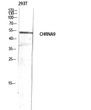
| Post Translational Modifications | N-glycosylated. |
| Function | Component of neuronal acetylcholine receptors (nAChRs) that function as pentameric, ligand-gated cation channels with high calcium permeability among other activities. nAChRs are excitatory neurotrasnmitter receptors formed by a collection of nAChR subunits known to mediate synaptic transmission in the nervous system and the neuromuscular junction. Each nAchR subunit confers differential attributes to channel properties, including activation, deactivation and desensitization kinetics, pH sensitivity, cation permeability, and binding to allosteric modulators. Forms either homopentamers or heteropentamers with CHRNA10. Expressed in the inner ear, in sympathetic neurons and in other non-neuronal cells, such as skin keratinocytes and lymphocytes. nAChR formed by CHRNA9:CHRNA10 mediate central nervous system control of auditory and vestibular sensory processing. The channel is permeable to a range of divalent cations including calcium, the influx of which may activate a potassium current which hyperpolarizes the cell membrane. In the ear, mediates synaptic transmission between efferent olivocochlear fibers and hair cells of the cochlea, this may lead to a reduction in basilar membrane motion, altering the activity of auditory nerve fibers and reducing the range of dynamic hearing. This may protect against acoustic trauma. May also regulate keratinocyte adhesion. |
| Protein Name | Neuronal Acetylcholine Receptor Subunit Alpha-9Nicotinic Acetylcholine Receptor Subunit Alpha-9Nachr Alpha-9 |
| Database Links | Reactome: R-HSA-629594Reactome: R-HSA-9667769 |
| Cellular Localisation | Synaptic Cell MembraneMulti-Pass Membrane ProteinCell Membrane |
| Alternative Antibody Names | Anti-Neuronal Acetylcholine Receptor Subunit Alpha-9 antibodyAnti-Nicotinic Acetylcholine Receptor Subunit Alpha-9 antibodyAnti-Nachr Alpha-9 antibodyAnti-CHRNA9 antibodyAnti-NACHRA9 antibody |
Information sourced from Uniprot.org