
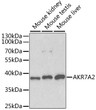


Anti-AKR7A2 antibody (100-359) (STJ22570)
SPECIFICATIONS
ClonalityPolyclonal
HostRabbit
ConjugationUnconjugated
IsotypeIgG
General Information
| Short Description | Rabbit polyclonal AKR7A2 (100-359) antibody for use in WB and ELISA in human and mouse samples. Datasheet included with dilution recommendations, and related reagents. |
| Applications | WB/ELISA |
| Host | Rabbit |
| Reactivity | Human/Mouse |
| Note | STRICTLY FOR FURTHER SCIENTIFIC RESEARCH USE ONLY (RUO). MUST NOT TO BE USED IN DIAGNOSTIC OR THERAPEUTIC APPLICATIONS. |
Product Properties
| Clonality | Polyclonal |
| Isotype | IgG |
| Conjugation | Unconjugated |
| Concentration | Lot specific |
| Purification | Affinity purification |
| Dilution Range | WB:1:500-1:2000ELISA:Recommended starting concentration is 1 Mu g/mL. Please optimize the concentration based on your specific assay requirements. |
| Formulation | PBS with 0.02% Sodium Azide, 50% Glycerol, pH 7.3. |
| Storage Instruction | Store at-20°C for up to 1 year from the date of receipt, and avoid repeat freeze-thaw cycles. |
Target Information
| Gene Symbol | AKR7A2 |
| Gene ID | 8574 |
| Uniprot ID | ARK72_HUMAN |
| Immunogen Region | 100-359 |
| Immunogen Sequence | VKIATKANPWDGKSLKPDSV RSQLETSLKRLQCPQVDLFY LHAPDHGTPVEETLHACQRL HQEGKFVELGLSNYASWEVA EICTLCKSNGWILPTVYQGM YNATTRQVETELFPCLRHFG LRFYAYNPLAGGLLTGKYKY EDKDGKQPVGRFFGNSWAET YRNRFWKEHHFEAIALVEKA LQAAYGASAPSVTSAALRWM YHHSQLQGAHGDAVILGMSS LEQLEQNLAATEEGPLEPA |
| Specificity | Recombinant fusion protein containing a sequence corresponding to amino acids 100-359 of human AKR7A2 (NP_003680.2). |
Additional Info
| Tissue Specificity | Detected in brain, liver, small intestine and testis, and at lower levels in heart, prostate, skeletal muscle and spleen. Detected in kidney proximal and distal tubules, endothelial cells lining the Bowman's capsules and some cysts. Detected at low levels in lung and pancreas (at protein level). Widely expressed. |
| Function | Catalyzes the NADPH-dependent reduction of succinic semialdehyde to gamma-hydroxybutyrate. May have an important role in producing the neuromodulator gamma-hydroxybutyrate (GHB). Has broad substrate specificity. Has NADPH-dependent aldehyde reductase activity towards 2-carboxybenzaldehyde, 2-nitrobenzaldehyde and pyridine-2-aldehyde (in vitro). Can reduce 1,2-naphthoquinone and 9,10-phenanthrenequinone (in vitro). Can reduce the dialdehyde protein-binding form of aflatoxin B1 (AFB1) to the non-binding AFB1 dialcohol. May be involved in protection of liver against the toxic and carcinogenic effects of AFB1, a potent hepatocarcinogen. |
| Protein Name | Aflatoxin B1 Aldehyde Reductase Member 2Afb1 Aldehyde Reductase 1Afb1-Ar 1Aldoketoreductase 7Succinic Semialdehyde ReductaseSsa Reductase |
| Database Links | Reactome: R-HSA-5423646 |
| Cellular Localisation | MitochondrionGolgi ApparatusCytoplasm |
| Alternative Antibody Names | Anti-Aflatoxin B1 Aldehyde Reductase Member 2 antibodyAnti-Afb1 Aldehyde Reductase 1 antibodyAnti-Afb1-Ar 1 antibodyAnti-Aldoketoreductase 7 antibodyAnti-Succinic Semialdehyde Reductase antibodyAnti-Ssa Reductase antibodyAnti-AKR7A2 antibodyAnti-AFAR antibodyAnti-AFAR1 antibodyAnti-AKR7 antibody |
Information sourced from Uniprot.org