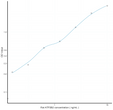
This ATP2B2 Sandwich ELISA Kit is an in-vitro enzyme-linked immunosorbent assay for the measurement of samples in rat serum, plasma, tissue homogenates, cell lysates, cell culture supernates or other biological fluids..
Applications
ELISA
Reactivity
Rat
Sensitivity
0.057ng/mL
Detection Limit
0.156-10ng/mL
Note
STRICTLY FOR FURTHER SCIENTIFIC RESEARCH USE ONLY (RUO). MUST NOT TO BE USED IN DIAGNOSTIC OR THERAPEUTIC APPLICATIONS.
Product Properties
Storage Instruction
Store the unopened kit in the fridge at 2-8°C for up to 6 months. Once opened store individual kit contents according to components table provided with the kit.
serum, plasma, tissue homogenates, cell lysates, cell culture supernates or other biological fluids.
Additional Info
Tissue Specificity
Isoforms containing segment B are found in brain, uterus, liver and kidney and in low levels in other tissues. Isoforms containing segment W are found in kidney, uterus, and pancreas. Isoforms containing segment Y are found in pancreas and in low levels in brain and heart. Isoforms containing segment Z are found in brain and heart and isoforms containing segment X are found in low levels in brain. Isoforms containing segment A are found in low levels in heart and small intestine while isoforms containing segment C are found in testis and in low levels in other tissues.
Post Translational Modifications
Function
ATP-driven Ca(2+) ion pump involved in the maintenance of basal intracellular Ca(2+) levels in specialized cells of cerebellar circuit and vestibular and cochlear systems. Uses ATP as an energy source to transport cytosolic Ca(2+) ions across the plasma membrane to the extracellular compartment. Has fast activation and Ca(2+) clearance rate suited to control fast neuronal Ca(2+) dynamics. At parallel fiber to Purkinje neuron synapse, mediates presynaptic Ca(2+) efflux in response to climbing fiber-induced Ca(2+) rise. Provides for fast return of Ca(2+) concentrations back to their resting levels, ultimately contributing to long-term depression induction and motor learning. Plays an essential role in hearing and balance. In cochlear hair cells, shuttles Ca(2+) ions from stereocilia to the endolymph and dissipates Ca(2+) transients generated by the opening of the mechanoelectrical transduction channels. Regulates Ca(2+) levels in the vestibular system, where it contributes to the formation of otoconia. In non-excitable cells, regulates Ca(2+) signaling through spatial control of Ca(2+) ions extrusion and dissipation of Ca(2+) transients generated by store-operated channels. In lactating mammary gland, allows for the high content of Ca(2+) ions in the milk.