

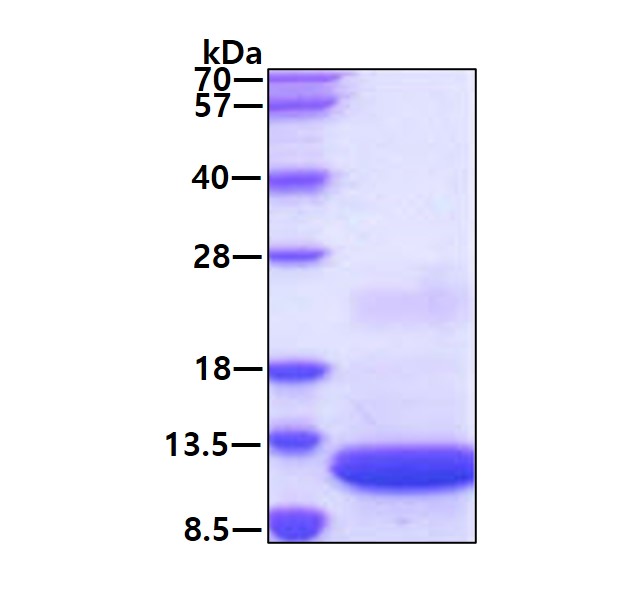

Mouse SDF-1/CXCL12 protein (Recombinant) (His-Tag) (STJP019215)
SPECIFICATIONS
HostE.coli
ImmunogenMouse
General Information
| Short Description | Recombinant-Mouse SDF-1/CXCL12-His-Tag protein was developed from e.coli and has a target region of His-Tag. For use in research applications. |
| Applications | SDS-PAGE |
| Host | E.coli |
| Note | STRICTLY FOR FURTHER SCIENTIFIC RESEARCH USE ONLY (RUO). MUST NOT TO BE USED IN DIAGNOSTIC OR THERAPEUTIC APPLICATIONS. |
Product Properties
| Concentration | 0.25 mg/mL |
| Formulation | Liquid in phosphate-Buffered Saline (pH 7.4) containing 10% Glycerol |
| Storage Instruction | For short term storage, keep at +2C to +8C for up to 1 week. For long term storage, aliquot and store at-20C, and avoid repeat freeze-thaw cycles. |
Target Information
| Gene Symbol | Cxcl12 |
| Gene ID | 20315 |
| Uniprot ID | SDF1_MOUSE |
| Accession Number | NP_068350.1 |
| Immunogen | Mouse |
| Immunogen Region | 22-89aa |
| Immunogen Sequence |
Additional Info
| Tissue Specificity | Highest expression levels detected in kidney, liver, spleen and muscle. Isoform Alpha is expressed ubiquitously but at varying levels, while isoform Beta displays tissue-specific expression, with expression detected in kidney, liver, heart, spleen and muscle but not in lung, colon, brain, skin and stomach. |
| Function | Chemoattractant active on T-lymphocytes and monocytes but not neutrophils. Activates the C-X-C chemokine receptor CXCR4 to induce a rapid and transient rise in the level of intracellular calcium ions and chemotaxis. Also binds to atypical chemokine receptor ACKR3, which activates the beta-arrestin pathway and acts as a scavenger receptor for SDF-1. Binds to the allosteric site (site 2) of integrins and activates integrins ITGAV:ITGB3, ITGA4:ITGB1 and ITGA5:ITGB1 in a CXCR4-independent manner. Acts as a positive regulator of monocyte migration and a negative regulator of monocyte adhesion via the LYN kinase. Stimulates migration of monocytes and T-lymphocytes through its receptors, CXCR4 and ACKR3, and decreases monocyte adherence to surfaces coated with ICAM-1, a ligand for beta-2 integrins. SDF1A/CXCR4 signaling axis inhibits beta-2 integrin LFA-1 mediated adhesion of monocytes to ICAM-1 through LYN kinase. Plays a protective role after myocardial infarction. Induces down-regulation and internalization of ACKR3 expressed in various cells. Has several critical functions during embryonic development.required for B-cell lymphopoiesis, myelopoiesis in bone marrow and heart ventricular septum formation. Stimulates the proliferation of bone marrow-derived B-cell progenitors in the presence of IL7 as well as growth of stromal cell-dependent pre-B-cells. |
| Protein Name | Stromal Cell-Derived Factor 1Sdf-112-O-Tetradecanoylphorbol 13-Acetate Repressed Protein 1Tpar1C-X-C Motif Chemokine 12Pre-B Cell Growth-Stimulating FactorPbsfThymic Lymphoma Cell-Stimulating FactorTlsf |
| Database Links | Reactome: R-MMU-376176Reactome: -MMU-380108Reactome: -MMU-418594 |
| Cellular Localisation | Secreted |
| Alternative Protein Names | Stromal Cell-Derived Factor 1 proteinSdf-1 protein12-O-Tetradecanoylphorbol 13-Acetate Repressed Protein 1 proteinTpar1 proteinC-X-C Motif Chemokine 12 proteinPre-B Cell Growth-Stimulating Factor proteinPbsf proteinThymic Lymphoma Cell-Stimulating Factor proteinTlsf proteinCxcl12 proteinSdf1 protein |
Information sourced from Uniprot.org