

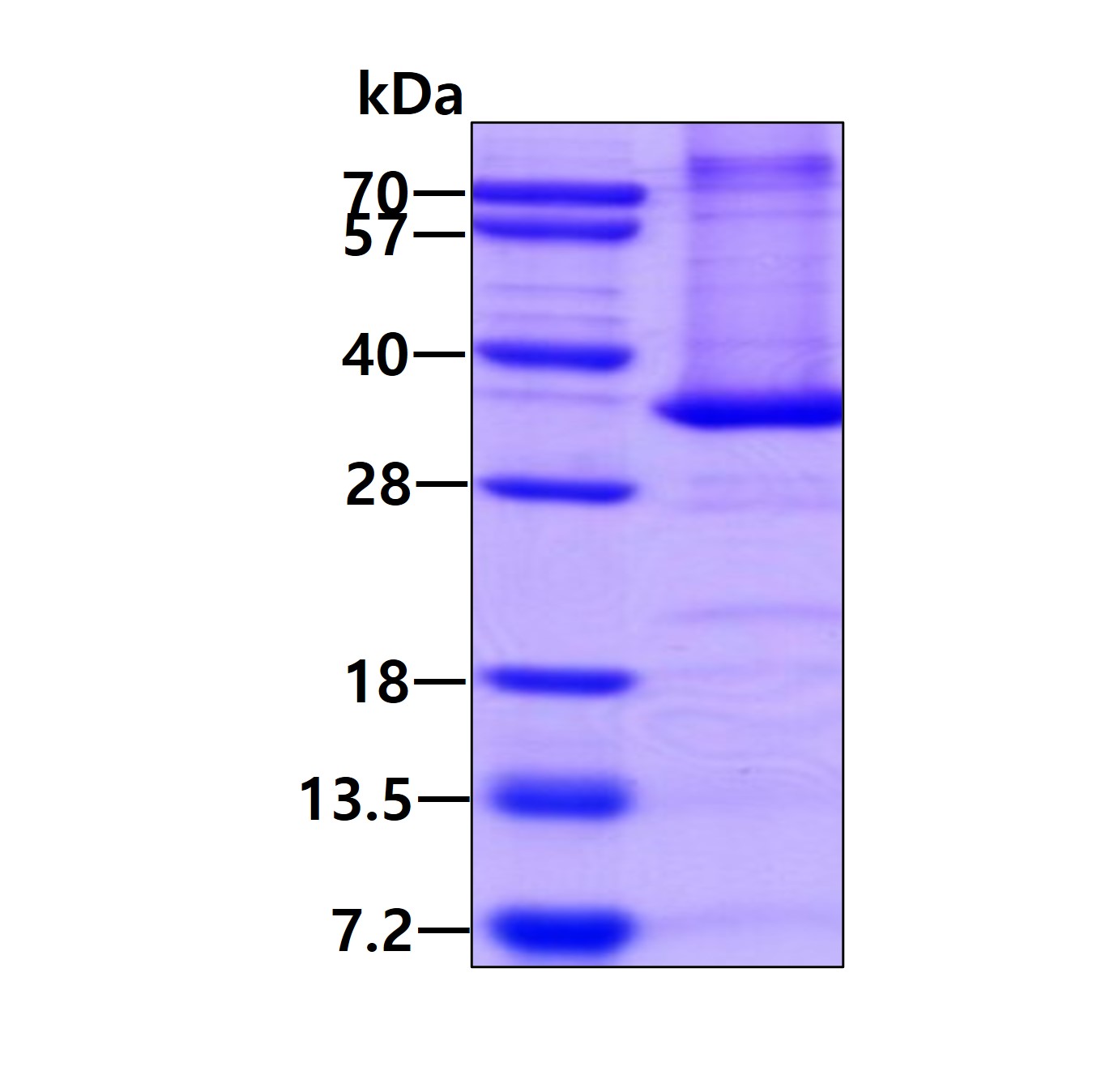

Mouse PD-L1/B7-H1 protein (Recombinant) (His-Tag) (STJP017754)
SPECIFICATIONS
HostE.coli
ImmunogenMouse
General Information
| Short Description | Recombinant-Mouse PD-L1/B7-H1-His-Tag protein was developed from e.coli and has a target region of His-Tag. For use in research applications. |
| Applications | SDS-PAGE |
| Host | E.coli |
| Note | STRICTLY FOR FURTHER SCIENTIFIC RESEARCH USE ONLY (RUO). MUST NOT TO BE USED IN DIAGNOSTIC OR THERAPEUTIC APPLICATIONS. |
Product Properties
| Concentration | 1 mg/mL |
| Formulation | Liquid in 20mM Tris-HCl buffer (pH 8.0) containing 10% Glycerol, 0.15M NaCl |
| Storage Instruction | For short term storage, keep at +2C to +8C for up to 1 week. For long term storage, aliquot and store at-20C, and avoid repeat freeze-thaw cycles. |
Target Information
| Gene Symbol | Cd274 |
| Gene ID | 60533 |
| Uniprot ID | PD1L1_MOUSE |
| Accession Number | NP_068693 |
| Immunogen | Mouse |
| Immunogen Region | 19-239aa |
| Immunogen Sequence |
Additional Info
| Tissue Specificity | Highly expressed in the heart, thymus, skeletal muscle, and lung. Weakly expressed in the kidney, spleen, thyroid, and liver. Expressed on activated dendritic cells, B-cells and macrophages. Expressed in numerous tumor cells lines of lymphoid origin. |
| Post Translational Modifications | Ubiquitinated.STUB1 likely mediates polyubiquitination of PD-L1/CD274 triggering its degradation. Ubiquitinated by MARCHF8.leading to degradation. Deubiquitinated by USP22.leading to stabilization. |
| Function | Plays a critical role in induction and maintenance of immune tolerance to self. As a ligand for the inhibitory receptor PDCD1/PD-1, modulates the activation threshold of T-cells and limits T-cell effector response. Through a yet unknown activating receptor, may costimulate T-cell subsets that predominantly produce interleukin-10 (IL10). The PDCD1-mediated inhibitory pathway is exploited by tumors to attenuate anti-tumor immunity and escape destruction by the immune system, thereby facilitating tumor survival. The interaction with PDCD1/PD-1 inhibits cytotoxic T lymphocytes (CTLs) effector function. The blockage of the PDCD1-mediated pathway results in the reversal of the exhausted T-cell phenotype and the normalization of the anti-tumor response, providing a rationale for cancer immunotherapy. |
| Protein Name | Programmed Cell Death 1 Ligand 1Pd-L1Pdcd1 Ligand 1Programmed Death Ligand 1B7 Homolog 1B7-H1Cd Antigen Cd274 |
| Database Links | Reactome: R-MMU-389948 |
| Cellular Localisation | Cell MembraneSingle-Pass Type I Membrane ProteinEarly Endosome MembraneRecycling Endosome Membrane |
| Alternative Protein Names | Programmed Cell Death 1 Ligand 1 proteinPd-L1 proteinPdcd1 Ligand 1 proteinProgrammed Death Ligand 1 proteinB7 Homolog 1 proteinB7-H1 proteinCd Antigen Cd274 proteinCd274 proteinB7h1 proteinPdcd1l1 proteinPdcd1lg1 proteinPdl1 protein |
Information sourced from Uniprot.org