

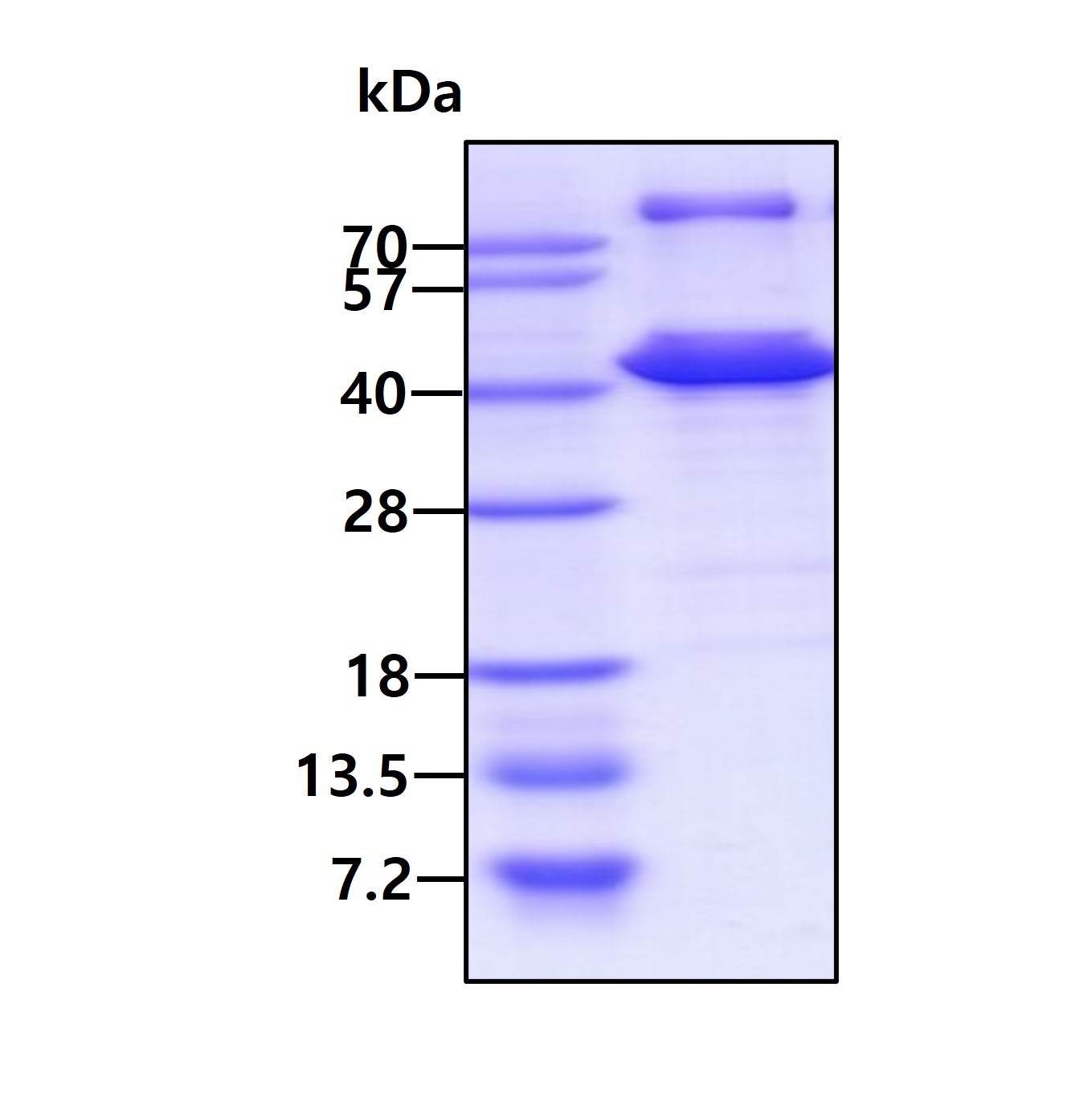

Human TPM2 protein (Recombinant) (His-Tag) (STJP017011)
SPECIFICATIONS
HostE.coli
ImmunogenHuman
General Information
| Short Description | Recombinant-Human TPM2-His-Tag protein was developed from e.coli and has a target region of His-Tag. For use in research applications. |
| Applications | SDS-PAGE |
| Host | E.coli |
| Note | STRICTLY FOR FURTHER SCIENTIFIC RESEARCH USE ONLY (RUO). MUST NOT TO BE USED IN DIAGNOSTIC OR THERAPEUTIC APPLICATIONS. |
Product Properties
| Concentration | 0.25 mg/mL |
| Formulation | Liquid in 20mM Tris-HCl buffer (pH 8.0) containing 30% Glycerol, 100mM NaCl |
| Storage Instruction | For short term storage, keep at +2C to +8C for up to 1 week. For long term storage, aliquot and store at-20C, and avoid repeat freeze-thaw cycles. |
Target Information
| Gene Symbol | TPM2 |
| Gene ID | 7169 |
| Uniprot ID | TPM2_HUMAN |
| Accession Number | NP_998839.1 |
| Immunogen | Human |
| Immunogen Region | 1-284aa |
| Immunogen Sequence |
Additional Info
| Tissue Specificity | Present in primary breast cancer tissue, absent from normal breast tissue. |
| Post Translational Modifications | Phosphorylated on Ser-61 by PIK3CG. Phosphorylation on Ser-61 is required for ADRB2 internalization. |
| Function | Binds to actin filaments in muscle and non-muscle cells. Plays a central role, in association with the troponin complex, in the calcium dependent regulation of vertebrate striated muscle contraction. Smooth muscle contraction is regulated by interaction with caldesmon. In non-muscle cells is implicated in stabilizing cytoskeleton actin filaments. The non-muscle isoform may have a role in agonist-mediated receptor internalization. |
| Protein Name | Tropomyosin Beta ChainBeta-TropomyosinTropomyosin-2 |
| Database Links | Reactome: R-HSA-390522Reactome: R-HSA-445355 |
| Cellular Localisation | CytoplasmCytoskeletonAssociates With F-Actin Stress Fibers |
| Alternative Protein Names | Tropomyosin Beta Chain proteinBeta-Tropomyosin proteinTropomyosin-2 proteinTPM2 proteinTMSB protein |
Information sourced from Uniprot.org