

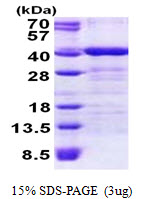

Human TOMM34 protein (Recombinant) (His-Tag) (STJP018256)
SPECIFICATIONS
HostE.coli
ImmunogenHuman
General Information
| Short Description | Recombinant-Human TOMM34-His-Tag protein was developed from e.coli and has a target region of His-Tag. For use in research applications. |
| Applications | SDS-PAGE |
| Host | E.coli |
| Note | STRICTLY FOR FURTHER SCIENTIFIC RESEARCH USE ONLY (RUO). MUST NOT TO BE USED IN DIAGNOSTIC OR THERAPEUTIC APPLICATIONS. |
Product Properties
| Concentration | 0.25 mg/mL |
| Formulation | Liquid in 20mM Tris-HCl buffer (pH 8.0) containing 0.15M NaCl, 20% Glycerol, 1mM DTT |
| Storage Instruction | For short term storage, keep at +2C to +8C for up to 1 week. For long term storage, aliquot and store at-20C, and avoid repeat freeze-thaw cycles. |
Target Information
| Gene Symbol | TOMM34 |
| Gene ID | 10953 |
| Uniprot ID | TOM34_HUMAN |
| Accession Number | NP_006800 |
| Immunogen | Human |
| Immunogen Region | 1-309aa |
| Immunogen Sequence | MGSSHHHHHH SSGLVPRGSH MGSMAPKFPD SVEELRAAGN ESFRNGQYAE ASALYGRALR VLQAQGSSDP EEESVLYSNR AACHLKDGNC RDCIKDCTSA LALVPFSIKP LLRRASAYEA LEKYPMAYVD YKTVLQIDDN VTSAVEGINR MTRALMDSLG PEWRLKLPSI PLVPVSAQKR WNSLPSENHK EMAKSKSKET TATKNRVPSA GDVEKARVLK EEGNELVK |
Additional Info
| Tissue Specificity | Ubiquitous. |
| Function | Plays a role in the import of cytosolically synthesized preproteins into mitochondria. Binds the mature portion of precursor proteins. Interacts with cellular components, and possesses weak ATPase activity. May be a chaperone-like protein that helps to keep newly synthesized precursors in an unfolded import compatible state. |
| Protein Name | Mitochondrial Import Receptor Subunit Tom34Htom34Translocase Of Outer Membrane 34 Kda Subunit |
| Database Links | |
| Cellular Localisation | CytoplasmMitochondrion Outer MembranePeripheral Membrane ProteinCytoplasmic Side |
| Alternative Protein Names | Mitochondrial Import Receptor Subunit Tom34 proteinHtom34 proteinTranslocase Of Outer Membrane 34 Kda Subunit proteinTOMM34 proteinURCC3 protein |
Information sourced from Uniprot.org