

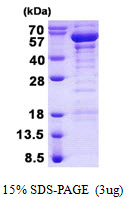

Human TANK protein (Recombinant) (His-Tag) (STJP018051)
SPECIFICATIONS
HostE.coli
ImmunogenHuman
General Information
| Short Description | Recombinant-Human TANK-His-Tag protein was developed from e.coli and has a target region of His-Tag. For use in research applications. |
| Applications | SDS-PAGE |
| Host | E.coli |
| Note | STRICTLY FOR FURTHER SCIENTIFIC RESEARCH USE ONLY (RUO). MUST NOT TO BE USED IN DIAGNOSTIC OR THERAPEUTIC APPLICATIONS. |
Product Properties
| Concentration | 0.5 mg/mL |
| Formulation | Liquid in 20mM Tris-HCl buffer (pH 8.0) containing 0.2M NaCl, 50% Glycerol, 2mM DTT |
| Storage Instruction | For short term storage, keep at +2C to +8C for up to 1 week. For long term storage, aliquot and store at-20C, and avoid repeat freeze-thaw cycles. |
Target Information
| Gene Symbol | TANK |
| Gene ID | 10010 |
| Uniprot ID | TANK_HUMAN |
| Accession Number | NP_001186064 |
| Immunogen | Human |
| Immunogen Region | 1-425aa |
| Immunogen Sequence | MGSSHHHHHH SSGLVPRGSH MGSMDKNIGE QLNKAYEAFR QACMDRDSAV KELQQKTENY EQRIREQQEQ LSLQQTIIDK LKSQLLLVNS TQDNNYGCVP LLEDSETRKN NLTLDQPQDK VISGIAREKL PKVRRQEVSS PRKETSARSL GSPLLHERGN IEKTFWDLKE EFHKICMLAK AQKDHLSKLN IPDTATETQC SVPIQCTDKT DKQEALFKPQ AKDDINRG |
Additional Info
| Tissue Specificity | Ubiquitous. |
| Post Translational Modifications | Phosphorylated by IKBKE. (Microbial infection) Cleaved by encephalomyocarditis virus (EMCV) protease 3C. This cleavage allows the virus to disrupt the TANK-TBK1-IKKepsilon-IRF3 complex, thereby inhibiting the induction of the IFN-beta signal pathway. (Microbial infection) Cleaved by Seneca Valley virus protease 3C allowing the virus to suppress interferon type-I through both RIG-I and Toll-like receptor-dependent pathways. |
| Function | Adapter protein involved in I-kappa-B-kinase (IKK) regulation which constitutively binds TBK1 and IKBKE playing a role in antiviral innate immunity. Acts as a regulator of TRAF function by maintaining them in a latent state. Blocks TRAF2 binding to LMP1 and inhibits LMP1-mediated NF-kappa-B activation. Negatively regulates NF-kappaB signaling and cell survival upon DNA damage. Plays a role as an adapter to assemble ZC3H12A, USP10 in a deubiquitination complex which plays a negative feedback response to attenuate NF-kappaB activation through the deubiquitination of IKBKG or TRAF6 in response to interleukin-1-beta (IL1B) stimulation or upon DNA damage. Promotes UBP10-induced deubiquitination of TRAF6 in response to DNA damage. May control negatively TRAF2-mediated NF-kappa-B activation signaled by CD40, TNFR1 and TNFR2. |
| Protein Name | Traf Family Member-Associated Nf-Kappa-B ActivatorTraf-Interacting ProteinI-Traf |
| Database Links | Reactome: R-HSA-9013973Reactome: R-HSA-933541Reactome: R-HSA-936964Reactome: R-HSA-9824878Reactome: R-HSA-9828211 |
| Cellular Localisation | Cytoplasm |
| Alternative Protein Names | Traf Family Member-Associated Nf-Kappa-B Activator proteinTraf-Interacting Protein proteinI-Traf proteinTANK proteinITRAF proteinTRAF2 protein |
Information sourced from Uniprot.org