
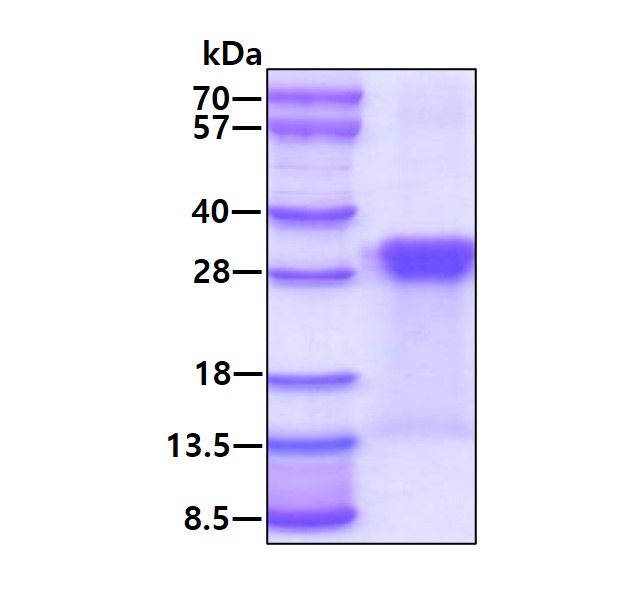

Human SNAP25 protein (Recombinant) (His-Tag) (STJP019778)
SPECIFICATIONS
HostE.coli
ImmunogenHuman
General Information
| Short Description | Recombinant-Human SNAP25-His-Tag protein was developed from e.coli and has a target region of His-Tag. For use in research applications. |
| Applications | SDS-PAGE |
| Host | E.coli |
| Note | STRICTLY FOR FURTHER SCIENTIFIC RESEARCH USE ONLY (RUO). MUST NOT TO BE USED IN DIAGNOSTIC OR THERAPEUTIC APPLICATIONS. |
Product Properties
| Concentration | 1 mg/mL |
| Formulation | Liquid in 50mM HEPES buffer (pH 7.4) containing 5mM DTT, 100mM NaCl |
| Storage Instruction | For short term storage, keep at +2C to +8C for up to 1 week. For long term storage, aliquot and store at-20C, and avoid repeat freeze-thaw cycles. |
Target Information
| Gene Symbol | SNAP25 |
| Gene ID | 6616 |
| Uniprot ID | SNP25_HUMAN |
| Accession Number | NP_570824.1 |
| Immunogen | Human |
| Immunogen Region | 1-206aa |
| Immunogen Sequence |
Additional Info
| Tissue Specificity | Neurons of the neocortex, hippocampus, piriform cortex, anterior thalamic nuclei, pontine nuclei, and granule cells of the cerebellum. |
| Post Translational Modifications | Palmitoylated. Cys-85 appears to be the main site, and palmitoylation is required for membrane association. (Microbial infection) Targeted and hydrolyzed by C.botulinum neurotoxin type A (BoNT/A, botA) which hydrolyzes the 197-Gln-|-Arg-198 bond and inhibits neurotransmitter release. (Microbial infection) Targeted and hydrolyzed by C.botulinum neurotoxin type C (BoNT/C) which hydrolyzes the 198-Arg-|-Ala-199 bond and inhibits neurotransmitter release. C.botulinum type C only rarely infects humans. (Microbial infection) Targeted and hydrolyzed by C.botulinum neurotoxin type E (BoNT/E) which hydrolyzes the 180-Arg-|-Ile-181 bond and inhibits neurotransmitter release. |
| Function | t-SNARE involved in the molecular regulation of neurotransmitter release. May play an important role in the synaptic function of specific neuronal systems. Associates with proteins involved in vesicle docking and membrane fusion. Regulates plasma membrane recycling through its interaction with CENPF. Modulates the gating characteristics of the delayed rectifier voltage-dependent potassium channel KCNB1 in pancreatic beta cells. |
| Protein Name | Synaptosomal-Associated Protein 25Snap-25Super ProteinSupSynaptosomal-Associated 25 Kda Protein |
| Database Links | Reactome: R-HSA-181429Reactome: R-HSA-181430Reactome: R-HSA-210500Reactome: R-HSA-212676Reactome: R-HSA-264642Reactome: R-HSA-422356Reactome: R-HSA-449836Reactome: R-HSA-5250968Reactome: R-HSA-5250971Reactome: R-HSA-5250992Reactome: R-HSA-6798695Reactome: R-HSA-888590Reactome: R-HSA-9662360 |
| Cellular Localisation | CytoplasmPerinuclear RegionCell MembraneLipid-AnchorSynapseSynaptosomePhotoreceptor Inner SegmentMembrane Association Requires PalmitoylationExpressed Throughout CytoplasmConcentrating At The Perinuclear RegionColocalizes With Kcnb1 At The Cell MembraneColocalizes With Plcl1 At The Cell Membrane |
| Alternative Protein Names | Synaptosomal-Associated Protein 25 proteinSnap-25 proteinSuper Protein proteinSup proteinSynaptosomal-Associated 25 Kda Protein proteinSNAP25 proteinSNAP protein |
Information sourced from Uniprot.org