

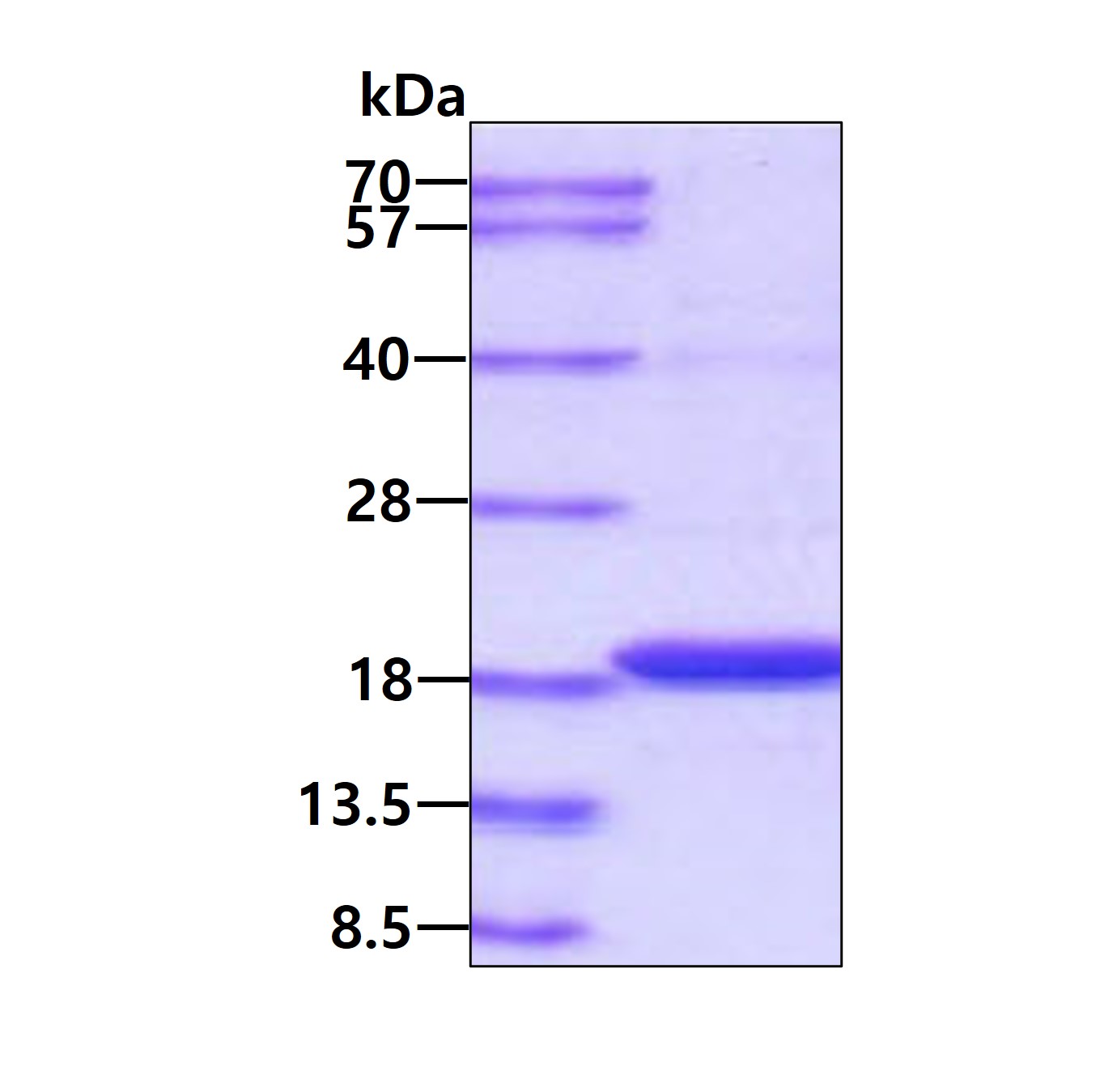

Human SCN3B protein (Recombinant) (His-Tag) (STJP018389)
SPECIFICATIONS
HostE.coli
ImmunogenHuman
General Information
| Short Description | Recombinant-Human SCN3B-His-Tag protein was developed from e.coli and has a target region of His-Tag. For use in research applications. |
| Applications | SDS-PAGE |
| Host | E.coli |
| Note | STRICTLY FOR FURTHER SCIENTIFIC RESEARCH USE ONLY (RUO). MUST NOT TO BE USED IN DIAGNOSTIC OR THERAPEUTIC APPLICATIONS. |
Product Properties
| Concentration | 0.5 mg/mL |
| Formulation | Liquid in 20mM Tris-HCl buffer (pH 8.0) containing 10% Glycerol |
| Storage Instruction | For short term storage, keep at +2C to +8C for up to 1 week. For long term storage, aliquot and store at-20C, and avoid repeat freeze-thaw cycles. |
Target Information
| Gene Symbol | SCN3B |
| Gene ID | 55800 |
| Uniprot ID | SCN3B_HUMAN |
| Accession Number | NP_060870 |
| Immunogen | Human |
| Immunogen Region | 23-159aa |
| Immunogen Sequence |
Additional Info
| Tissue Specificity | Expressed in the atrium. |
| Post Translational Modifications | Intramolecular disulfide bonds favor the voltage-gated sodium channel oligomeric complex assembly. N-glycosylated. |
| Function | Regulatory subunit of multiple voltage-gated sodium (Nav) channels directly mediating the depolarization of excitable membranes. Navs, also called VGSCs (voltage-gated sodium channels) or VDSCs (voltage-dependent sodium channels), operate by switching between closed and open conformations depending on the voltage difference across the membrane. In the open conformation they allow Na(+) ions to selectively pass through the pore, along their electrochemical gradient. The influx of Na+ ions provokes membrane depolarization, initiating the propagation of electrical signals throughout cells and tissues. The accessory beta subunits participate in localization and functional modulation of the Nav channels. Modulates the activity of SCN2A/Nav1.2, causing a hyperpolarizing shift in the voltage-dependence of inactivation of the channel and increasing the fraction of channels operating in the fast gating mode. Modulates the activity of SCN5A/Nav1.5. Could also regulate the atypical sodium channel SCN7A/Nav2.1. Modulates the activity of SCN10A/Nav1.8, regulating its oligomerization and accelerating the recovery from inactivation. |
| Protein Name | Sodium Channel Regulatory Subunit Beta-3 |
| Database Links | Reactome: R-HSA-445095Reactome: R-HSA-5576892 |
| Cellular Localisation | Cell MembraneSingle-Pass Type I Membrane Protein |
| Alternative Protein Names | Sodium Channel Regulatory Subunit Beta-3 proteinSCN3B proteinKIAA1158 protein |
Information sourced from Uniprot.org