

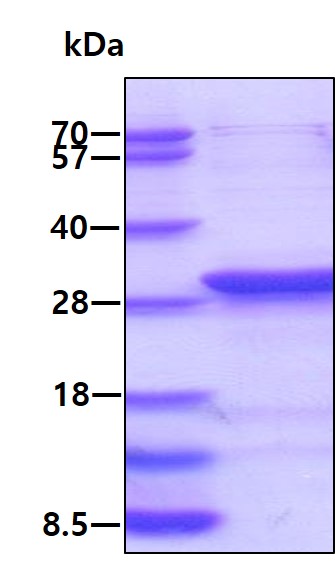

Human RalA protein (Recombinant) (His-Tag) (STJP016961)
SPECIFICATIONS
HostE.coli
ImmunogenHuman
General Information
| Short Description | Recombinant-Human RalA-His-Tag protein was developed from e.coli and has a target region of His-Tag. For use in research applications. |
| Applications | SDS-PAGE |
| Host | E.coli |
| Note | STRICTLY FOR FURTHER SCIENTIFIC RESEARCH USE ONLY (RUO). MUST NOT TO BE USED IN DIAGNOSTIC OR THERAPEUTIC APPLICATIONS. |
Product Properties
| Concentration | 0.5 mg/mL |
| Formulation | Liquid in 20mM Tris-HCl buffer (pH 8.0) containing 10% Glycerol, 2mM DTT, 100mM NaCl, 0.1mM PMSF |
| Storage Instruction | For short term storage, keep at +2C to +8C for up to 1 week. For long term storage, aliquot and store at-20C, and avoid repeat freeze-thaw cycles. |
Target Information
| Gene Symbol | RALA |
| Gene ID | 5898 |
| Uniprot ID | RALA_HUMAN |
| Accession Number | NP_005393 |
| Immunogen | Human |
| Immunogen Region | 1-203aa |
| Immunogen Sequence |
Additional Info
| Post Translational Modifications | Phosphorylated. Phosphorylation at Ser-194 by AURKA/Aurora kinase A, during mitosis, induces RALA localization to the mitochondrion where it regulates mitochondrial fission. Prenylation is essential for membrane localization. The geranylgeranylated form and the farnesylated mutant do not undergo alternative prenylation in response to geranylgeranyltransferase I inhibitors (GGTIs) and farnesyltransferase I inhibitors (FTIs). (Microbial infection) Glucosylated at Thr-46 by P.sordellii toxin TcsL from strain 6018. Monoglucosylation completely prevents the recognition of the downstream effector, blocking the GTPases in their inactive form. Not glucosylated by TcsL from strain VPI 9048. |
| Function | Multifunctional GTPase involved in a variety of cellular processes including gene expression, cell migration, cell proliferation, oncogenic transformation and membrane trafficking. Accomplishes its multiple functions by interacting with distinct downstream effectors. Acts as a GTP sensor for GTP-dependent exocytosis of dense core vesicles. The RALA-exocyst complex regulates integrin-dependent membrane raft exocytosis and growth signaling. Key regulator of LPAR1 signaling and competes with GRK2 for binding to LPAR1 thus affecting the signaling properties of the receptor. Required for anchorage-independent proliferation of transformed cells. During mitosis, supports the stabilization and elongation of the intracellular bridge between dividing cells. Cooperates with EXOC2 to recruit other components of the exocyst to the early midbody. During mitosis, also controls mitochondrial fission by recruiting to the mitochondrion RALBP1, which mediates the phosphorylation and activation of DNM1L by the mitotic kinase cyclin B-CDK1. |
| Protein Name | Ras-Related Protein Ral-A |
| Database Links | Reactome: R-HSA-1445148Reactome: R-HSA-171007Reactome: R-HSA-8950505 |
| Cellular Localisation | Cell MembraneLipid-AnchorCytoplasmic SideCleavage FurrowMidbodyMidbody RingMitochondrionPredominantly At The Cell Surface In The Absence Of LpaIn The Presence Of LpaColocalizes With Lpar1 And Lpar2 In Endocytic VesiclesMay Colocalize With Cntrl/Centriolin At The Midbody RingHoweverLocalization At The Midbody At Late Cytokinesis Was Not ConfirmedRelocalizes To The Mitochondrion During Mitosis Where It Regulates Mitochondrial Fission |
| Alternative Protein Names | Ras-Related Protein Ral-A proteinRALA proteinRAL protein |
Information sourced from Uniprot.org