

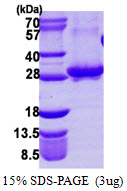

Human RAB3A protein (Recombinant) (His-Tag) (STJP017240)
SPECIFICATIONS
HostE.coli
ImmunogenHuman
General Information
| Short Description | Recombinant-Human RAB3A-His-Tag protein was developed from e.coli and has a target region of His-Tag. For use in research applications. |
| Applications | SDS-PAGE |
| Host | E.coli |
| Note | STRICTLY FOR FURTHER SCIENTIFIC RESEARCH USE ONLY (RUO). MUST NOT TO BE USED IN DIAGNOSTIC OR THERAPEUTIC APPLICATIONS. |
Product Properties
| Concentration | 0.5 mg/mL |
| Formulation | Liquid in 20mM Tris-HCl buffer (pH 8.0) containing 20% Glycerol, 0.1M NaCl, 1mM DTT |
| Storage Instruction | For short term storage, keep at +2C to +8C for up to 1 week. For long term storage, aliquot and store at-20C, and avoid repeat freeze-thaw cycles. |
Target Information
| Gene Symbol | RAB3A |
| Gene ID | 5864 |
| Uniprot ID | RAB3A_HUMAN |
| Accession Number | NP_002857 |
| Immunogen | Human |
| Immunogen Region | 1-220aa |
| Immunogen Sequence | MGSSHHHHHH SSGLVPRGSH MASATDSRYG QKESSDQNFD YMFKILIIGN SSVGKTSFLF RYADDSFTPA FVSTVGIDFK VKTIYRNDKR IKLQIWDTAG QERYRTITTA YYRGAMGFIL MYDITNEESF NAVQDWSTQI KTYSWDNAQV LLVGNKCDME DERVVSSERG RQLADHLGFE FFEASAKDNI NVKQTFERLV DVICEKMSES LDTADPAVTG AKQGPQLS |
Additional Info
| Tissue Specificity | Specifically expressed in brain. |
| Post Translational Modifications | Phosphorylation of Thr-86 in the switch II region by LRRK2 prevents the association of RAB regulatory proteins, including CHM, CHML and RAB GDP dissociation inhibitors GDI1 and GDI2. |
| Function | The small GTPases Rab are key regulators of intracellular membrane trafficking, from the formation of transport vesicles to their fusion with membranes. Rabs cycle between an inactive GDP-bound form and an active GTP-bound form that is able to recruit to membranes different sets of downstream effectors directly responsible for vesicle formation, movement, tethering and fusion. RAB3A plays a central role in regulated exocytosis and secretion. Controls the recruitment, tethering and docking of secretory vesicles to the plasma membrane. Upon stimulation, switches to its active GTP-bound form, cycles to vesicles and recruits effectors such as RIMS1, RIMS2, Rabphilin-3A/RPH3A, RPH3AL or SYTL4 to help the docking of vesicules onto the plasma membrane. Upon GTP hydrolysis by GTPase-activating protein, dissociates from the vesicle membrane allowing the exocytosis to proceed. Stimulates insulin secretion through interaction with RIMS2 or RPH3AL effectors in pancreatic beta cells. Regulates calcium-dependent lysosome exocytosis and plasma membrane repair (PMR) via the interaction with 2 effectors, SYTL4 and myosin-9/MYH9. Acts as a positive regulator of acrosome content secretion in sperm cells by interacting with RIMS1. Also plays a role in the regulation of dopamine release by interacting with synaptotagmin I/SYT. |
| Protein Name | Ras-Related Protein Rab-3a |
| Database Links | Reactome: R-HSA-181429Reactome: R-HSA-181430Reactome: R-HSA-210500Reactome: R-HSA-212676Reactome: R-HSA-264642Reactome: R-HSA-6798695Reactome: R-HSA-8873719Reactome: R-HSA-8876198Reactome: R-HSA-888590Reactome: R-HSA-9662360 |
| Cellular Localisation | CytoplasmCytosolLysosomeCytoplasmic VesicleSecretory VesicleCell ProjectionAxonCell MembraneLipid-AnchorCytoplasmic SidePresynapsePostsynapseCycles Between A Vesicle-Associated Gtp-Bound Form And A Cytosolic Gdp-Bound Form |
| Alternative Protein Names | Ras-Related Protein Rab-3a proteinRAB3A protein |
Information sourced from Uniprot.org