

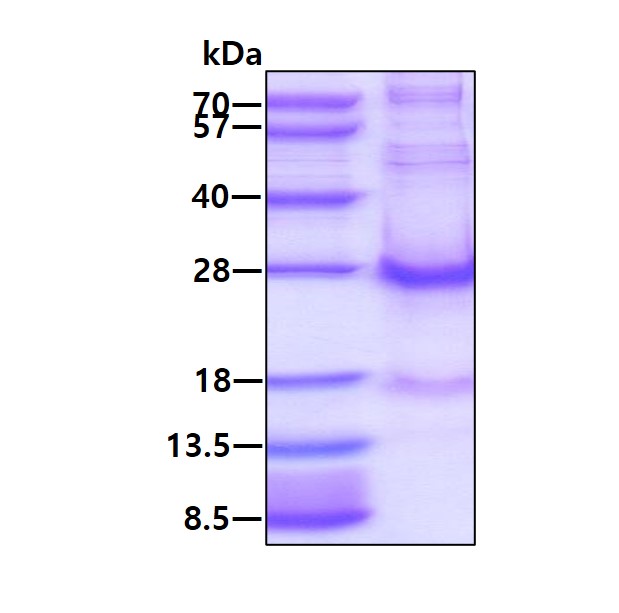

Human RAB13 protein (Recombinant) (His-Tag) (STJP017261)
SPECIFICATIONS
HostE.coli
ImmunogenHuman
General Information
| Short Description | Recombinant-Human RAB13-His-Tag protein was developed from e.coli and has a target region of His-Tag. For use in research applications. |
| Applications | SDS-PAGE |
| Host | E.coli |
| Note | STRICTLY FOR FURTHER SCIENTIFIC RESEARCH USE ONLY (RUO). MUST NOT TO BE USED IN DIAGNOSTIC OR THERAPEUTIC APPLICATIONS. |
Product Properties
| Concentration | 0.25 mg/mL |
| Formulation | Liquid in 20mM Tris-HCl buffer (pH 8.0) containing 1mM DTT, 20% Glycerol, 200mM NaCl, 1mM EDTA |
| Storage Instruction | For short term storage, keep at +2C to +8C for up to 1 week. For long term storage, aliquot and store at-20C, and avoid repeat freeze-thaw cycles. |
Target Information
| Gene Symbol | RAB13 |
| Gene ID | 5872 |
| Uniprot ID | RAB13_HUMAN |
| Accession Number | NP_002861.1 |
| Immunogen | Human |
| Immunogen Region | 1-200aa |
| Immunogen Sequence |
Additional Info
| Tissue Specificity | Detected in several types of epithelia, including intestine, kidney, liver and in endothelial cells. |
| Post Translational Modifications | (Microbial infection) Stearoylated By S.flexneri N-epsilon-fatty acyltransferase IcsB, thereby disrupting the host actin cytoskeleton. Ubiquitinated via 'Lys-11'-linked ubiquitination on Lys-46 and Lys-58.impairing the recruitment of guanosine diphosphate (GDP) dissociation inhibitor 1/GDI1. |
| Function | The small GTPases Rab are key regulators of intracellular membrane trafficking, from the formation of transport vesicles to their fusion with membranes. Rabs cycle between an inactive GDP-bound form and an active GTP-bound form that is able to recruit to membranes different sets of downstream effectors directly responsible for vesicle formation, movement, tethering and fusion. RAB13 is involved in endocytic recycling and regulates the transport to the plasma membrane of transmembrane proteins like the tight junction protein OCLN/occludin. Thereby, it regulates the assembly and the activity of tight junctions. Moreover, it may also regulate tight junction assembly by activating the PKA signaling pathway and by reorganizing the actin cytoskeleton through the activation of the downstream effectors PRKACA and MICALL2 respectively. Through its role in tight junction assembly, may play a role in the establishment of Sertoli cell barrier. Plays also a role in angiogenesis through regulation of endothelial cells chemotaxis. Also involved in neurite outgrowth. Has also been proposed to play a role in post-Golgi membrane trafficking from the TGN to the recycling endosome. Finally, it has been involved in insulin-induced transport to the plasma membrane of the glucose transporter GLUT4 and therefore may play a role in glucose homeostasis. |
| Protein Name | Ras-Related Protein Rab-13Cell Growth-Inhibiting Gene 4 Protein |
| Database Links | Reactome: R-HSA-1445148Reactome: R-HSA-8873719Reactome: R-HSA-8876198 |
| Cellular Localisation | Cell MembraneLipid-AnchorCytoplasmic SideCytoplasmic Vesicle MembraneCell JunctionTight JunctionGolgi ApparatusTrans-Golgi Network MembraneRecycling Endosome MembraneCell ProjectionLamellipodiumTight Junctions Or Associated With Vesicles Scattered Throughout The Cytoplasm In Cells Lacking Tight JunctionsRelocalizes To The Leading Edge Of Lamellipodia In Migrating Endothelial Cells |
| Alternative Protein Names | Ras-Related Protein Rab-13 proteinCell Growth-Inhibiting Gene 4 Protein proteinRAB13 proteinGIG4 protein |
Information sourced from Uniprot.org