

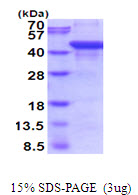

Human Prostatic Acid Phosphatase/ACPP protein (Recombinant) (His-Tag) (STJP019046)
SPECIFICATIONS
HostE.coli
ImmunogenHuman
General Information
| Short Description | Recombinant-Human Prostatic Acid Phosphatase/ACPP-His-Tag protein was developed from e.coli and has a target region of His-Tag. For use in research applications. |
| Applications | SDS-PAGE/Denatured |
| Host | E.coli |
| Note | STRICTLY FOR FURTHER SCIENTIFIC RESEARCH USE ONLY (RUO). MUST NOT TO BE USED IN DIAGNOSTIC OR THERAPEUTIC APPLICATIONS. |
Product Properties
| Concentration | 0.5 mg/mL |
| Formulation | Liquid in 20mM Tris-HCl buffer (pH 8.0) containing 10% Glycerol |
| Storage Instruction | For short term storage, keep at +2C to +8C for up to 1 week. For long term storage, aliquot and store at-20C, and avoid repeat freeze-thaw cycles. |
Target Information
| Gene Symbol | ACP3 |
| Gene ID | 55 |
| Uniprot ID | PPAP_HUMAN |
| Accession Number | AAH08493 |
| Immunogen | Human |
| Immunogen Region | 33-386aa |
| Immunogen Sequence | MGSSHHHHHH SSGLVPRGSH MKELKFVTLV FRHGDRSPID TFPTDPIKES SWPQGFGQLT QLGMEQHYEL GEYIRKRYRK FLNESYKHEQ VYIRSTDVDR TLMSAMTNLA ALVPPEGVSI WNPILLWQPI PVHTVPLSED QLLYLPFRNC PRFQELESET LKSEEFQKRL HPYKDFIATL GKLSGLHGQD LFGIWSKVYD PLYCESVHNF TLPSRATEDT MTKLRELS |
Additional Info
| Tissue Specificity | Highly expressed in the prostate, restricted to glandular and ductal epithelial cells. Also expressed in bladder, kidney, pancreas, lung, cervix, testis and ovary. Weak expression in a subset of pancreatic islet cells, squamous epithelia, the pilosebaceous unit, colonic neuroendocrine cells and skin adnexal structures. Low expression in prostate carcinoma cells and tissues. Isoform 2: Widely expressed. Expressed in the sarcolemma of skeletal muscle. |
| Post Translational Modifications | N-glycosylated. High mannose content, partially sialylated and fucosylated biantennary complex. Also fucosylated with partially sialylated triantennary complex oligosaccharides. Proteolytically cleaved in seminal fluid to produce several peptides. Peptide PAPf39, the most prominent, forms amyloid beta-sheet fibrils, SEVI (semen-derived enhancer of viral infection). |
| Function | A non-specific tyrosine phosphatase that dephosphorylates a diverse number of substrates under acidic conditions (pH 4-6) including alkyl, aryl, and acyl orthophosphate monoesters and phosphorylated proteins. Has lipid phosphatase activity and inactivates lysophosphatidic acid in seminal plasma. Isoform 2: Tyrosine phosphatase that acts as a tumor suppressor of prostate cancer through dephosphorylation of ERBB2 and deactivation of MAPK-mediated signaling. In addition to its tyrosine phosphatase activity has ecto-5'-nucleotidase activity in dorsal root ganglion (DRG) neurons. Generates adenosine from AMP which acts as a pain suppressor. PAPf39: (Microbial infection) Forms amyloid beta-sheet fibrils in semen. These fibrils, termed SEVI (semen-derived enhancer of viral infection) capture HIV virions, attach them to target cells and enhance infection. SEVI amyloid fibrils are degraded by polyphenol epigallocatechin-3-gallate (EGCG), a constituent of green tea. Target cell attachment and enhancement of HIV infection is inhibited by surfen. Also similarly boosts XMRV (xenotropic murine leukemia virus-related virus) infection. |
| Protein Name | Prostatic Acid PhosphatasePap5'-Nucleotidase5'-NtAcid Phosphatase 3Ecto-5'-NucleotidaseProtein Tyrosine Phosphatase Acp3Thiamine MonophosphataseTmpase Cleaved Into - Papf39 |
| Database Links | Reactome: R-HSA-6798695 |
| Cellular Localisation | Isoform 1: SecretedIsoform 2: Cell MembraneSingle-Pass Type I Membrane ProteinLysosome MembraneNucleusCytoplasmCytosolAppears To Shuttle Between The Cell Membrane And Intracellular VesiclesColocalizes With Flot1 At Cell Membrane And In Intracellular VesiclesColocalizes With Lamp2 On The Lysosome Membrane |
| Alternative Protein Names | Prostatic Acid Phosphatase proteinPap protein5'-Nucleotidase protein5'-Nt proteinAcid Phosphatase 3 proteinEcto-5'-Nucleotidase proteinProtein Tyrosine Phosphatase Acp3 proteinThiamine Monophosphatase proteinTmpase Cleaved Into - Papf39 proteinACP3 proteinACPP protein |
Information sourced from Uniprot.org