

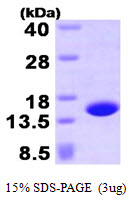

Human Profilin 4/PFN4 protein (Recombinant) (His-Tag) (STJP016650)
SPECIFICATIONS
HostE.coli
ImmunogenHuman
General Information
| Short Description | Recombinant-Human Profilin 4/PFN4-His-Tag protein was developed from e.coli and has a target region of His-Tag. For use in research applications. |
| Applications | SDS-PAGE |
| Host | E.coli |
| Note | STRICTLY FOR FURTHER SCIENTIFIC RESEARCH USE ONLY (RUO). MUST NOT TO BE USED IN DIAGNOSTIC OR THERAPEUTIC APPLICATIONS. |
Product Properties
| Concentration | 0.5 mg/mL |
| Formulation | Liquid in 20mM Tris-HCl buffer (pH 8.0) containing 1mM DTT, 10% Glycerol |
| Storage Instruction | For short term storage, keep at +2C to +8C for up to 1 week. For long term storage, aliquot and store at-20C, and avoid repeat freeze-thaw cycles. |
Target Information
| Gene Symbol | PFN4 |
| Gene ID | 375189 |
| Uniprot ID | PROF4_HUMAN |
| Accession Number | NP_955378 |
| Immunogen | Human |
| Immunogen Region | 1-129aa |
| Immunogen Sequence |
Additional Info
| Tissue Specificity | Expressed in testis, in germ cells in seminiferous tubules (at protein level). Prominently expressed in pachytene/diplotene stage spematocytes. |
| Function | Involved in male fertility. Required for manchette development and acrosome biogenesis during spermiogenesis. Binds in vitro to phospholipids, including phosphatidylinositol 3-phosphate (PtdIns(3)P), phosphatidylinositol 4,5-bisphosphate (PtdIns(4,5)P2), phosphatidylinositol 4-phosphate (PtdIns(4)P) and phosphatidic acid (PA). Contrary to other profilin family members, does not bind to actin in vitro. |
| Protein Name | Profilin-4Profilin Iv |
| Database Links | |
| Cellular Localisation | CytoplasmIn Round SpermatidsMainly Observed In The AcroplaxomeDuring The Progression Of SpermiogenesisRelocalizes To The Developing Manchette Of Spermatids Step 8 (S8)Coinciding With The Initiation Of Manchette Disassembly In Spermatids S14Seen In The Cytoplasm Subjacent To The Disassembling Manchette |
| Alternative Protein Names | Profilin-4 proteinProfilin Iv proteinPFN4 protein |
Information sourced from Uniprot.org