

Human PPBP/CXCL7 protein (Recombinant) (No-Tag) (STJP017244)
SPECIFICATIONS
HostE.coli
ImmunogenHuman
General Information
| Short Description | Recombinant-Human PPBP/CXCL7-No-Tag protein was developed from e.coli and has a target region of No-Tag. For use in research applications. |
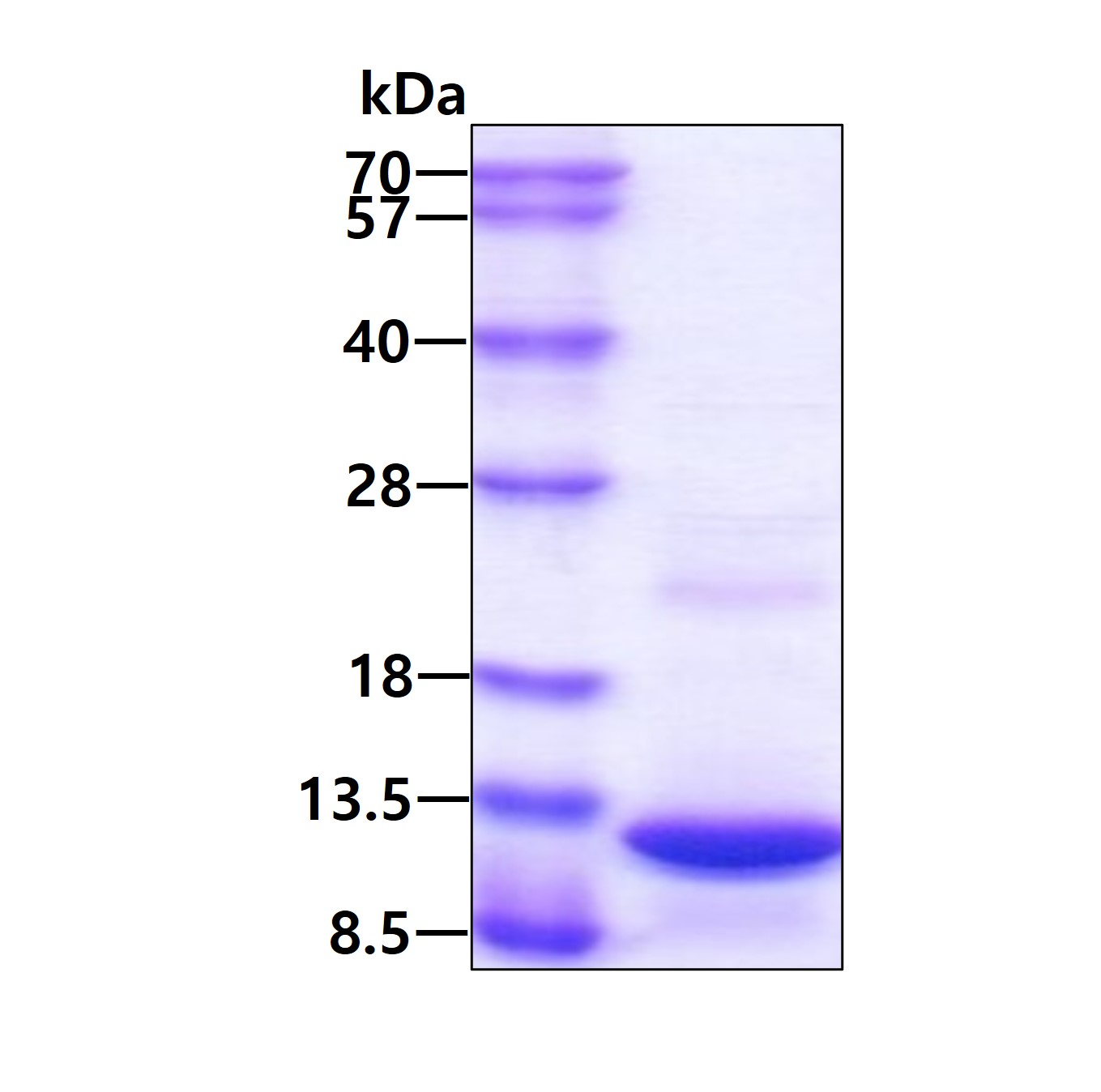
| Applications | SDS-PAGE |
| Host | E.coli |
| Note | STRICTLY FOR FURTHER SCIENTIFIC RESEARCH USE ONLY (RUO). MUST NOT TO BE USED IN DIAGNOSTIC OR THERAPEUTIC APPLICATIONS. |
Product Properties
| Concentration | 1 mg/mL |
| Formulation | Liquid in phosphate-Buffered Saline (pH 7.4) containing 10% Glycerol |
| Storage Instruction | For short term storage, keep at +2C to +8C for up to 1 week. For long term storage, aliquot and store at-20C, and avoid repeat freeze-thaw cycles. |
| Endotoxin | < 1 EU per 1ug of protein (determined by LAL method) |
Target Information
| Gene Symbol | PPBP |
| Gene ID | 5473 |
| Uniprot ID | CXCL7_HUMAN |
| Accession Number | NP_002695.1 |
| Immunogen | Human |
| Immunogen Region | 35-128aa |
| Immunogen Sequence | MSSTKGQTKR NLAKGKEESL DSDLYAELRC MCIKTTSGIH PKNIQSLEVI GKGTHCNQVE VIATLKDGRK ICLDPDAPRI KKIVQKKLAG DESAD |
Additional Info
| Post Translational Modifications | Proteolytic removal of residues 1-9 produces the active peptide connective tissue-activating peptide III (CTAP-III) (low-affinity platelet factor IV (LA-PF4)). Proteolytic removal of residues 1-13 produces the active peptide beta-thromboglobulin, which is released from platelets along with platelet factor 4 and platelet-derived growth factor. NAP-2(1-66) is produced by proteolytical processing, probably after secretion by leukocytes other than neutrophils. NAP-2(73) and NAP-2(74) seem not be produced by proteolytical processing of secreted precursors but are released in an active form from platelets. |
| Function | LA-PF4 stimulates DNA synthesis, mitosis, glycolysis, intracellular cAMP accumulation, prostaglandin E2 secretion, and synthesis of hyaluronic acid and sulfated glycosaminoglycan. It also stimulates the formation and secretion of plasminogen activator by human synovial cells. NAP-2 is a ligand for CXCR1 and CXCR2, and NAP-2, NAP-2(73), NAP-2(74), NAP-2(1-66), and most potent NAP-2(1-63) are chemoattractants and activators for neutrophils. TC-1 and TC-2 are antibacterial proteins, in vitro released from activated platelet alpha-granules. CTAP-III(1-81) is more potent than CTAP-III desensitize chemokine-induced neutrophil activation. |
| Protein Name | Platelet Basic ProteinPbpC-X-C Motif Chemokine 7Leukocyte-Derived Growth FactorLdgfMacrophage-Derived Growth FactorMdgfSmall-Inducible Cytokine B7 Cleaved Into - Connective Tissue-Activating Peptide IiiCtap-IiiLa-Pf4Low-Affinity Platelet Factor Iv - Tc-2 - Connective Tissue-Activating Peptide Iii(1-81Ctap-Iii(1-81 - Beta-ThromboglobulinBeta-Tg - Neutrophil-Activating Peptide 2(74Nap-2(74 - Neutrophil-Activating Peptide 2(73Nap-2(73 - Neutrophil-Activating Peptide 2Nap-2 - Tc-1 - Neutrophil-Activating Peptide 2(1-66Nap-2(1-66 - Neutrophil-Activating Peptide 2(1-63Nap-2(1-63 |
| Database Links | Reactome: R-HSA-114608Reactome: R-HSA-380108Reactome: R-HSA-418594Reactome: R-HSA-6798695 |
| Cellular Localisation | Secreted |
| Alternative Protein Names | Platelet Basic Protein proteinPbp proteinC-X-C Motif Chemokine 7 proteinLeukocyte-Derived Growth Factor proteinLdgf proteinMacrophage-Derived Growth Factor proteinMdgf proteinSmall-Inducible Cytokine B7 Cleaved Into - Connective Tissue-Activating Peptide Iii proteinCtap-Iii proteinLa-Pf4 proteinLow-Affinity Platelet Factor Iv - Tc-2 - Connective Tissue-Activating Peptide Iii(1-81 proteinCtap-Iii(1-81 - Beta-Thromboglobulin proteinBeta-Tg - Neutrophil-Activating Peptide 2(74 proteinNap-2(74 - Neutrophil-Activating Peptide 2(73 proteinNap-2(73 - Neutrophil-Activating Peptide 2 proteinNap-2 - Tc-1 - Neutrophil-Activating Peptide 2(1-66 proteinNap-2(1-66 - Neutrophil-Activating Peptide 2(1-63 proteinNap-2(1-63 proteinPPBP proteinCTAP3 proteinCXCL7 proteinSCYB7 proteinTGB1 proteinTHBGB1 protein |
Information sourced from Uniprot.org