

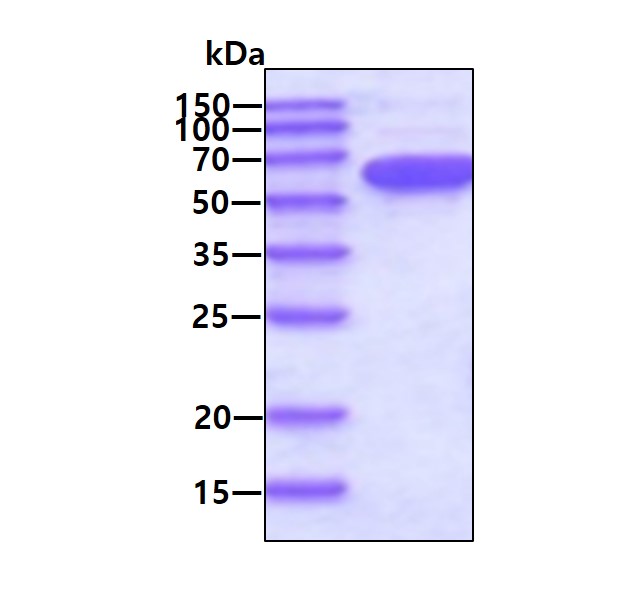

Human PKM protein (Recombinant) (His-Tag) (STJP016571)
SPECIFICATIONS
HostE.coli
ImmunogenHuman
General Information
| Short Description | Recombinant-Human PKM-His-Tag protein was developed from e.coli and has a target region of His-Tag. For use in research applications. |
| Applications | SDS-PAGE/Enzyme Activity |
| Host | E.coli |
| Note | STRICTLY FOR FURTHER SCIENTIFIC RESEARCH USE ONLY (RUO). MUST NOT TO BE USED IN DIAGNOSTIC OR THERAPEUTIC APPLICATIONS. |
Product Properties
| Concentration | 1 mg/mL |
| Formulation | Liquid in 20mM Tris-HCl buffer (pH 8.0) containing 10% Glycerol |
| Storage Instruction | For short term storage, keep at +2C to +8C for up to 1 week. For long term storage, aliquot and store at-20C, and avoid repeat freeze-thaw cycles. |
| Endotoxin | < 1 EU per 1ug of protein (determined by LAL method) |
| Immunoreactivity | Specific activity: > 25, 000pmol/min/ug. One unit will convert 1.0pmole of phospho (enol) pyruvate to pyruvate per minute at pH 7.5 at 37C. |
Target Information
| Gene Symbol | PKM |
| Gene ID | 5315 |
| Uniprot ID | KPYM_HUMAN |
| Accession Number | NP_002645.3 |
| Immunogen | Human |
| Immunogen Region | 1-531aa |
| Immunogen Sequence |
Additional Info
| Tissue Specificity | Isoform M2: Specifically expressed in proliferating cells, such as embryonic stem cells, embryonic carcinoma cells, as well as cancer cells. Isoform M1: Expressed in adult tissues. Not expressed in tumor cells. |
| Post Translational Modifications | ISGylated. Under hypoxia, hydroxylated by EGLN3. Acetylation at Lys-305 is stimulated by high glucose concentration, it decreases enzyme activity and promotes its lysosomal-dependent degradation via chaperone-mediated autophagy. Isoform M2: Acetylated at Lys-433 by EP300, leading to impair phosphoenolpyruvate substrate-binding and promote its homodimerization and subsequent translocation to the nucleus. Deacetylation at Lys-433 by SIRT6 promotes its nuclear export into the cytoplasm, leading to suppress its nuclear localization and oncogenic function. Isoform M2: S-nitrosylation at Cys-423 and Cys-424 inhibits homotetramerization and pyruvate kinase activity. S-nitrosylation is indirectly inhibited by AKR1A1 which degrades S-nitroso-CoA, a cofactor required to S-nitrosylate proteins. FGFR1-dependent tyrosine phosphorylation is reduced by interaction with TRIM35. |
| Function | Catalyzes the final rate-limiting step of glycolysis by mediating the transfer of a phosphoryl group from phosphoenolpyruvate (PEP) to ADP, generating ATP. The ratio between the highly active tetrameric form and nearly inactive dimeric form determines whether glucose carbons are channeled to biosynthetic processes or used for glycolytic ATP production. The transition between the 2 forms contributes to the control of glycolysis and is important for tumor cell proliferation and survival. Isoform M2: Isoform specifically expressed during embryogenesis that has low pyruvate kinase activity by itself and requires allosteric activation by D-fructose 1,6-bisphosphate (FBP) for pyruvate kinase activity. In addition to its pyruvate kinase activity in the cytoplasm, also acts as a regulator of transcription in the nucleus by acting as a protein kinase. Translocates into the nucleus in response to various signals, such as EGF receptor activation, and homodimerizes, leading to its conversion into a protein threonine- and tyrosine-protein kinase. Catalyzes phosphorylation of STAT3 at 'Tyr-705' and histone H3 at 'Thr-11' (H3T11ph), leading to activate transcription. Its ability to activate transcription plays a role in cancer cells by promoting cell proliferation and promote tumorigenesis. Promotes the expression of the immune checkpoint protein CD274 in BMAL1-deficient macrophages. May also act as a translation regulator for a subset of mRNAs, independently of its pyruvate kinase activity: associates with subpools of endoplasmic reticulum-associated ribosomes, binds directly to the mRNAs translated at the endoplasmic reticulum and promotes translation of these endoplasmic reticulum-destined mRNAs. Plays a role in caspase independent cell death of tumor cells. Isoform M1: Pyruvate kinase isoform expressed in adult tissues, which replaces isoform M2 after birth. In contrast to isoform M2, has high pyruvate kinase activity by itself and does not require allosteric activation by D-fructose 1,6-bisphosphate (FBP) for activity. |
| Protein Name | Pyruvate Kinase PkmCytosolic Thyroid Hormone-Binding ProteinCthbpOpa-Interacting Protein 3Oip-3Pyruvate Kinase 2/3Pyruvate Kinase Muscle IsozymeThreonine-Protein Kinase Pkm2Thyroid Hormone-Binding Protein 1Thbp1Tumor M2-PkTyrosine-Protein Kinase Pkm2P58 |
| Database Links | Reactome: R-HSA-6798695Reactome: R-HSA-70171Reactome: R-HSA-70268Reactome: R-HSA-9861718 P14618-1 |
| Cellular Localisation | Isoform M2: CytoplasmNucleusTranslocates To The Nucleus In Response To Various SignalsSuch As Egf Receptor Activation Or Apoptotic StimuliNuclear Translocation Is Promoted By Acetylation By Ep300Deacetylation By Sirt6 Promotes Its Nuclear Export In A Process Dependent Of Xpo4Thereby Suppressing Its Ability To Activate Transcription And Promote TumorigenesisIsoform M1: Cytoplasm |
| Alternative Protein Names | Pyruvate Kinase Pkm proteinCytosolic Thyroid Hormone-Binding Protein proteinCthbp proteinOpa-Interacting Protein 3 proteinOip-3 proteinPyruvate Kinase 2/3 proteinPyruvate Kinase Muscle Isozyme proteinThreonine-Protein Kinase Pkm2 proteinThyroid Hormone-Binding Protein 1 proteinThbp1 proteinTumor M2-Pk proteinTyrosine-Protein Kinase Pkm2 proteinP58 proteinPKM proteinOIP3 proteinPK2 proteinPK3 proteinPKM2 protein |
Information sourced from Uniprot.org