

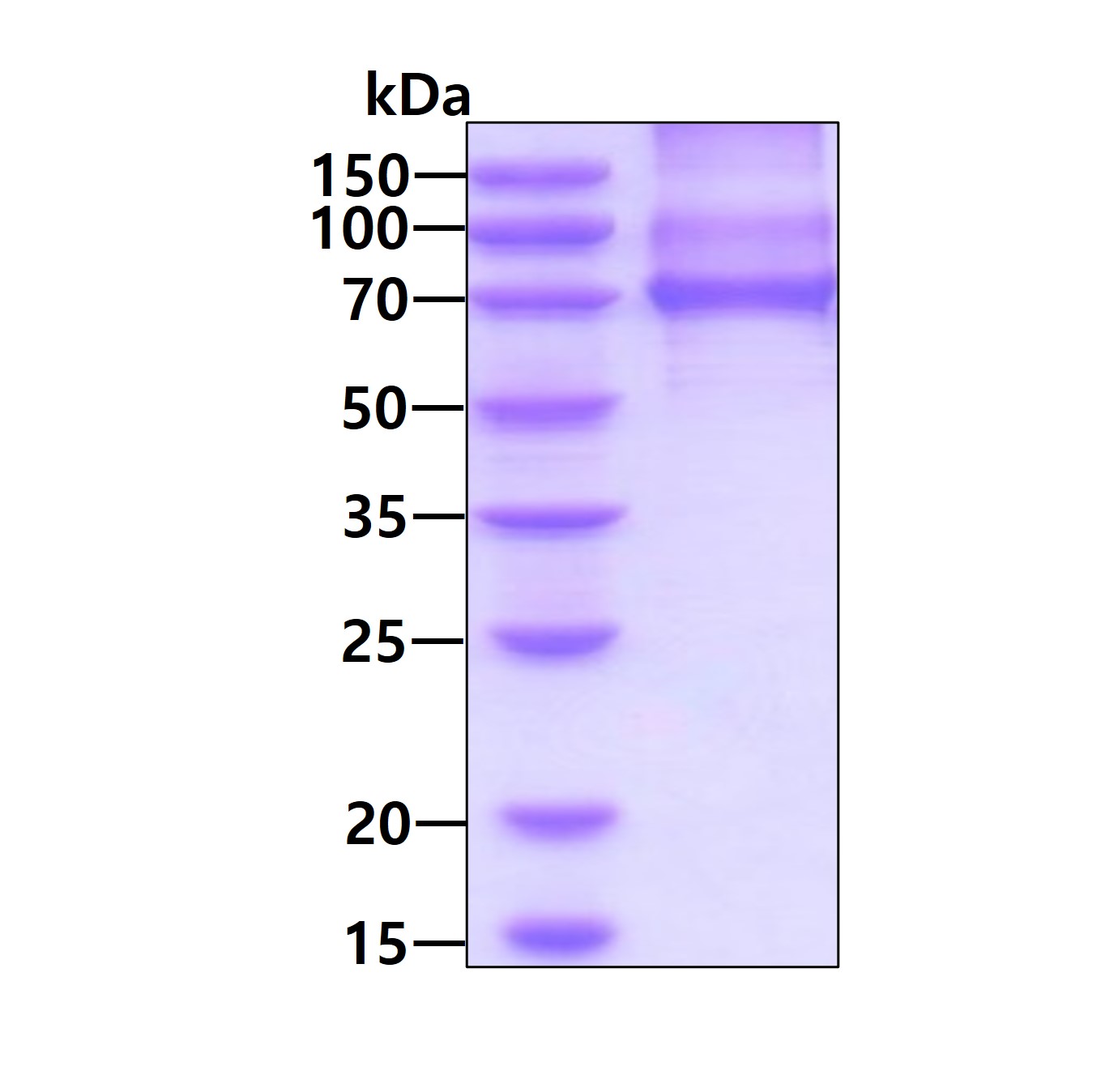

Human PKC iota protein (Recombinant) (His-Tag) (STJP019507)
SPECIFICATIONS
HostHEK293 Cells
ImmunogenHuman
General Information
| Short Description | Recombinant-Human PKC iota-His-Tag protein was developed from hek293 cells and has a target region of His-Tag. For use in research applications. |
| Applications | SDS-PAGE |
| Host | HEK293 Cells |
| Note | STRICTLY FOR FURTHER SCIENTIFIC RESEARCH USE ONLY (RUO). MUST NOT TO BE USED IN DIAGNOSTIC OR THERAPEUTIC APPLICATIONS. |
Product Properties
| Concentration | 0.5 mg/mL |
| Formulation | Liquid In Phosphate-Buffered Saline (pH 7.4) containing 10% Glycerol |
| Storage Instruction | For short term storage, keep at +2C to +8C for up to 1 week. For long term storage, aliquot and store at-20C, and avoid repeat freeze-thaw cycles. |
| Endotoxin | < 1 EU per 1ug of protein (determined by LAL method) |
Target Information
| Gene Symbol | PRKCI |
| Gene ID | 5584 |
| Uniprot ID | KPCI_HUMAN |
| Accession Number | NP_002731.4 |
| Immunogen | Human |
| Immunogen Region | 1-596aa |
| Immunogen Sequence | MPTQRDSSTM SHTVAGGGSG DHSHQVRVKA YYRGDIMITH FEPSISFEGL CNEVRDMCSF DNEQLFTMKW IDEEGDPCTV SSQLELEEAF RLYELNKDSE LLIHVFPCVP ERPGMPCPGE DKSIYRRGAR RWRKLYCANG HTFQAKRFNR RAHCAICTDR IWGLGRQGYK CINCKLLVHK KCHKLVTIEC GRHSLPQEPV MPMDQSSMHS DHAQTVIPYN PSSHESLD |
Additional Info
| Tissue Specificity | Predominantly expressed in lung and brain, but also expressed at lower levels in many tissues including pancreatic islets. Highly expressed in non-small cell lung cancers. |
| Post Translational Modifications | Phosphorylation at Thr-412 in the activation loop is not mandatory for activation. Upon neuronal growth factor (NGF) stimulation, phosphorylated by SRC at Tyr-265, Tyr-280 and Tyr-334. Phosphorylation at Tyr-265 facilitates binding to KPNB1/importin-beta regulating entry of PRKCI into the nucleus. Phosphorylation on Tyr-334 is important for NF-kappa-B stimulation. Phosphorylated at Thr-564 during the initial phase of long term potentiation. |
| Function | Calcium- and diacylglycerol-independent serine/ threonine-protein kinase that plays a general protective role against apoptotic stimuli, is involved in NF-kappa-B activation, cell survival, differentiation and polarity, and contributes to the regulation of microtubule dynamics in the early secretory pathway. Is necessary for BCR-ABL oncogene-mediated resistance to apoptotic drug in leukemia cells, protecting leukemia cells against drug-induced apoptosis. In cultured neurons, prevents amyloid beta protein-induced apoptosis by interrupting cell death process at a very early step. In glioblastoma cells, may function downstream of phosphatidylinositol 3-kinase (PI(3)K) and PDPK1 in the promotion of cell survival by phosphorylating and inhibiting the pro-apoptotic factor BAD. Can form a protein complex in non-small cell lung cancer (NSCLC) cells with PARD6A and ECT2 and regulate ECT2 oncogenic activity by phosphorylation, which in turn promotes transformed growth and invasion. In response to nerve growth factor (NGF), acts downstream of SRC to phosphorylate and activate IRAK1, allowing the subsequent activation of NF-kappa-B and neuronal cell survival. Functions in the organization of the apical domain in epithelial cells by phosphorylating EZR. This step is crucial for activation and normal distribution of EZR at the early stages of intestinal epithelial cell differentiation. Forms a protein complex with LLGL1 and PARD6B independently of PARD3 to regulate epithelial cell polarity. Plays a role in microtubule dynamics in the early secretory pathway through interaction with RAB2A and GAPDH and recruitment to vesicular tubular clusters (VTCs). In human coronary artery endothelial cells (HCAEC), is activated by saturated fatty acids and mediates lipid-induced apoptosis. Involved in early synaptic long term potentiation phase in CA1 hippocampal cells and short term memory formation. |
| Protein Name | Protein Kinase C Iota TypeAtypical Protein Kinase C-Lambda/IotaPrkc-Lambda/IotaApkc-Lambda/IotaNpkc-Iota |
| Database Links | Reactome: R-HSA-1912408Reactome: R-HSA-209543Reactome: R-HSA-420029Reactome: R-HSA-9755511 |
| Cellular Localisation | CytoplasmMembraneEndosomeNucleusTransported Into The Endosome Through Interaction With Sqstm1/P62After Phosphorylation By SrcTransported Into The Nucleus Through Interaction With Kpnb1Colocalizes With Cdk7 In The Cytoplasm And NucleusTransported To Vesicular Tubular Clusters (Vtcs) Through Interaction With Rab2a |
| Alternative Protein Names | Protein Kinase C Iota Type proteinAtypical Protein Kinase C-Lambda/Iota proteinPrkc-Lambda/Iota proteinApkc-Lambda/Iota proteinNpkc-Iota proteinPRKCI proteinDXS1179E protein |
Information sourced from Uniprot.org