

Human PDCD6IP protein (Recombinant) (His-Tag) (STJP016623)
SPECIFICATIONS
HostE.coli
ImmunogenHuman
General Information
| Short Description | Recombinant-Human PDCD6IP-His-Tag protein was developed from e.coli and has a target region of His-Tag. For use in research applications. |
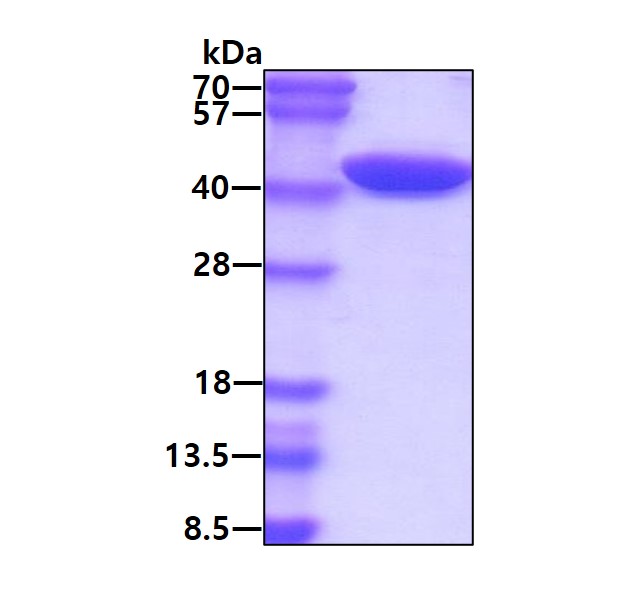
| Applications | SDS-PAGE |
| Host | E.coli |
| Note | STRICTLY FOR FURTHER SCIENTIFIC RESEARCH USE ONLY (RUO). MUST NOT TO BE USED IN DIAGNOSTIC OR THERAPEUTIC APPLICATIONS. |
Product Properties
| Concentration | 1 mg/mL |
| Formulation | Liquid in 20mM Tris-HCl buffer (pH 8.0) containing 10% Glycerol 1mM DTT |
| Storage Instruction | For short term storage, keep at +2C to +8C for up to 1 week. For long term storage, aliquot and store at-20C, and avoid repeat freeze-thaw cycles. |
Target Information
| Gene Symbol | PDCD6IP |
| Gene ID | 10015 |
| Uniprot ID | PDC6I_HUMAN |
| Accession Number | NP_037506.2 |
| Immunogen | Human |
| Immunogen Region | 1-392aa |
| Immunogen Sequence |
Additional Info
| Post Translational Modifications | May be phosphorylated on tyrosine residues by activated PDGFRB. |
| Function | Multifunctional protein involved in endocytosis, multivesicular body biogenesis, membrane repair, cytokinesis, apoptosis and maintenance of tight junction integrity. Class E VPS protein involved in concentration and sorting of cargo proteins of the multivesicular body (MVB) for incorporation into intralumenal vesicles (ILVs) that are generated by invagination and scission from the limiting membrane of the endosome. Binds to the phospholipid lysobisphosphatidic acid (LBPA) which is abundant in MVBs internal membranes. The MVB pathway requires the sequential function of ESCRT-O, -I,-II and -III complexes. The ESCRT machinery also functions in topologically equivalent membrane fission events, such as the terminal stages of cytokinesis. Adapter for a subset of ESCRT-III proteins, such as CHMP4, to function at distinct membranes. Required for completion of cytokinesis. May play a role in the regulation of both apoptosis and cell proliferation. Regulates exosome biogenesis in concert with SDC1/4 and SDCBP. By interacting with F-actin, PARD3 and TJP1 secures the proper assembly and positioning of actomyosin-tight junction complex at the apical sides of adjacent epithelial cells that defines a spatial membrane domain essential for the maintenance of epithelial cell polarity and barrier. (Microbial infection) Involved in HIV-1 virus budding. Can replace TSG101 it its role of supporting HIV-1 release.this function requires the interaction with CHMP4B. The ESCRT machinery also functions in topologically equivalent membrane fission events, such as enveloped virus budding (HIV-1 and other lentiviruses). |
| Protein Name | Programmed Cell Death 6-Interacting ProteinPdcd6-Interacting ProteinAlg-2-Interacting Protein 1Alg-2-Interacting Protein XHp95 |
| Database Links | Reactome: R-HSA-162588Reactome: R-HSA-5210891Reactome: R-HSA-5213460Reactome: R-HSA-5675482 |
| Cellular Localisation | CytoplasmCytosolMelanosomeCytoskeletonMicrotubule Organizing CenterCentrosomeSecretedExtracellular ExosomeCell JunctionTight JunctionMidbodyMidbody RingIdentified By Mass Spectrometry In Melanosome Fractions From Stage I To Stage IvColocalized With Cep55 At Centrosomes Of Non-Dividing CellsComponent Of The Actomyosin-Tight Junction ComplexPdcd6ip Targeting To The Midbody Requires The Interaction With Cep55 |
| Alternative Protein Names | Programmed Cell Death 6-Interacting Protein proteinPdcd6-Interacting Protein proteinAlg-2-Interacting Protein 1 proteinAlg-2-Interacting Protein X proteinHp95 proteinPDCD6IP proteinAIP1 proteinALIX proteinKIAA1375 protein |
Information sourced from Uniprot.org