

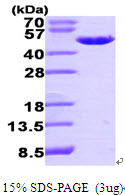

Human PA2G4 protein (Recombinant) (His-Tag) (STJP016687)
SPECIFICATIONS
HostE.coli
ImmunogenHuman
General Information
| Short Description | Recombinant-Human PA2G4-His-Tag protein was developed from e.coli and has a target region of His-Tag. For use in research applications. |
| Applications | SDS-PAGE |
| Host | E.coli |
| Note | STRICTLY FOR FURTHER SCIENTIFIC RESEARCH USE ONLY (RUO). MUST NOT TO BE USED IN DIAGNOSTIC OR THERAPEUTIC APPLICATIONS. |
Product Properties
| Concentration | 1 mg/mL |
| Formulation | Liquid in 20mM Tris-HCl buffer (pH 8.0) containing 10% Glycerol |
| Storage Instruction | For short term storage, keep at +2C to +8C for up to 1 week. For long term storage, aliquot and store at-20C, and avoid repeat freeze-thaw cycles. |
Target Information
| Gene Symbol | PA2G4 |
| Gene ID | 5036 |
| Uniprot ID | PA2G4_HUMAN |
| Accession Number | NP_006182 |
| Immunogen | Human |
| Immunogen Region | 1-394aa |
| Immunogen Sequence | MSGEDEQQEQ TIAEDLVVTK YKMGGDIANR VLRSLVEASS SGVSVLSLCE KGDAMIMEET GKIFKKEKEM KKGIAFPTSI SVNNCVCHFS PLKSDQDYIL KEGDLVKIDL GVHVDGFIAN VAHTFVVDVA QGTQVTGRKA DVIKAAHLCA EAALRLVKPG NQNTQVTEAW NKVAHSFNCT PIEGMLSHQL KQHVIDGEKT IIQNPTDQQK KDHEKAEFEV HEVYAVDV |
Additional Info
| Tissue Specificity | Isoform 2 is undetectable whereas isoform 1 is strongly expressed in cancer cells (at protein level). Isoform 1 and isoform 2 are widely expressed, including heart, brain, lung, pancreas, skeletal muscle, kidney, placenta and liver. |
| Post Translational Modifications | Phosphorylated on serine and threonine residues. Phosphorylation is enhanced by HRG treatment. Basal phosphorylation is PKC-dependent and HRG-induced phosphorylation is predominantly PKC-independent. Phosphorylation at Ser-361 by PKC/PRKCD regulates its nucleolar localization. In cancer cells, isoform 2 is polyubiquitinated leading to its proteasomal degradation and phosphorylation by PKC/PRKCD enhances polyubiquitination. |
| Function | May play a role in a ERBB3-regulated signal transduction pathway. Seems be involved in growth regulation. Acts a corepressor of the androgen receptor (AR) and is regulated by the ERBB3 ligand neuregulin-1/heregulin (HRG). Inhibits transcription of some E2F1-regulated promoters, probably by recruiting histone acetylase (HAT) activity. Binds RNA. Associates with 28S, 18S and 5.8S mature rRNAs, several rRNA precursors and probably U3 small nucleolar RNA. May be involved in regulation of intermediate and late steps of rRNA processing. May be involved in ribosome assembly. Mediates cap-independent translation of specific viral IRESs (internal ribosomal entry site). Regulates cell proliferation, differentiation, and survival. Isoform 1 suppresses apoptosis whereas isoform 2 promotes cell differentiation. |
| Protein Name | Proliferation-Associated Protein 2g4Cell Cycle Protein P38-2g4 HomologHg4-1Erbb3-Binding Protein 1 |
| Database Links | Reactome: R-HSA-6798695 |
| Cellular Localisation | Isoform 1: CytoplasmNucleusNucleolusTranslocates To The Nucleus Upon Treatment With HrgPhosphorylation At Ser-361 By Pkc/Prkcd Regulates Its Nucleolar LocalizationIsoform 2: Cytoplasm |
| Alternative Protein Names | Proliferation-Associated Protein 2g4 proteinCell Cycle Protein P38-2g4 Homolog proteinHg4-1 proteinErbb3-Binding Protein 1 proteinPA2G4 proteinEBP1 protein |
Information sourced from Uniprot.org