
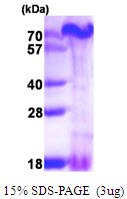

Human PA1/PAGR1 protein (Recombinant) (His-Tag) (STJP017193)
SPECIFICATIONS
HostE.coli
ImmunogenHuman
General Information
| Short Description | Recombinant-Human PA1/PAGR1-His-Tag protein was developed from e.coli and has a target region of His-Tag. For use in research applications. |
| Applications | SDS-PAGE |
| Host | E.coli |
| Note | STRICTLY FOR FURTHER SCIENTIFIC RESEARCH USE ONLY (RUO). MUST NOT TO BE USED IN DIAGNOSTIC OR THERAPEUTIC APPLICATIONS. |
Product Properties
| Concentration | 1 mg/mL |
| Formulation | Liquid in 20mM Tris-HCl buffer (pH 8.0) containing 10% Glycerol, 2mM DTT, 0.1M NaCl. |
| Storage Instruction | For short term storage, keep at +2C to +8C for up to 1 week. For long term storage, aliquot and store at-20C, and avoid repeat freeze-thaw cycles. |
Target Information
| Gene Symbol | PAGR1 |
| Gene ID | 79447 |
| Uniprot ID | PAGR1_HUMAN |
| Accession Number | NP_078792 |
| Immunogen | Human |
| Immunogen Region | 1-254aa |
| Immunogen Sequence | MGSSHHHHHH SSGLVPRGSH MSLARGHGDT AASTAAPLSE EGEVTSGLQA LAVEDTGGPS ASAGKAEDEG EGGREETERE GSGGEEAQGE VPSAGGEEPA EEDSEDWCVP CSDEEVELPA DGQPWMPPPS EIQRLYELLA AHGTLELQAE ILPRRPPTPE AQSEEERSDE EPEAKEEEEE KPHMPTEFDF DDEPVTPKDS LIDRRRTPGS SARSQKREAR LDKVLSDM |
Additional Info
| Tissue Specificity | Ubiquitously expressed. |
| Function | Its association with the histone methyltransferase MLL2/MLL3 complex is suggesting a role in epigenetic transcriptional activation. However, in association with PAXIP1/PTIP is proposed to function at least in part independently of the MLL2/MLL3 complex. Proposed to be recruited by PAXIP1 to sites of DNA damage where the PAGR1:PAXIP1 complex is required for cell survival in response to DNA damage independently of the MLL2/MLL3 complex. However, its function in DNA damage has been questioned. During immunoglobulin class switching in activated B-cells is involved in transcription regulation of downstream switch regions at the immunoglobulin heavy-chain (Igh) locus independently of the MLL2/MLL3 complex. Involved in both estrogen receptor-regulated gene transcription and estrogen-stimulated G1/S cell-cycle transition. Acts as a transcriptional cofactor for nuclear hormone receptors. Inhibits the induction properties of several steroid receptors such as NR3C1, AR and PPARG.the mechanism of inhibition appears to be gene-dependent. |
| Protein Name | Paxip1-Associated Glutamate-Rich Protein 1Glutamate-Rich Coactivator Interacting With Src1GasPaxip1-Associated Protein 1Ptip-Associated Protein 1 |
| Database Links | Reactome: R-HSA-5617472Reactome: R-HSA-9772755Reactome: R-HSA-9818564Reactome: R-HSA-9841922 |
| Cellular Localisation | Nucleus |
| Alternative Protein Names | Paxip1-Associated Glutamate-Rich Protein 1 proteinGlutamate-Rich Coactivator Interacting With Src1 proteinGas proteinPaxip1-Associated Protein 1 proteinPtip-Associated Protein 1 proteinPAGR1 proteinC16orf53 proteinPA1 protein |
Information sourced from Uniprot.org