
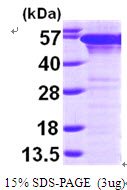

Human P4HB protein (Recombinant) (His-Tag) (STJP016810)
SPECIFICATIONS
HostE.coli
ImmunogenHuman
General Information
| Short Description | Recombinant-Human P4HB-His-Tag protein was developed from e.coli and has a target region of His-Tag. For use in research applications. |
| Applications | SDS-PAGE |
| Host | E.coli |
| Note | STRICTLY FOR FURTHER SCIENTIFIC RESEARCH USE ONLY (RUO). MUST NOT TO BE USED IN DIAGNOSTIC OR THERAPEUTIC APPLICATIONS. |
Product Properties
| Concentration | 1 mg/mL |
| Formulation | Liquid in 20mM Tris-HCl buffer (pH 8.0) containing 10% Glycerol |
| Storage Instruction | For short term storage, keep at +2C to +8C for up to 1 week. For long term storage, aliquot and store at-20C, and avoid repeat freeze-thaw cycles. |
Target Information
| Gene Symbol | P4HB |
| Gene ID | 5034 |
| Uniprot ID | PDIA1_HUMAN |
| Accession Number | NP_000909 |
| Immunogen | Human |
| Immunogen Region | 18-508aa |
| Immunogen Sequence | MGSSHHHHHH SSGLVPRGSH MDAPEEEDHV LVLRKSNFAE ALAAHKYLLV EFYAPWCGHC KALAPEYAKA AGKLKAEGSE IRLAKVDATE ESDLAQQYGV RGYPTIKFFR NGDTASPKEY TAGREADDIV NWLKKRTGPA ATTLPDGAAA ESLVESSEVA VIGFFKDVES DSAKQFLQAA EAIDDIPFGI TSNSDVFSKY QLDKDGVVLF KKFDEGRNNF EGEVTKEN |
Additional Info
| Post Translational Modifications | Phosphorylation of Ser-357 by FAM20C is induced by endoplasmic reticulum stress and results in a functional switch from oxidoreductase to molecular chaperone. It also promotes interaction with ERN1. |
| Function | This multifunctional protein catalyzes the formation, breakage and rearrangement of disulfide bonds. At the cell surface, seems to act as a reductase that cleaves disulfide bonds of proteins attached to the cell. May therefore cause structural modifications of exofacial proteins. Inside the cell, seems to form/rearrange disulfide bonds of nascent proteins. At high concentrations and following phosphorylation by FAM20C, functions as a chaperone that inhibits aggregation of misfolded proteins. At low concentrations, facilitates aggregation (anti-chaperone activity). May be involved with other chaperones in the structural modification of the TG precursor in hormone biogenesis. Also acts as a structural subunit of various enzymes such as prolyl 4-hydroxylase and microsomal triacylglycerol transfer protein MTTP. Receptor for LGALS9.the interaction retains P4HB at the cell surface of Th2 T helper cells, increasing disulfide reductase activity at the plasma membrane, altering the plasma membrane redox state and enhancing cell migration. |
| Protein Name | Protein Disulfide-IsomerasePdiCellular Thyroid Hormone-Binding ProteinProlyl 4-Hydroxylase Subunit BetaP55 |
| Database Links | Reactome: R-HSA-1650814Reactome: R-HSA-264876Reactome: R-HSA-3299685Reactome: R-HSA-381426Reactome: R-HSA-5358346Reactome: R-HSA-8866423Reactome: R-HSA-8957275Reactome: R-HSA-8963888Reactome: R-HSA-8964041Reactome: R-HSA-9020591Reactome: R-HSA-9020933 |
| Cellular Localisation | Endoplasmic ReticulumEndoplasmic Reticulum LumenMelanosomeCell MembranePeripheral Membrane ProteinHighly AbundantIn Some Cell TypesSeems To Be Also Secreted Or Associated With The Plasma MembraneWhere It Undergoes Constant Shedding And Replacement From Intracellular Sources (Probable)Localizes Near Cd4-Enriched Regions On Lymphoid Cell SurfacesIdentified By Mass Spectrometry In Melanosome Fractions From Stage I To Stage IvColocalizes With Mttp In The Endoplasmic Reticulum |
| Alternative Protein Names | Protein Disulfide-Isomerase proteinPdi proteinCellular Thyroid Hormone-Binding Protein proteinProlyl 4-Hydroxylase Subunit Beta proteinP55 proteinP4HB proteinERBA2L proteinPDI proteinPDIA1 proteinPO4DB protein |
Information sourced from Uniprot.org