

Human NME3 protein (Recombinant) (His-Tag) (STJP019255)
SPECIFICATIONS
HostE.coli
ImmunogenHuman
General Information
| Short Description | Recombinant-Human NME3-His-Tag protein was developed from e.coli and has a target region of His-Tag. For use in research applications. |
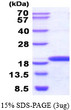
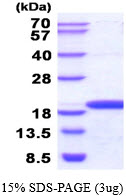
| Applications | Enzyme Activity/SDS-PAGE |
| Host | E.coli |
| Note | STRICTLY FOR FURTHER SCIENTIFIC RESEARCH USE ONLY (RUO). MUST NOT TO BE USED IN DIAGNOSTIC OR THERAPEUTIC APPLICATIONS. |
Product Properties
| Concentration | 0.5 mg/mL |
| Formulation | Liquid in 20mM Tris-HCl buffer (pH 8.0) containing 50% Glycerol, 0.1M NaCl, 2mM DTT |
| Storage Instruction | For short term storage, keep at +2C to +8C for up to 1 week. For long term storage, aliquot and store at-20C, and avoid repeat freeze-thaw cycles. |
| Immunoreactivity | Specific activity is > 150unit/mg, and is defined as the amount of enzyme that convert 1.0 umole each of ATP and TDP to ADP and TTP per minute at pH 7.5 at 25C in a couple system with PK/LDH. |
Target Information
| Gene Symbol | NME3 |
| Gene ID | 4832 |
| Uniprot ID | NDK3_HUMAN |
| Accession Number | NP_002504 |
| Immunogen | Human |
| Immunogen Region | 22-169aa |
| Immunogen Sequence | MGSSHHHHHH SSGLVPRGSH MERTFLAVKP DGVQRRLVGE IVRRFERKGF KLVALKLVQA SEELLREHYA ELRERPFYGR LVKYMASGPV VAMVWQGLDV VRTSRALIGA TNPADAPPGT IRGDFCIEVG KNLIHGSDSV ESARREIALW FRADELLCWE DSAGHWLYE |
Additional Info
| Function | Catalyzes the phosphorylation of ribonucleosides and deoxyribonucleoside diphosphates, other than ATP, into the corresponding triphosphates with ATP as the major phosphate donor. The ATP gamma phosphate is transferred to the nucleoside diphosphate beta phosphate via a ping-pong mechanism, using a phosphorylated active-site intermediate. Through the catalyzed exchange of gamma-phosphate between di- and triphosphonucleosides participates in regulation of intracellular nucleotide homeostasis. Inhibits granulocyte differentiation. May be required for ciliary function during renal development. Independently of its kinase activity, facilitates mitochondrial tethering prior to membrane fusion through its direct membrane-binding and hexamerization. Implicated in repair of both single- and double-stranded breaks in DNA through its association with the ribonucleotide reductase complex (RNR complex) via its interaction with the histone acetyltransferase KAT5, this interaction enables recruitment of NME3 at DNA damage sites where it plays a role in the repair of DNA, independently of its kinase activity. |
| Protein Name | Nucleoside Diphosphate Kinase 3Ndk 3Ndp Kinase 3Dr-Nm23Nucleoside Diphosphate Kinase CNdpkcNm23-H3 |
| Database Links | Reactome: R-HSA-499943 |
| Cellular Localisation | Mitochondrion Outer MembranePeripheral Membrane ProteinCytoplasmCytoskeletonCilium Basal Body |
| Alternative Protein Names | Nucleoside Diphosphate Kinase 3 proteinNdk 3 proteinNdp Kinase 3 proteinDr-Nm23 proteinNucleoside Diphosphate Kinase C proteinNdpkc proteinNm23-H3 proteinNME3 protein |
Information sourced from Uniprot.org