

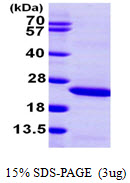

Human Lipocalin-2/NGAL protein (Recombinant) (His-Tag) (STJP017046)
SPECIFICATIONS
HostE.coli
ImmunogenHuman
General Information
| Short Description | Recombinant-Human Lipocalin-2/NGAL-His-Tag protein was developed from e.coli and has a target region of His-Tag. For use in research applications. |
| Applications | SDS-PAGE |
| Host | E.coli |
| Note | STRICTLY FOR FURTHER SCIENTIFIC RESEARCH USE ONLY (RUO). MUST NOT TO BE USED IN DIAGNOSTIC OR THERAPEUTIC APPLICATIONS. |
Product Properties
| Concentration | 1 mg/mL |
| Formulation | Liquid in 20mM Tris-HCl buffer (pH 8.0) containing 10% Glycerol, 1mM DTT, 50mM NaCl |
| Storage Instruction | For short term storage, keep at +2C to +8C for up to 1 week. For long term storage, aliquot and store at-20C, and avoid repeat freeze-thaw cycles. |
Target Information
| Gene Symbol | LCN2 |
| Gene ID | 3934 |
| Uniprot ID | NGAL_HUMAN |
| Accession Number | NP_005555 |
| Immunogen | Human |
| Immunogen Region | 21-198aa |
| Immunogen Sequence | MGSSHHHHHH SSGLVPRGSH MQDSTSDLIP APPLSKVPLQ QNFQDNQFQG KWYVVGLAGN AILREDKDPQ KMYATIYELK EDKSYNVTSV LFRKKKCDYW IRTFVPGCQP GEFTLGNIKS YPGLTSYLVR VVSTNYNQHA MVFFKKVSQN REYFKITLYG RTKELTSELK ENFIRFSKSL GLPENHIVFP VPIDQCIDG |
Additional Info
| Tissue Specificity | Detected in neutrophils (at protein level). Expressed in bone marrow and in tissues that are prone to exposure to microorganism. High expression is found in bone marrow as well as in uterus, prostate, salivary gland, stomach, appendix, colon, trachea and lung. Expressed in the medullary tubules of the kidney. Not found in the small intestine or peripheral blood leukocytes. |
| Function | Iron-trafficking protein involved in multiple processes such as apoptosis, innate immunity and renal development. Binds iron through association with 2,3-dihydroxybenzoic acid (2,3-DHBA), a siderophore that shares structural similarities with bacterial enterobactin, and delivers or removes iron from the cell, depending on the context. Iron-bound form (holo-24p3) is internalized following binding to the SLC22A17 (24p3R) receptor, leading to release of iron and subsequent increase of intracellular iron concentration. In contrast, association of the iron-free form (apo-24p3) with the SLC22A17 (24p3R) receptor is followed by association with an intracellular siderophore, iron chelation and iron transfer to the extracellular medium, thereby reducing intracellular iron concentration. Involved in apoptosis due to interleukin-3 (IL3) deprivation: iron-loaded form increases intracellular iron concentration without promoting apoptosis, while iron-free form decreases intracellular iron levels, inducing expression of the proapoptotic protein BCL2L11/BIM, resulting in apoptosis. Involved in innate immunity.limits bacterial proliferation by sequestering iron bound to microbial siderophores, such as enterobactin. Can also bind siderophores from M.tuberculosis. |
| Protein Name | Neutrophil Gelatinase-Associated LipocalinNgal25 Kda Alpha-2-Microglobulin-Related Subunit Of Mmp-9Lipocalin-2Oncogene 24p3SiderocalinP25 |
| Database Links | Reactome: R-HSA-6785807Reactome: R-HSA-6798695Reactome: R-HSA-6799990Reactome: R-HSA-917937 |
| Cellular Localisation | SecretedCytoplasmic Granule LumenCytoplasmic Vesicle LumenUpon Binding To The Slc22a17 (24p3r) ReceptorIt Is InternalizedReleases The Bound Iron In The Acidic Lumen Of Cytoplasmic Vesicles |
| Alternative Protein Names | Neutrophil Gelatinase-Associated Lipocalin proteinNgal protein25 Kda Alpha-2-Microglobulin-Related Subunit Of Mmp-9 proteinLipocalin-2 proteinOncogene 24p3 proteinSiderocalin proteinP25 proteinLCN2 proteinHNL proteinNGAL protein |
Information sourced from Uniprot.org