

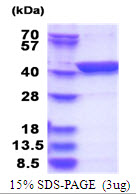

Human LANCL1 protein (Recombinant) (His-Tag) (STJP018832)
SPECIFICATIONS
HostE.coli
ImmunogenHuman
General Information
| Short Description | Recombinant-Human LANCL1-His-Tag protein was developed from e.coli and has a target region of His-Tag. For use in research applications. |
| Applications | SDS-PAGE |
| Host | E.coli |
| Note | STRICTLY FOR FURTHER SCIENTIFIC RESEARCH USE ONLY (RUO). MUST NOT TO BE USED IN DIAGNOSTIC OR THERAPEUTIC APPLICATIONS. |
Product Properties
| Concentration | 1 mg/mL |
| Formulation | Liquid in 20mM Tris-HCl buffer (pH 7.5) containing 0.15M NaCl, 20% Glycerol, 1mM DTT |
| Storage Instruction | For short term storage, keep at +2C to +8C for up to 1 week. For long term storage, aliquot and store at-20C, and avoid repeat freeze-thaw cycles. |
Target Information
| Gene Symbol | LANCL1 |
| Gene ID | 10314 |
| Uniprot ID | LANC1_HUMAN |
| Accession Number | NP_006046 |
| Immunogen | Human |
| Immunogen Region | 1-399aa |
| Immunogen Sequence |
Additional Info
| Tissue Specificity | Detected in erythrocytes, brain, kidney, testis, ovary, heart, lung, placenta and spleen (at protein level). Ubiquitous. Strongly expressed in brain, spinal cord, pituitary gland, kidney, heart, skeletal muscle, pancreas, ovary and testis. |
| Function | Functions as a glutathione transferase. Catalyzes conjugation of the glutathione (GSH) to artificial substrates 1-chloro-2,4-dinitrobenzene (CDNB) and p-nitrophenyl acetate. Mitigates neuronal oxidative stress during normal postnatal development and in response to oxidative stresses probably through GSH antioxidant defense mechanism. May play a role in EPS8 signaling. Binds glutathione. |
| Protein Name | Glutathione S-Transferase Lancl140 Kda Erythrocyte Membrane ProteinP40Lanc-Like Protein 1 |
| Database Links | |
| Cellular Localisation | CytoplasmCell MembranePeripheral Membrane Protein |
| Alternative Protein Names | Glutathione S-Transferase Lancl1 protein40 Kda Erythrocyte Membrane Protein proteinP40 proteinLanc-Like Protein 1 proteinLANCL1 proteinGPR69A protein |
Information sourced from Uniprot.org