



Human IL-1 beta/IL1B protein (Recombinant) (No-Tag) (STJP019680)
SPECIFICATIONS
HostE.coli
ImmunogenHuman
General Information
| Short Description | Recombinant-Human IL-1 beta/IL1B-No-Tag protein was developed from e.coli and has a target region of No-Tag. For use in research applications. |
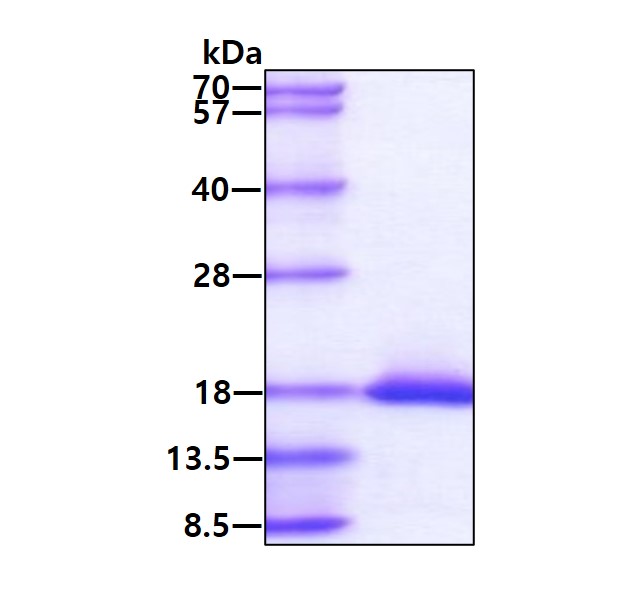
| Applications | SDS-PAGE/Bioactivity |
| Host | E.coli |
| Note | STRICTLY FOR FURTHER SCIENTIFIC RESEARCH USE ONLY (RUO). MUST NOT TO BE USED IN DIAGNOSTIC OR THERAPEUTIC APPLICATIONS. |
Product Properties
| Concentration | 1 mg/mL |
| Formulation | Liquid in phosphate-Buffered Saline (pH 7.4) |
| Storage Instruction | For short term storage, keep at +2C to +8C for up to 1 week. For long term storage, aliquot and store at-20C, and avoid repeat freeze-thaw cycles. |
| Endotoxin | < 1 EU per 1ug of protein (determined by LAL method) |
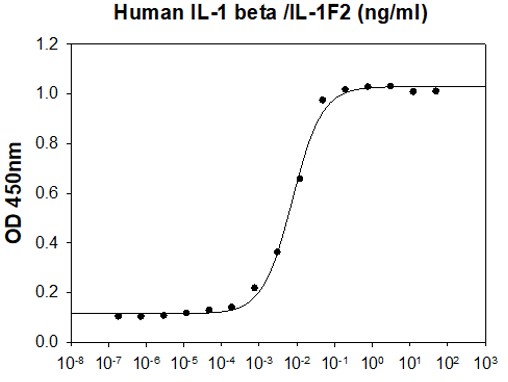
| Immunoreactivity | Measured in a cell proliferation assay using D10.G4.1 mouse helper T cells. The ED50 range ≤ 12pg/ml. |
Target Information
| Gene Symbol | IL1B |
| Gene ID | 3553 |
| Uniprot ID | IL1B_HUMAN |
| Accession Number | NP_000567.1 |
| Immunogen | Human |
| Immunogen Region | 117-269aa |
| Immunogen Sequence | MAPVRSLNCT LRDSQQKSLV MSGPYELKAL HLQGQDMEQQ VVFSMSFVQG EESNDKIPVA LGLKEKNLYL SCVLKDDKPT LQLESVDPKN YPKKKMEKRF VFNKIEINNK LEFESAQFPN WYISTSQAEN MPVFLGGTKG GQDITDFTMQ FVSS |
Additional Info
| Tissue Specificity | Expressed in activated monocytes/macrophages (at protein level). |
| Post Translational Modifications | Activation of the IL1B precursor involves a CASP1-catalyzed proteolytic cleavage. Processing and secretion are temporarily associated. (Microbial infection) Cleavage by S.pyogenes cysteine protease SpeB promotes its activation independently of CASP1. |
| Function | Potent pro-inflammatory cytokine. Initially discovered as the major endogenous pyrogen, induces prostaglandin synthesis, neutrophil influx and activation, T-cell activation and cytokine production, B-cell activation and antibody production, and fibroblast proliferation and collagen production. Promotes Th17 differentiation of T-cells. Synergizes with IL12/interleukin-12 to induce IFNG synthesis from T-helper 1 (Th1) cells. Plays a role in angiogenesis by inducing VEGF production synergistically with TNF and IL6. Involved in transduction of inflammation downstream of pyroptosis: its mature form is specifically released in the extracellular milieu by passing through the gasdermin-D (GSDMD) pore. Acts as a sensor of S.pyogenes infection in skin: cleaved and activated by pyogenes SpeB protease, leading to an inflammatory response that prevents bacterial growth during invasive skin infection. |
| Protein Name | Interleukin-1 BetaIl-1 BetaCatabolin |
| Database Links | Reactome: R-HSA-448706Reactome: R-HSA-5620971Reactome: R-HSA-5660668Reactome: R-HSA-6783783Reactome: R-HSA-6785807Reactome: R-HSA-9020702Reactome: R-HSA-9660826 |
| Cellular Localisation | CytoplasmCytosolSecretedLysosomeExtracellular ExosomeThe Precursor Is CytosolicIn Response To Inflammasome-Activating SignalsSuch As Atp For Nlrp3 Inflammasome Or Bacterial Flagellin For Nlrc4 InflammasomeCleaved And SecretedMature Form Is Secreted And Released In The Extracellular Milieu By Passing Through The Gasdermin-D (Gsdmd) PoreIn ContrastThe Precursor Form Is Not ReleasedDue To The Presence Of An Acidic Region That Is Proteolytically Removed By Casp1 During MaturationThe Secretion Is Dependent On Protein Unfolding And Facilitated By The Cargo Receptor Tmed10 |
| Alternative Protein Names | Interleukin-1 Beta proteinIl-1 Beta proteinCatabolin proteinIL1B proteinIL1F2 protein |
Information sourced from Uniprot.org