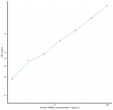
This IkBKg Sandwich ELISA Kit is an in-vitro enzyme-linked immunosorbent assay for the measurement of samples in human tissue homogenates, cell lysates or other biological fluids..
Applications
ELISA
Reactivity
Human
Sensitivity
0.67ng/mL
Detection Limit
1.56-100ng/mL
Note
STRICTLY FOR FURTHER SCIENTIFIC RESEARCH USE ONLY (RUO). MUST NOT TO BE USED IN DIAGNOSTIC OR THERAPEUTIC APPLICATIONS.
Product Properties
Storage Instruction
Store the unopened kit in the fridge at 2-8°C for up to 6 months. Once opened store individual kit contents according to components table provided with the kit.
tissue homogenates, cell lysates or other biological fluids.
Additional Info
Tissue Specificity
Heart, brain, placenta, lung, liver, skeletal muscle, kidney and pancreas.
Post Translational Modifications
Phosphorylation at Ser-68 attenuates aminoterminal homodimerization. Polyubiquitinated on Lys-285 via 'Lys-63'-linked ubiquitin.the ubiquitination is mediated downstream of NOD2 and RIPK2 and probably plays a role in signaling by facilitating interactions with ubiquitin domain-containing proteins and activates the NF-kappa-B pathway. Polyubiquitinated on Lys-285 and Lys-399 through 'Lys-63'-linked ubiquitin.the ubiquitination is mediated by BCL10, MALT1 and TRAF6 and probably plays a role in signaling by facilitating interactions with ubiquitin domain-containing proteins and activates the NF-kappa-B pathway. Monoubiquitinated on Lys-277 and Lys-309.promotes nuclear export. Polyubiquitinated through 'Lys-27' by TRIM23.involved in antiviral innate and inflammatory responses. Linear polyubiquitinated on Lys-111, Lys-143, Lys-226, Lys-246, Lys-264, Lys-277, Lys-285, Lys-292, Lys-302, Lys-309 and Lys-326.the head-to-tail polyubiquitination is mediated by the LUBAC complex and plays a key role in NF-kappa-B activation. Deubiquitinated by USP10 in a TANK-dependent and -independent manner, leading to the negative regulation of NF-kappa-B signaling upon DNA damage. Ubiquitinated at Lys-326 by MARCHF2 following bacterial and viral infection which leads to its degradation. Polyubiquitinated via 'Lys-29'-linked ubiquitin.leading to lysosomal degradation. Sumoylated on Lys-277 and Lys-309 with SUMO1.the modification results in phosphorylation of Ser-85 by ATM leading to a replacement of the sumoylation by mono-ubiquitination on these residues. Neddylated by TRIM40, resulting in stabilization of NFKBIA and down-regulation of NF-kappa-B activity. (Microbial infection) Cleaved by hepatitis A virus (HAV) protease 3C allowing the virus to disrupt the host innate immune signaling. (Microbial infection) Deubiquitinated by Epstein-Barr virus BPLF1 on both 'Lys-48' and 'Lys-63'-linked ubiquitin chains.leading to NF-kappa-B signaling inhibition. (Microbial infection) Polyubiquitinated on Lys-309 and Lys-321 via 'Lys-27'-linked ubiquitin by Shigella flexneri E3 ubiquitin-protein ligase ipah9.8, leading to its degradation by the proteasome. (Microbial infection) Polyubiquitination through 'Lys-63' is interrupted by interaction with SARS coronavirus-2/SARS-CoV-2 virus protein ORF9B which inhibits the NF-kappa-B pathway.
Function
Regulatory subunit of the IKK core complex which phosphorylates inhibitors of NF-kappa-B thus leading to the dissociation of the inhibitor/NF-kappa-B complex and ultimately the degradation of the inhibitor. Its binding to scaffolding polyubiquitin plays a key role in IKK activation by multiple signaling receptor pathways. Can recognize and bind both 'Lys-63'-linked and linear polyubiquitin upon cell stimulation, with a much higher affinity for linear polyubiquitin. Could be implicated in NF-kappa-B-mediated protection from cytokine toxicity. Essential for viral activation of IRF3. Involved in TLR3- and IFIH1-mediated antiviral innate response.this function requires 'Lys-27'-linked polyubiquitination. (Microbial infection) Also considered to be a mediator for HTLV-1 Tax oncoprotein activation of NF-kappa-B.