

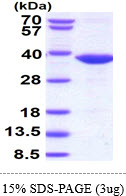

Human HNRNPK protein (Recombinant) (His-Tag) (STJP018296)
SPECIFICATIONS
HostE.coli
ImmunogenHuman
General Information
| Short Description | Recombinant-Human HNRNPK-His-Tag protein was developed from e.coli and has a target region of His-Tag. For use in research applications. |
| Applications | SDS-PAGE |
| Host | E.coli |
| Note | STRICTLY FOR FURTHER SCIENTIFIC RESEARCH USE ONLY (RUO). MUST NOT TO BE USED IN DIAGNOSTIC OR THERAPEUTIC APPLICATIONS. |
Product Properties
| Concentration | 1 mg/mL |
| Formulation | Liquid in 20mM Tris-HCl buffer (pH 8.0) containing 0.15M NaCl, 20% Glycerol, 1mM DTT |
| Storage Instruction | For short term storage, keep at +2C to +8C for up to 1 week. For long term storage, aliquot and store at-20C, and avoid repeat freeze-thaw cycles. |
Target Information
| Gene Symbol | HNRNPK |
| Gene ID | 3190 |
| Uniprot ID | HNRPK_HUMAN |
| Accession Number | NP_002131 |
| Immunogen | Human |
| Immunogen Region | 1-276aa |
| Immunogen Sequence | MGSSHHHHHH SSGLVPRGSH MGSMETEQPE ETFPNTETNG EFGKRPAEDM EEEQAFKRSR NTDEMVELRI LLQSKNAGAV IGKGGKNIKA LRTDYNASVS VPDSSGPERI LSISADIETI GEILKKIIPT LEEGLQLPSP TATSQLPLES DAVECLNYQH YKGSDFDCEL RLLIHQSLAG GIIGVKGAKI KELRENTQTT IKLFQECCPH STDRVVLIGG KPDRVVEC |
Additional Info
| Post Translational Modifications | Arg-296 and Arg-299 are dimethylated, probably to asymmetric dimethylarginine. Sumoylated by CBX4. Sumoylation is increased upon DNA damage, such as that produced by doxorubicin, etoposide, UV light and camptothecin, due to enhanced CBX4 phosphorylation by HIPK2 under these conditions. Ubiquitinated by MDM2. Doxorubicin treatment does not affect monoubiquitination, but slightly decreases HNRNPK poly-ubiquitination. O-glycosylated (O-GlcNAcylated), in a cell cycle-dependent manner. |
| Function | One of the major pre-mRNA-binding proteins. Binds tenaciously to poly(C) sequences. Likely to play a role in the nuclear metabolism of hnRNAs, particularly for pre-mRNAs that contain cytidine-rich sequences. Can also bind poly(C) single-stranded DNA. Plays an important role in p53/TP53 response to DNA damage, acting at the level of both transcription activation and repression. When sumoylated, acts as a transcriptional coactivator of p53/TP53, playing a role in p21/CDKN1A and 14-3-3 sigma/SFN induction. As far as transcription repression is concerned, acts by interacting with long intergenic RNA p21 (lincRNA-p21), a non-coding RNA induced by p53/TP53. This interaction is necessary for the induction of apoptosis, but not cell cycle arrest. As part of a ribonucleoprotein complex composed at least of ZNF827, HNRNPL and the circular RNA circZNF827 that nucleates the complex on chromatin, may negatively regulate the transcription of genes involved in neuronal differentiation. |
| Protein Name | Heterogeneous Nuclear Ribonucleoprotein KHnrnp KTransformation Up-Regulated Nuclear ProteinTunp |
| Database Links | Reactome: R-HSA-4570464Reactome: R-HSA-72163Reactome: R-HSA-72203Reactome: R-HSA-9610379 |
| Cellular Localisation | CytoplasmNucleusNucleoplasmCell ProjectionPodosomeRecruited To P53/Tp53-Responsive PromotersIn The Presence Of Functional P53/Tp53In Case Of Asfv InfectionThere Is A Shift In The Localization Which Becomes Predominantly Nuclear |
| Alternative Protein Names | Heterogeneous Nuclear Ribonucleoprotein K proteinHnrnp K proteinTransformation Up-Regulated Nuclear Protein proteinTunp proteinHNRNPK proteinHNRPK protein |
Information sourced from Uniprot.org