

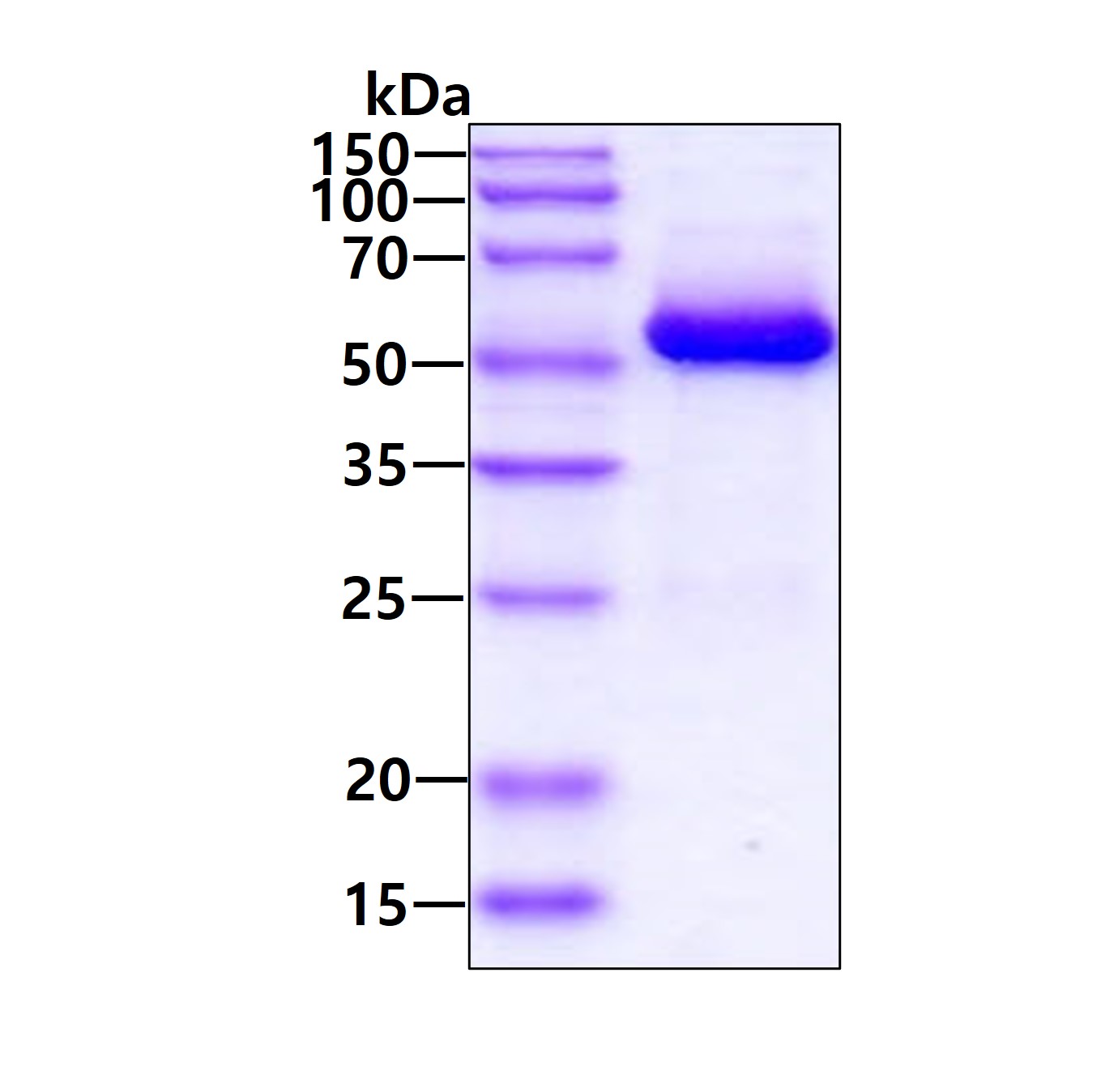

Human Hexokinase 4 protein (Recombinant) (His-Tag) (STJP019402)
SPECIFICATIONS
HostE.coli
ImmunogenHuman
General Information
| Short Description | Recombinant-Human Hexokinase 4-His-Tag protein was developed from e.coli and has a target region of His-Tag. For use in research applications. |
| Applications | SDS-PAGE/Enzyme Activity |
| Host | E.coli |
| Note | STRICTLY FOR FURTHER SCIENTIFIC RESEARCH USE ONLY (RUO). MUST NOT TO BE USED IN DIAGNOSTIC OR THERAPEUTIC APPLICATIONS. |
Product Properties
| Concentration | 1 mg/mL |
| Formulation | Liquid in 20mM Tris-HCl buffer (pH 8.0) containing 10% Glycerol |
| Storage Instruction | For short term storage, keep at +2C to +8C for up to 1 week. For long term storage, aliquot and store at-20C, and avoid repeat freeze-thaw cycles. |
| Endotoxin | < 1 EU per 1ug of protein (determined by LAL method) |
| Immunoreactivity | Specific activity is > 2, 000pmol/min/ug. One unit will convert 1pmole of D-Glucose to D-Glucose-6-phosphate per minute at pH8.0 at 37C. |
Target Information
| Gene Symbol | GCK |
| Gene ID | 2645 |
| Uniprot ID | HXK4_HUMAN |
| Accession Number | NP_000153 |
| Immunogen | Human |
| Immunogen Region | 1-465aa |
| Immunogen Sequence |
Additional Info
| Function | Catalyzes the phosphorylation of hexose, such as D-glucose, D-fructose and D-mannose, to hexose 6-phosphate (D-glucose 6-phosphate, D-fructose 6-phosphate and D-mannose 6-phosphate, respectively). Compared to other hexokinases, has a weak affinity for D-glucose, and is effective only when glucose is abundant. Mainly expressed in pancreatic beta cells and the liver and constitutes a rate-limiting step in glucose metabolism in these tissues. Since insulin secretion parallels glucose metabolism and the low glucose affinity of GCK ensures that it can change its enzymatic activity within the physiological range of glucose concentrations, GCK acts as a glucose sensor in the pancreatic beta cell. In pancreas, plays an important role in modulating insulin secretion. In liver, helps to facilitate the uptake and conversion of glucose by acting as an insulin-sensitive determinant of hepatic glucose usage. Required to provide D-glucose 6-phosphate for the synthesis of glycogen. Mediates the initial step of glycolysis by catalyzing phosphorylation of D-glucose to D-glucose 6-phosphate. |
| Protein Name | Hexokinase-4Hk4GlucokinaseHexokinase Type IvHk IvHexokinase-D |
| Database Links | Reactome: R-HSA-170822Reactome: R-HSA-210745Reactome: R-HSA-5619073Reactome: R-HSA-5619107Reactome: R-HSA-70171Reactome: R-HSA-9615017 |
| Cellular Localisation | CytoplasmNucleusMitochondrionUnder Low Glucose ConcentrationsGck Associates With Gckr And The Inactive Complex Is Recruited To The Hepatocyte Nucleus |
| Alternative Protein Names | Hexokinase-4 proteinHk4 proteinGlucokinase proteinHexokinase Type Iv proteinHk Iv proteinHexokinase-D proteinGCK protein |
Information sourced from Uniprot.org