

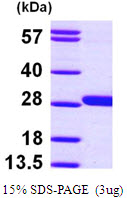

Human Glutathione S-transferase mu 4/GSTM4 protein (Recombinant) (His-Tag) (STJP016789)
SPECIFICATIONS
HostE.coli
ImmunogenHuman
General Information
| Short Description | Recombinant-Human Glutathione S-transferase mu 4/GSTM4-His-Tag protein was developed from e.coli and has a target region of His-Tag. For use in research applications. |
| Applications | SDS-PAGE |
| Host | E.coli |
| Note | STRICTLY FOR FURTHER SCIENTIFIC RESEARCH USE ONLY (RUO). MUST NOT TO BE USED IN DIAGNOSTIC OR THERAPEUTIC APPLICATIONS. |
Product Properties
| Concentration | 1 mg/mL |
| Formulation | Liquid in 20mM Tris-HCl buffer (pH 8.0) containing 1mM DTT, 10% Glycerol, 50mM NaCl |
| Storage Instruction | For short term storage, keep at +2C to +8C for up to 1 week. For long term storage, aliquot and store at-20C, and avoid repeat freeze-thaw cycles. |
Target Information
| Gene Symbol | GSTM4 |
| Gene ID | 2948 |
| Uniprot ID | GSTM4_HUMAN |
| Accession Number | NP_000841 |
| Immunogen | Human |
| Immunogen Region | 1-218aa |
| Immunogen Sequence | MGSSHHHHHH SSGLVPRGSH MSMTLGYWDI RGLAHAIRLL LEYTDSSYEE KKYTMGDAPD YDRSQWLNEK FKLGLDFPNL PYLIDGAHKI TQSNAILCYI ARKHNLCGET EEEKIRVDIL ENQAMDVSNQ LARVCYSPDF EKLKPEYLEE LPTMMQHFSQ FLGKRPWFVG DKITFVDFLA YDVLDLHRIF EPNCLDAFPN LKDFISRFEG LEKISAYMKS SRFLPKPL |
Additional Info
| Tissue Specificity | Expressed in a wide variety of tissues. |
| Function | Conjugation of reduced glutathione to a wide number of exogenous and endogenous hydrophobic electrophiles. Catalyzes the conjugation of leukotriene A4 with reduced glutathione (GSH) to form leukotriene C4. Can also catalyze the transfer of a glutathionyl group from glutathione (GSH) to 13(S),14(S)-epoxy-docosahexaenoic acid to form maresin conjugate in tissue regeneration 1 (MCTR1), a bioactive lipid mediator that possess potent anti-inflammatory and proresolving actions. |
| Protein Name | Glutathione S-Transferase Mu 4Gst Class-Mu 4Gst-Mu2Gstm4-4Leukotriene C4 Synthase Gstm4 |
| Database Links | Reactome: R-HSA-156590Reactome: R-HSA-9026762 |
| Cellular Localisation | Cytoplasm |
| Alternative Protein Names | Glutathione S-Transferase Mu 4 proteinGst Class-Mu 4 proteinGst-Mu2 proteinGstm4-4 proteinLeukotriene C4 Synthase Gstm4 proteinGSTM4 protein |
Information sourced from Uniprot.org