

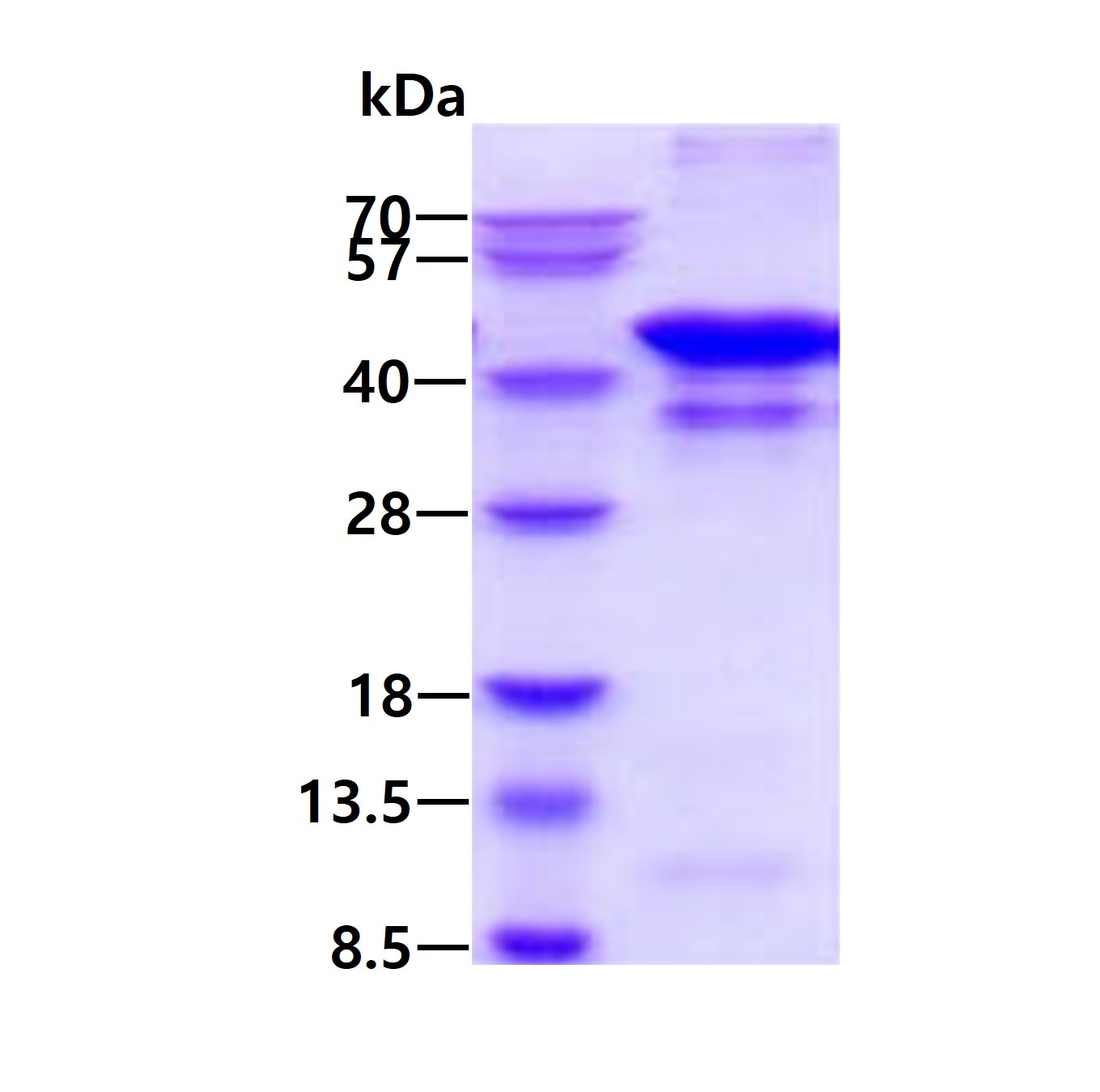

Human Glutamine synthetase/GLUL protein (Recombinant) (No-Tag) (STJP019284)
SPECIFICATIONS
HostE.coli
ImmunogenHuman
General Information
| Short Description | Recombinant-Human Glutamine synthetase/GLUL-No-Tag protein was developed from e.coli and has a target region of No-Tag. For use in research applications. |
| Applications | SDS-PAGE/Enzyme Activity |
| Host | E.coli |
| Note | STRICTLY FOR FURTHER SCIENTIFIC RESEARCH USE ONLY (RUO). MUST NOT TO BE USED IN DIAGNOSTIC OR THERAPEUTIC APPLICATIONS. |
Product Properties
| Concentration | 1 mg/mL |
| Formulation | Liquid in 20mM Tris-HCl buffer (pH 8.0) containing 10% Glycerol, 1mM DTT, 0.1mM PMSF |
| Storage Instruction | For short term storage, keep at +2C to +8C for up to 1 week. For long term storage, aliquot and store at-20C, and avoid repeat freeze-thaw cycles. |
| Immunoreactivity | Specific activity is > 2.000pmol/min/ug, and is defined as the amount of enzyme that convert L-glutamate to L-glutamine per miunte at pH 7.5 at 37C in coupled system with PK/LDH. |
Target Information
| Gene Symbol | GLUL |
| Gene ID | 2752 |
| Uniprot ID | GLNA_HUMAN |
| Accession Number | NP_001028216.1 |
| Immunogen | Human |
| Immunogen Region | 1-373aa |
| Immunogen Sequence | MTTSASSHLN KGIKQVYMSL PQGEKVQAMY IWIDGTGEGL RCKTRTLDSE PKCVEELPEW NFDGSSTLQS EGSNSDMYLV PAAMFRDPFR KDPNKLVLCE VFKYNRRPAE TNLRHTCKRI MDMVSNQHPW FGMEQEYTLM GTDGHPFGWP SNGFPGPQGP YYCGVGADRA YGRDIVEAHY RACLYAGVKI AGTNAEVMPA QWEFQIGPCE GISMGDHLWV ARFILHRV |
Additional Info
| Tissue Specificity | Expressed in endothelial cells. |
| Post Translational Modifications | Acetylated by EP300/p300.acetylation is stimulated by increased glutamine levels and promotes ubiquitin-mediated proteasomal degradation. Palmitoylated.undergoes autopalmitoylation. Ubiquitinated by ZNRF1. Ubiquitinated by the DCX (DDB1-CUL4-X-box) E3 ubiquitin-protein ligase complex called CRL4(CRBN), leading to proteasomal degradation. |
| Function | Glutamine synthetase that catalyzes the ATP-dependent conversion of glutamate and ammonia to glutamine. Its role depends on tissue localization: in the brain, it regulates the levels of toxic ammonia and converts neurotoxic glutamate to harmless glutamine, whereas in the liver, it is one of the enzymes responsible for the removal of ammonia. Plays a key role in ammonium detoxification during erythropoiesis: the glutamine synthetase activity is required to remove ammonium generated by porphobilinogen deaminase (HMBS) during heme biosynthesis to prevent ammonium accumulation and oxidative stress. Essential for proliferation of fetal skin fibroblasts. Independently of its glutamine synthetase activity, required for endothelial cell migration during vascular development: acts by regulating membrane localization and activation of the GTPase RHOJ, possibly by promoting RHOJ palmitoylation. May act as a palmitoyltransferase for RHOJ: able to autopalmitoylate and then transfer the palmitoyl group to RHOJ. Plays a role in ribosomal 40S subunit biogenesis. Through the interaction with BEST2, inhibits BEST2 channel activity by affecting the gating at the aperture in the absence of intracellular L-glutamate, but sensitizes BEST2 to intracellular L-glutamate, which promotes the opening of BEST2 and thus relieves its inhibitory effect on BEST2. |
| Protein Name | Glutamine SynthetaseGsGlutamate--Ammonia LigasePalmitoyltransferase Glul |
| Database Links | Reactome: R-HSA-210455Reactome: R-HSA-8964539 |
| Cellular Localisation | CytoplasmCytosolMicrosomeMitochondrionCell MembraneLipid-AnchorMainly Localizes In The CytosolWith A Fraction Associated With The Cell Membrane |
| Alternative Protein Names | Glutamine Synthetase proteinGs proteinGlutamate--Ammonia Ligase proteinPalmitoyltransferase Glul proteinGLUL proteinGLNS protein |
Information sourced from Uniprot.org