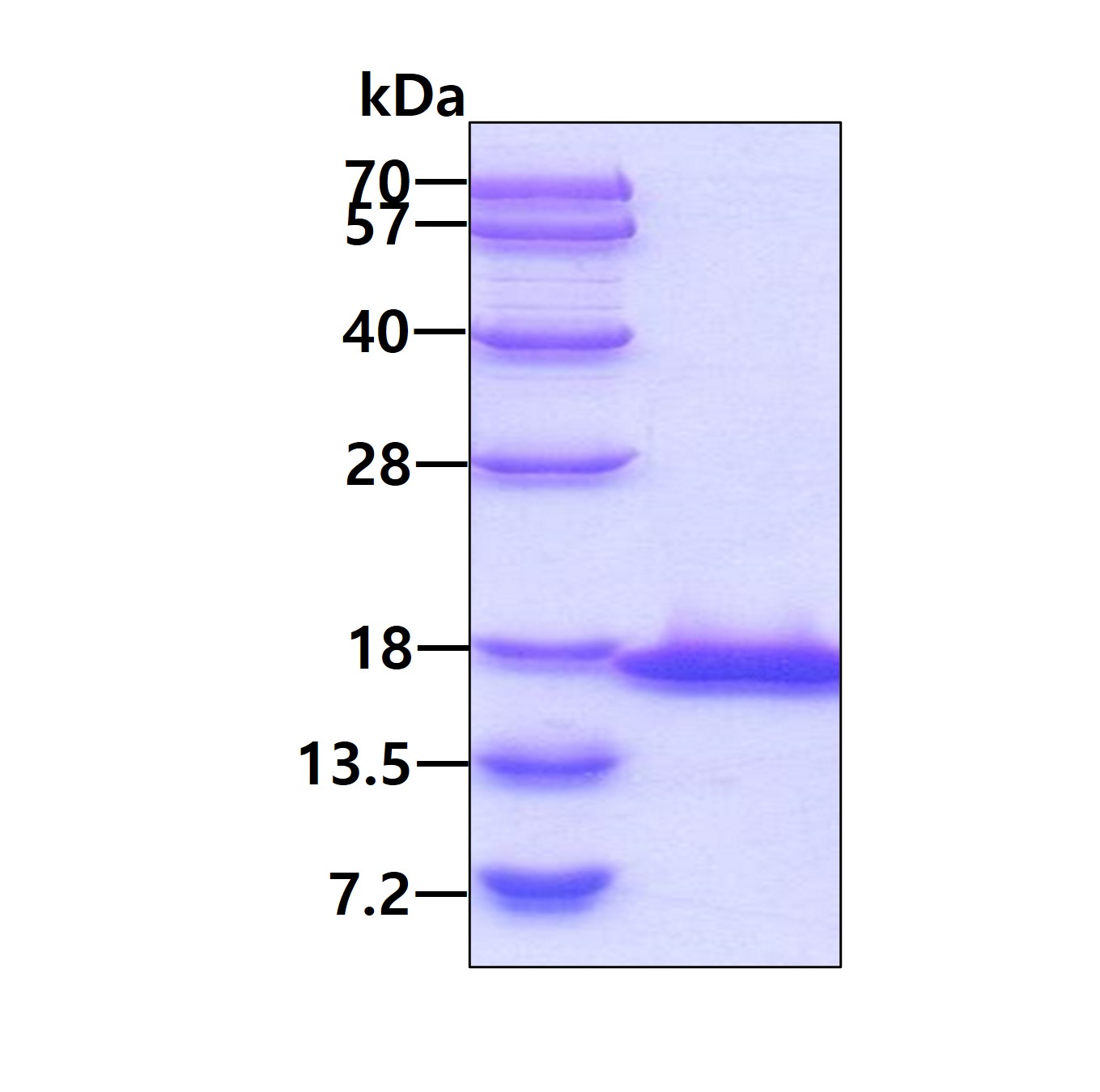
| Short Description : | Recombinant-Human FGF basic/FGF-2-No-Tag protein was developed from e.coli and has a target region of No-Tag. For use in research applications. |
| Applications: | SDS-PAGE/Bioactivity |
| Host: | E.coli |
| Note: | STRICTLY FOR FURTHER SCIENTIFIC RESEARCH USE ONLY (RUO). MUST NOT TO BE USED IN DIAGNOSTIC OR THERAPEUTIC APPLICATIONS. |
| Concentration: | 1 mg/mL |
| Formulation: | Liquid in 50mM Tris-HCl buffer (pH 8.0) |
| Storage Instruction: | For short term storage, keep at +2C to +8C for up to 1 week. For long term storage, aliquot and store at-20C, and avoid repeat freeze-thaw cycles. |
| Endotoxin: | < 1 EU per 1ug of protein (determined by LAL method) |
| Immunoreactivity: | Measured in a cell proliferation assay using Balb/3T3 mouse embryonic fibroblast cells in the presence of 10 ug/ml of heparin. The ED50 range ≤ 0.2 ng/ml. |
| Gene Symbol: | FGF2 |
| Gene ID: | 2247 |
| Uniprot ID: | FGF2_HUMAN |
| Accession Number: | NP_001997.5 |
| Immunogen: | Human |
| Immunogen Region: | 143-288aa |
| Immunogen Sequence: | MPALPEDGGS GAFPPGHFKD PKRLYCKNGG FFLRIHPDGR VDGVREKSDP HIKLQLQAEE RGVVSIKGVC ANRYLAMKED GRLLASKCVT DECFFFERLE SNNYNTYRSR KYTSWYVALK RTGQYKLGSK TGPGQKAILF LPMSAKS |
| Tissue Specificity | Expressed in granulosa and cumulus cells. Expressed in hepatocellular carcinoma cells, but not in non-cancerous liver tissue. |
| Post Translational Modifications | Phosphorylation at Tyr-215 regulates FGF2 unconventional secretion. Several N-termini starting at positions 94, 125, 126, 132, 143 and 162 have been identified by direct sequencing. |
| Function | Acts as a ligand for FGFR1, FGFR2, FGFR3 and FGFR4. Also acts as an integrin ligand which is required for FGF2 signaling. Binds to integrin ITGAV:ITGB3. Plays an important role in the regulation of cell survival, cell division, cell differentiation and cell migration. Functions as a potent mitogen in vitro. Can induce angiogenesis. Mediates phosphorylation of ERK1/2 and thereby promotes retinal lens fiber differentiation. |
| Protein Name | Fibroblast Growth Factor 2Fgf-2Basic Fibroblast Growth FactorBfgfHeparin-Binding Growth Factor 2Hbgf-2 |
| Database Links | Reactome: R-HSA-109704Reactome: R-HSA-1257604Reactome: R-HSA-1839122Reactome: R-HSA-1839130Reactome: R-HSA-190322Reactome: R-HSA-190370Reactome: R-HSA-190372Reactome: R-HSA-190373Reactome: R-HSA-190375Reactome: R-HSA-190377Reactome: R-HSA-2033519Reactome: R-HSA-2219530Reactome: R-HSA-2892247Reactome: R-HSA-3000170Reactome: R-HSA-3000171Reactome: R-HSA-5654219Reactome: R-HSA-5654221Reactome: R-HSA-5654227Reactome: R-HSA-5654228Reactome: R-HSA-5654687Reactome: R-HSA-5654688Reactome: R-HSA-5654689Reactome: R-HSA-5654693Reactome: R-HSA-5654695Reactome: R-HSA-5654699Reactome: R-HSA-5654700Reactome: R-HSA-5654704Reactome: R-HSA-5654706Reactome: R-HSA-5654710Reactome: R-HSA-5654712Reactome: R-HSA-5654719Reactome: R-HSA-5654720Reactome: R-HSA-5654726Reactome: R-HSA-5654727Reactome: R-HSA-5654732Reactome: R-HSA-5654733Reactome: R-HSA-5655253Reactome: R-HSA-5655302Reactome: R-HSA-5655332Reactome: R-HSA-5658623Reactome: R-HSA-5673001Reactome: R-HSA-6785807Reactome: R-HSA-6811558Reactome: R-HSA-8851708Reactome: R-HSA-9761174Reactome: R-HSA-9830364Reactome: R-HSA-9839397Reactome: R-HSA-9925561 |
| Cellular Localisation | SecretedNucleusExported From Cells By An Endoplasmic Reticulum (Er)/Golgi-Independent MechanismUnconventional Secretion Of Fgf2 Occurs By Direct Translocation Across The Plasma MembraneBinding Of Exogenous Fgf2 To Fgfr Facilitates Endocytosis Followed By Translocation Of Fgf2 Across Endosomal Membrane Into The CytosolNuclear Import From The Cytosol Requires The Classical Nuclear Import MachineryInvolving Proteins Kpna1 And Kpnb1As Well As Cep57 |
| Alternative Protein Names | Fibroblast Growth Factor 2 proteinFgf-2 proteinBasic Fibroblast Growth Factor proteinBfgf proteinHeparin-Binding Growth Factor 2 proteinHbgf-2 proteinFGF2 proteinFGFB protein |
Information sourced from Uniprot.org