

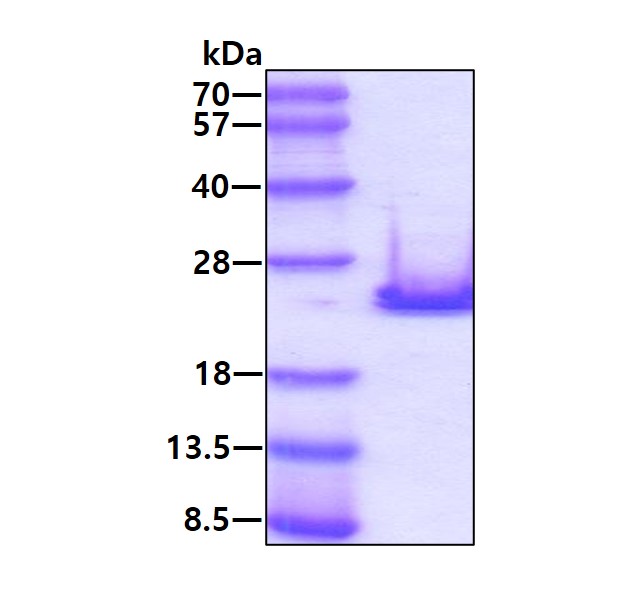

Human FGF-10 protein (Recombinant) (His-Tag) (STJP017510)
SPECIFICATIONS
HostE.coli
ImmunogenHuman
General Information
| Short Description | Recombinant-Human FGF-10-His-Tag protein was developed from e.coli and has a target region of His-Tag. For use in research applications. |
| Applications | SDS-PAGE |
| Host | E.coli |
| Note | STRICTLY FOR FURTHER SCIENTIFIC RESEARCH USE ONLY (RUO). MUST NOT TO BE USED IN DIAGNOSTIC OR THERAPEUTIC APPLICATIONS. |
Product Properties
| Concentration | 0.25 mg/mL |
| Formulation | Liquid in 20mM Tris-HCl buffer (pH 8.0) containing 50% Glycerol, 0.2M NaCl, 2mM DTT, 2mM EDTA |
| Storage Instruction | For short term storage, keep at +2C to +8C for up to 1 week. For long term storage, aliquot and store at-20C, and avoid repeat freeze-thaw cycles. |
| Endotoxin | < 1 EU per 1ug of protein (determined by LAL method) |
Target Information
| Gene Symbol | FGF10 |
| Gene ID | 2255 |
| Uniprot ID | FGF10_HUMAN |
| Accession Number | NP_004456.1 |
| Immunogen | Human |
| Immunogen Region | 38-208aa |
| Immunogen Sequence |
Additional Info
| Function | Plays an important role in the regulation of embryonic development, cell proliferation and cell differentiation. Required for normal branching morphogenesis. May play a role in wound healing. |
| Protein Name | Fibroblast Growth Factor 10Fgf-10Keratinocyte Growth Factor 2 |
| Database Links | Reactome: R-HSA-109704Reactome: R-HSA-1257604Reactome: R-HSA-190370Reactome: R-HSA-190377Reactome: R-HSA-2033519Reactome: R-HSA-210747Reactome: R-HSA-2219530Reactome: R-HSA-5654219Reactome: R-HSA-5654221Reactome: R-HSA-5654687Reactome: R-HSA-5654688Reactome: R-HSA-5654689Reactome: R-HSA-5654693Reactome: R-HSA-5654695Reactome: R-HSA-5654699Reactome: R-HSA-5654700Reactome: R-HSA-5654726Reactome: R-HSA-5654727Reactome: R-HSA-5655253Reactome: R-HSA-5658623Reactome: R-HSA-5673001Reactome: R-HSA-6811558Reactome: R-HSA-9925561 |
| Cellular Localisation | Secreted |
| Alternative Protein Names | Fibroblast Growth Factor 10 proteinFgf-10 proteinKeratinocyte Growth Factor 2 proteinFGF10 protein |
Information sourced from Uniprot.org