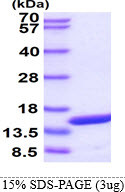
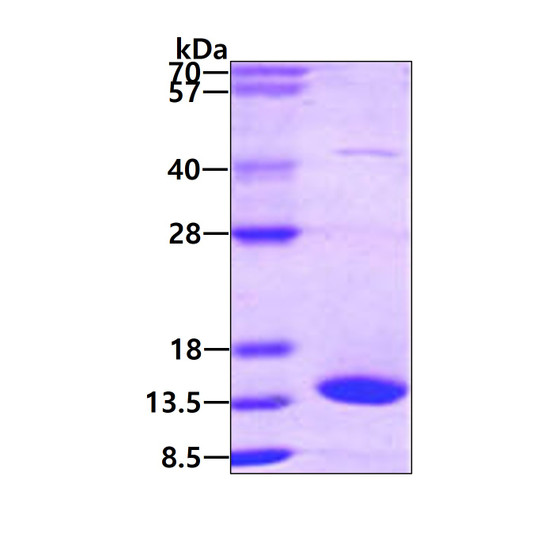
| Short Description : | Recombinant-Human FABP4/A-FABP/ALBP-No tag protein was developed in e.coli using the region Cys2-Ala132. For use in research applications. |
| Host: | E.coli |
| Note: | STRICTLY FOR FURTHER SCIENTIFIC RESEARCH USE ONLY (RUO). MUST NOT TO BE USED IN DIAGNOSTIC OR THERAPEUTIC APPLICATIONS. |
| Conjugation: | Unconjugated |
| Formulation: | Lyophilised from a 0.22 Mu m filtered solution of PBS, pH 7.4. |
| Storage Instruction: | Store at-20°C for up to 1 year from the date of receipt, and avoid repeat freeze-thaw cycles. |
| Determination Method: | < 0.1 EU/Mu g of the protein by LAL method. |
| Gene Symbol: | FABP4 |
| Gene ID: | 2167 |
| Uniprot ID: | FABP4_HUMAN |
| Immunogen: | Recombinant Human FABP4/A-FABP/ALBP Protein is produced by E. coli expression system. The target protein is expressed with sequence (Cys2-Ala132) of human FABP4 (Accession #NP_001433.1). |
| Immunogen Region: | Cys2-Ala132 |
| Immunogen Sequence: | CDAFVGTWKLVSSENFDDYM KEVGVGFATRKVAGMAKPNM IISVNGDVITIKSESTFKNT EISFILGQEFDEVTADDRKV KSTITLDGGVLVHVQKWDGK STTIKRKREDDKLVVECVMK GVTSTRVYERA |
| Function | Lipid transport protein in adipocytes. Binds both long chain fatty acids and retinoic acid. Delivers long-chain fatty acids and retinoic acid to their cognate receptors in the nucleus. |
| Protein Name | Fatty Acid-Binding Protein - AdipocyteAdipocyte Lipid-Binding ProteinAlbpAdipocyte-Type Fatty Acid-Binding ProteinA-FabpAfabpFatty Acid-Binding Protein 4 |
| Database Links | Reactome: R-HSA-163560Reactome: R-HSA-381340Reactome: R-HSA-9841922 |
| Cellular Localisation | CytoplasmNucleusDepending On The Nature Of The LigandA Conformation Change Exposes A Nuclear Localization Motif And The Protein Is Transported Into The NucleusSubject To Constitutive Nuclear Export |
| Alternative Protein Names | Fatty Acid-Binding Protein - Adipocyte proteinAdipocyte Lipid-Binding Protein proteinAlbp proteinAdipocyte-Type Fatty Acid-Binding Protein proteinA-Fabp proteinAfabp proteinFatty Acid-Binding Protein 4 proteinFABP4 protein |
Information sourced from Uniprot.org