

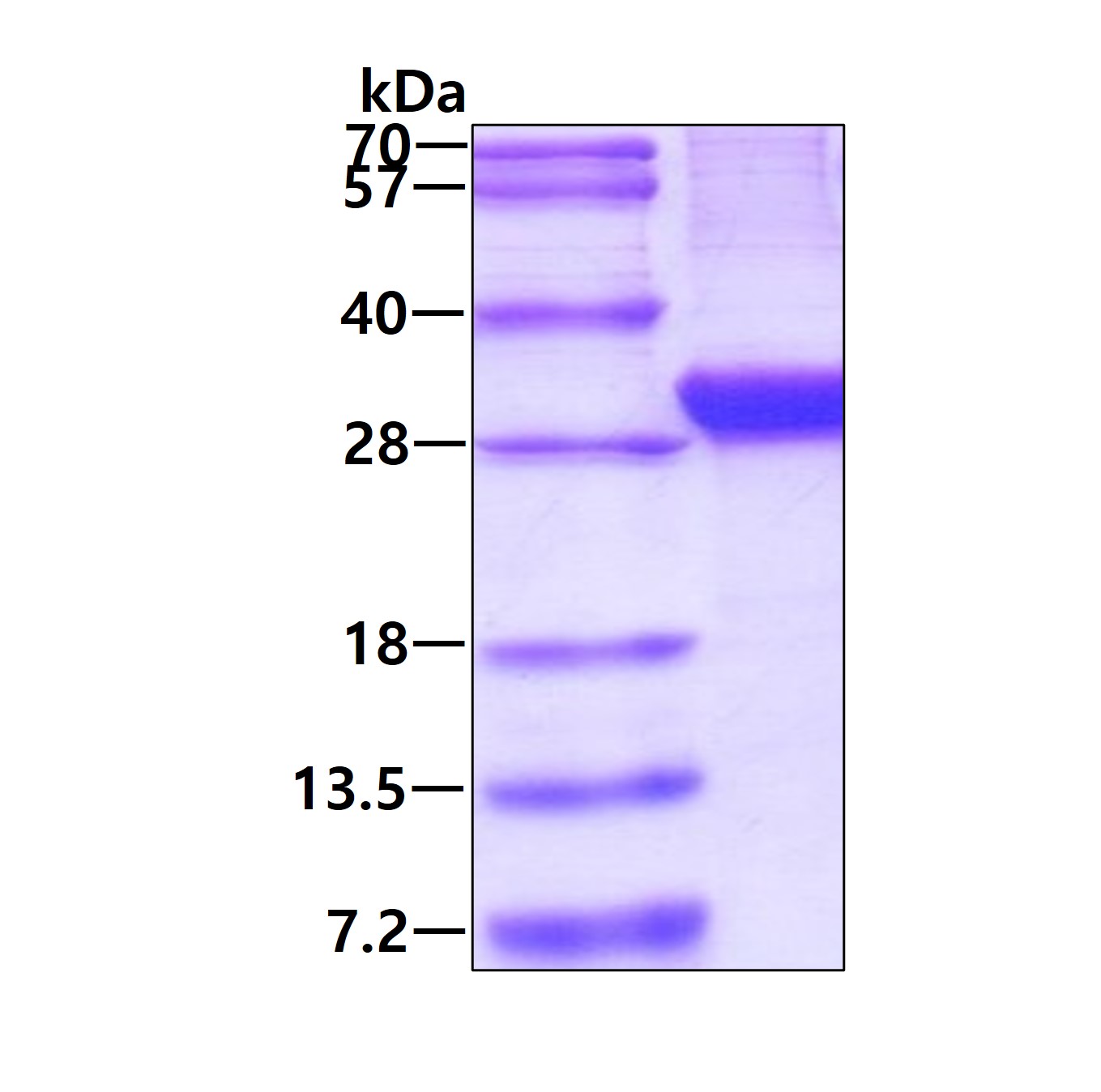

Human Ephrin-B1 protein (Recombinant) (His-Tag) (STJP017320)
SPECIFICATIONS
HostE.coli
ImmunogenHuman
General Information
| Short Description | Recombinant-Human Ephrin-B1-His-Tag protein was developed from e.coli and has a target region of His-Tag. For use in research applications. |
| Applications | SDS-PAGE/Denatured |
| Host | E.coli |
| Note | STRICTLY FOR FURTHER SCIENTIFIC RESEARCH USE ONLY (RUO). MUST NOT TO BE USED IN DIAGNOSTIC OR THERAPEUTIC APPLICATIONS. |
Product Properties
| Concentration | 1 mg/mL |
| Formulation | Liquid in 20mM Tris-HCl buffer (pH 8.0) containing 0.4M urea, 5% Glycerol |
| Storage Instruction | For short term storage, keep at +2C to +8C for up to 1 week. For long term storage, aliquot and store at-20C, and avoid repeat freeze-thaw cycles. |
Target Information
| Gene Symbol | EFNB1 |
| Gene ID | 1947 |
| Uniprot ID | EFNB1_HUMAN |
| Accession Number | NP_004420 |
| Immunogen | Human |
| Immunogen Region | 28-237aa |
| Immunogen Sequence |
Additional Info
| Tissue Specificity | Widely expressed. Detected in both neuronal and non-neuronal tissues. Seems to have particularly strong expression in retina, sciatic nerve, heart and spinal cord. |
| Post Translational Modifications | Inducible phosphorylation of tyrosine residues in the cytoplasmic domain. Proteolytically processed. The ectodomain is cleaved, probably by a metalloprotease, to produce a membrane-tethered C-terminal fragment. This fragment is then further processed by the gamma-secretase complex to yield a soluble intracellular domain peptide which can translocate to the nucleus. The intracellular domain peptide is highly labile suggesting that it is targeted for degradation by the proteasome. |
| Function | Cell surface transmembrane ligand for Eph receptors, a family of receptor tyrosine kinases which are crucial for migration, repulsion and adhesion during neuronal, vascular and epithelial development. Binding to Eph receptors residing on adjacent cells leads to contact-dependent bidirectional signaling into neighboring cells. Shows high affinity for the receptor tyrosine kinase EPHB1/ELK. Can also bind EPHB2 and EPHB3. Binds to, and induces collapse of, commissural axons/growth cones in vitro. May play a role in constraining the orientation of longitudinally projecting axons. |
| Protein Name | Ephrin-B1Efl-3Elk LigandElk-LEph-Related Receptor Tyrosine Kinase Ligand 2Lerk-2 Cleaved Into - Ephrin-B1 C-Terminal FragmentEphrin-B1 Ctf - Ephrin-B1 Intracellular DomainEphrin-B1 Icd |
| Database Links | Reactome: R-HSA-2682334Reactome: R-HSA-3928662Reactome: R-HSA-3928664Reactome: R-HSA-3928665 |
| Cellular Localisation | Cell MembraneSingle-Pass Type I Membrane ProteinMembrane RaftMay Recruit Grip1 And Grip2 To Membrane Raft DomainsEphrin-B1 C-Terminal Fragment: Cell MembraneEphrin-B1 Intracellular Domain: NucleusColocalizes With Zhx2 In The Nucleus |
| Alternative Protein Names | Ephrin-B1 proteinEfl-3 proteinElk Ligand proteinElk-L proteinEph-Related Receptor Tyrosine Kinase Ligand 2 proteinLerk-2 Cleaved Into - Ephrin-B1 C-Terminal Fragment proteinEphrin-B1 Ctf - Ephrin-B1 Intracellular Domain proteinEphrin-B1 Icd proteinEFNB1 proteinEFL3 proteinEPLG2 proteinLERK2 protein |
Information sourced from Uniprot.org