



Human Ephrin-A5/EFNA5 protein (Recombinant) (C-hFc&His) (STJP000951)
SPECIFICATIONS
HostHEK293 cells
ConjugationUnconjugated
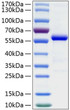
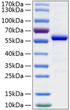
ImmunogenRecombinant Human Ephrin-A5/EFNA5 Protein is produced by HEK293 expression system. The target protein is expressed with sequence (Gln21-Asn203) of human Ephrin-A5/EFNA5 (Accession #NP_001953.1) fused with an Fc, 6×His tag at the C-terminus.
General Information
| Short Description | Recombinant-Human Ephrin-A5/EFNA5-C-hFc&His protein was developed in hek293 cells using the region Gln21-Asn203. For use in research applications. |
| Host | HEK293 cells |
| Note | STRICTLY FOR FURTHER SCIENTIFIC RESEARCH USE ONLY (RUO). MUST NOT TO BE USED IN DIAGNOSTIC OR THERAPEUTIC APPLICATIONS. |
Product Properties
| Conjugation | Unconjugated |
| Formulation | Lyophilised from a 0.22 Mu m filtered solution of PBS, pH 7.4. |
| Storage Instruction | Store at-20°C for up to 1 year from the date of receipt, and avoid repeat freeze-thaw cycles. |
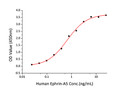
| Immunoreactivity | Measured by its binding ability in a functional ELISA. Immobilized Human EPHA2 at 0.5 Mu g/mL (100 Mu L/well) can bind Human EFNA5 with a linear range of 0.02-0.67 ng/mL. |
| Determination Method | < 0.1 EU/Mu g of the protein by LAL method. |
Target Information
| Gene Symbol | EFNA5 |
| Gene ID | 1946 |
| Uniprot ID | EFNA5_HUMAN |
| Immunogen | Recombinant Human Ephrin-A5/EFNA5 Protein is produced by HEK293 expression system. The target protein is expressed with sequence (Gln21-Asn203) of human Ephrin-A5/EFNA5 (Accession #NP_001953.1) fused with an Fc, 6×His tag at the C-terminus. |
| Immunogen Region | Gln21-Asn203 |
| Immunogen Sequence | QDPGSKAVADRYAVYWNSSN PRFQRGDYHIDVCINDYLDV FCPHYEDSVPEDKTERYVLY MVNFDGYSACDHTSKGFKRW ECNRPHSPNGPLKFSEKFQL FTPFSLGFEFRPGREYFYIS SAIPDNGRRSCLKLKVFVRP TNSCMKTIGVHDRVFDVNDK VENSLEPADDTVHESAEPSR GEN |
Additional Info
| Function | Cell surface GPI-bound ligand for Eph receptors, a family of receptor tyrosine kinases which are crucial for migration, repulsion and adhesion during neuronal, vascular and epithelial development. Binds promiscuously Eph receptors residing on adjacent cells, leading to contact-dependent bidirectional signaling into neighboring cells. The signaling pathway downstream of the receptor is referred to as forward signaling while the signaling pathway downstream of the ephrin ligand is referred to as reverse signaling. Induces compartmentalized signaling within a caveolae-like membrane microdomain when bound to the extracellular domain of its cognate receptor. This signaling event requires the activity of the Fyn tyrosine kinase. Activates the EPHA3 receptor to regulate cell-cell adhesion and cytoskeletal organization. With the receptor EPHA2 may regulate lens fiber cells shape and interactions and be important for lens transparency maintenance. May function actively to stimulate axon fasciculation. The interaction of EFNA5 with EPHA5 also mediates communication between pancreatic islet cells to regulate glucose-stimulated insulin secretion. Cognate/functional ligand for EPHA7, their interaction regulates brain development modulating cell-cell adhesion and repulsion. |
| Protein Name | Ephrin-A5Al-1Eph-Related Receptor Tyrosine Kinase Ligand 7Lerk-7 |
| Database Links | Reactome: R-HSA-2682334Reactome: R-HSA-3928663Reactome: R-HSA-3928665 |
| Cellular Localisation | Cell MembraneLipid-AnchorGpi-AnchorMembraneCaveolaCompartmentalized In Discrete Caveolae-Like Membrane Microdomains |
| Alternative Protein Names | Ephrin-A5 proteinAl-1 proteinEph-Related Receptor Tyrosine Kinase Ligand 7 proteinLerk-7 proteinEFNA5 proteinEPLG7 proteinLERK7 protein |
Information sourced from Uniprot.org