

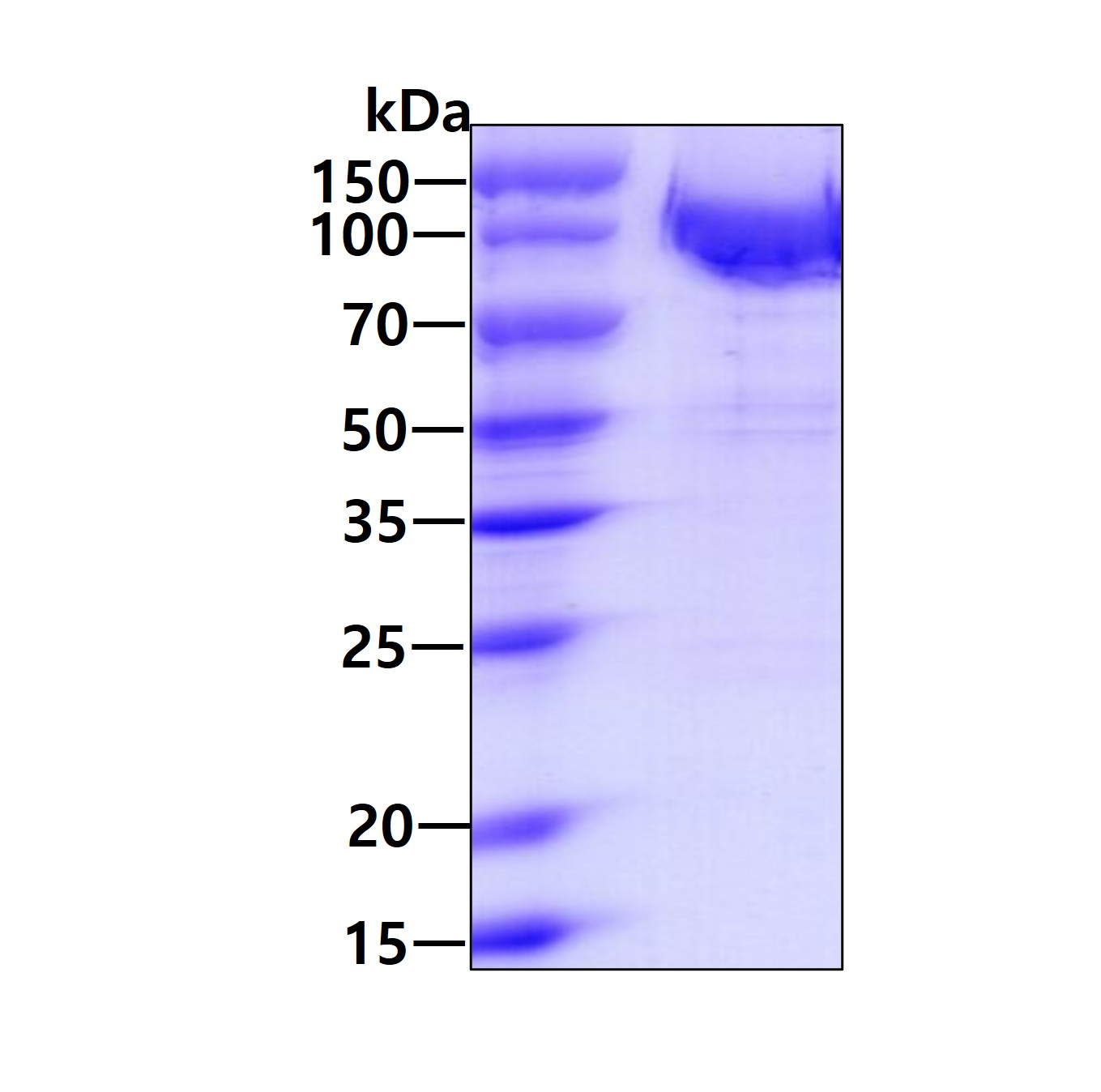

Human ENPP-2/Autotaxin protein (Recombinant) (His-Tag) (STJP019489)
SPECIFICATIONS
HostHEK293 Cells
ImmunogenHuman
General Information
| Short Description | Recombinant-Human ENPP-2/Autotaxin-His-Tag protein was developed from hek293 cells and has a target region of His-Tag. For use in research applications. |
| Applications | SDS-PAGE/Enzyme Activity |
| Host | HEK293 Cells |
| Note | STRICTLY FOR FURTHER SCIENTIFIC RESEARCH USE ONLY (RUO). MUST NOT TO BE USED IN DIAGNOSTIC OR THERAPEUTIC APPLICATIONS. |
Product Properties
| Concentration | 0.25 mg/mL |
| Formulation | Liquid In Phosphate-Buffered Saline (pH 7.4) containing 10% Glycerol |
| Storage Instruction | For short term storage, keep at +2C to +8C for up to 1 week. For long term storage, aliquot and store at-20C, and avoid repeat freeze-thaw cycles. |
| Endotoxin | < 1 EU per 1ug of protein (determined by LAL method) |
| Immunoreactivity | Specific activity is > 15, 000 units/mg, and defined as the amount of enzyme that hydrolyze 1nmole of bis (p-Nitrophenyl) phosphate per minute at pH8.7 at 37 °C. |
Target Information
| Gene Symbol | ENPP2 |
| Gene ID | 5168 |
| Uniprot ID | ENPP2_HUMAN |
| Accession Number | NP_001035181.1 |
| Immunogen | Human |
| Immunogen Region | 49-863aa |
| Immunogen Sequence |
Additional Info
| Tissue Specificity | Detected in blood plasma (at protein level). Predominantly expressed in brain, placenta, ovary, and small intestine. Expressed in a number of carcinomas such as hepatocellular and prostate carcinoma, neuroblastoma and non-small-cell lung cancer. Expressed in body fluids such as plasma, cerebral spinal fluid (CSF), saliva, follicular and amniotic fluids. Not detected in leukocytes. Isoform 1 is more highly expressed in peripheral tissues than in the central nervous system (CNS). Adipocytes only express isoform 1. Isoform 3 is more highly expressed in the brain than in peripheral tissues. |
| Post Translational Modifications | N-glycosylation, but not furin-cleavage, plays a critical role on secretion and on lysoPLD activity. The interdomain disulfide bond between Cys-414 and Cys-806 is essential for catalytic activity. |
| Function | Secreted lysophospholipase D that hydrolyzes lysophospholipids to produce the signaling molecule lysophosphatidic acid (LPA) in extracellular fluids. Its major substrate is lysophosphatidylcholine. Can also act on sphingosylphosphorylcholine producing sphingosine-1-phosphate, a modulator of cell motility. Can hydrolyze, in vitro, bis-pNPP, to some extent pNP-TMP, and barely ATP. Involved in several motility-related processes such as angiogenesis and neurite outgrowth. Acts as an angiogenic factor by stimulating migration of smooth muscle cells and microtubule formation. Stimulates migration of melanoma cells, probably via a pertussis toxin-sensitive G protein. May have a role in induction of parturition. Possible involvement in cell proliferation and adipose tissue development (Probable). Required for LPA production in activated platelets, cleaves the sn-1 lysophospholipids to generate sn-1 lysophosphatidic acids containing predominantly 18:2 and 20:4 fatty acids. Shows a preference for the sn-1 to the sn-2 isomer of 1-O-alkyl-sn-glycero-3-phosphocholine (lyso-PAF). |
| Protein Name | AutotaxinEctonucleotide Pyrophosphatase/Phosphodiesterase Family Member 2E-Npp 2Extracellular Lysophospholipase DLysopld |
| Database Links | Reactome: R-HSA-199220 |
| Cellular Localisation | Secreted |
| Alternative Protein Names | Autotaxin proteinEctonucleotide Pyrophosphatase/Phosphodiesterase Family Member 2 proteinE-Npp 2 proteinExtracellular Lysophospholipase D proteinLysopld proteinENPP2 proteinATX proteinPDNP2 protein |
Information sourced from Uniprot.org