

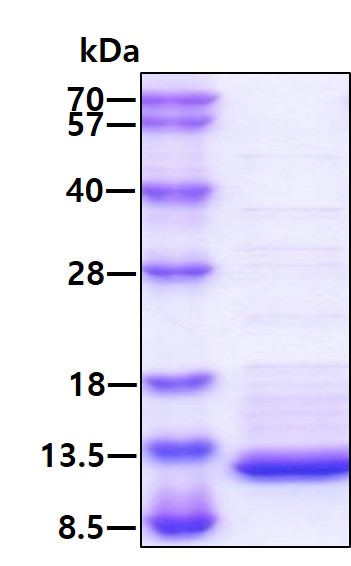

Human CX3CL1/Fractalkine protein (Recombinant) (His-Tag) (STJP016522)
SPECIFICATIONS
HostE.coli
ImmunogenHuman
General Information
| Short Description | Recombinant-Human CX3CL1/Fractalkine-His-Tag protein was developed from e.coli and has a target region of His-Tag. For use in research applications. |
| Applications | SDS-PAGE |
| Host | E.coli |
| Note | STRICTLY FOR FURTHER SCIENTIFIC RESEARCH USE ONLY (RUO). MUST NOT TO BE USED IN DIAGNOSTIC OR THERAPEUTIC APPLICATIONS. |
Product Properties
| Concentration | 0.5 mg/mL |
| Formulation | Liquid in phosphate-Buffered Saline (pH 7.4) 10% Glycerol |
| Storage Instruction | For short term storage, keep at +2C to +8C for up to 1 week. For long term storage, aliquot and store at-20C, and avoid repeat freeze-thaw cycles. |
| Endotoxin | < 1 EU per 1ug of protein (determined by LAL method) |
Target Information
| Gene Symbol | CX3CL1 |
| Gene ID | 6376 |
| Uniprot ID | X3CL1_HUMAN |
| Accession Number | NP_002987 |
| Immunogen | Human |
| Immunogen Region | 25-100aa |
| Immunogen Sequence | MGSSHHHHHH SSGLVPRGSH MQHHGVTKCN ITCSKMTSKI PVALLIHYQQ NQASCGKRAI ILETRQHRLF CADPKEQWVK DAMQHLDRQA AALTRNG |
Additional Info
| Tissue Specificity | Expressed in the seminal plasma, endometrial fluid and follicular fluid (at protein level). Small intestine, colon, testis, prostate, heart, brain, lung, skeletal muscle, kidney and pancreas. Most abundant in the brain and heart. |
| Post Translational Modifications | A soluble short 95 kDa form may be released by proteolytic cleavage from the long membrane-anchored form. O-glycosylated with core 1 or possibly core 8 glycans. |
| Function | Chemokine that acts as a ligand for both CX3CR1 and integrins ITGAV:ITGB3 and ITGA4:ITGB1. The CX3CR1-CX3CL1 signaling exerts distinct functions in different tissue compartments, such as immune response, inflammation, cell adhesion and chemotaxis. Regulates leukocyte adhesion and migration processes at the endothelium. Can activate integrins in both a CX3CR1-dependent and CX3CR1-independent manner. In the presence of CX3CR1, activates integrins by binding to the classical ligand-binding site (site 1) in integrins. In the absence of CX3CR1, binds to a second site (site 2) in integrins which is distinct from site 1 and enhances the binding of other integrin ligands to site 1. Processed fractalkine: The soluble form is chemotactic for T-cells and monocytes, but not for neutrophils. Fractalkine: The membrane-bound form promotes adhesion of those leukocytes to endothelial cells. (Microbial infection) Mediates the cytoadherence of erythrocytes infected with parasite P.falciparum (strain 3D7) with endothelial cells by interacting with P.falciparum CBP1 and CBP2 expressed at the surface of erythrocytes. The adhesion prevents the elimination of infected erythrocytes by the spleen (Probable). |
| Protein Name | FractalkineC-X3-C Motif Chemokine 1Cx3c Membrane-Anchored ChemokineNeurotactinSmall-Inducible Cytokine D1 Cleaved Into - Processed Fractalkine |
| Database Links | Reactome: R-HSA-380108Reactome: R-HSA-418594 |
| Cellular Localisation | Cell MembraneSingle-Pass Type I Membrane ProteinProcessed Fractalkine: Secreted |
| Alternative Protein Names | Fractalkine proteinC-X3-C Motif Chemokine 1 proteinCx3c Membrane-Anchored Chemokine proteinNeurotactin proteinSmall-Inducible Cytokine D1 Cleaved Into - Processed Fractalkine proteinCX3CL1 proteinFKN proteinNTT proteinSCYD1 proteinA-152E5.2 protein |
Information sourced from Uniprot.org