

Human CTH protein (Recombinant) (His-Tag) (STJP017456)
SPECIFICATIONS
HostE.coli
ImmunogenHuman
General Information
| Short Description | Recombinant-Human CTH-His-Tag protein was developed from e.coli and has a target region of His-Tag. For use in research applications. |
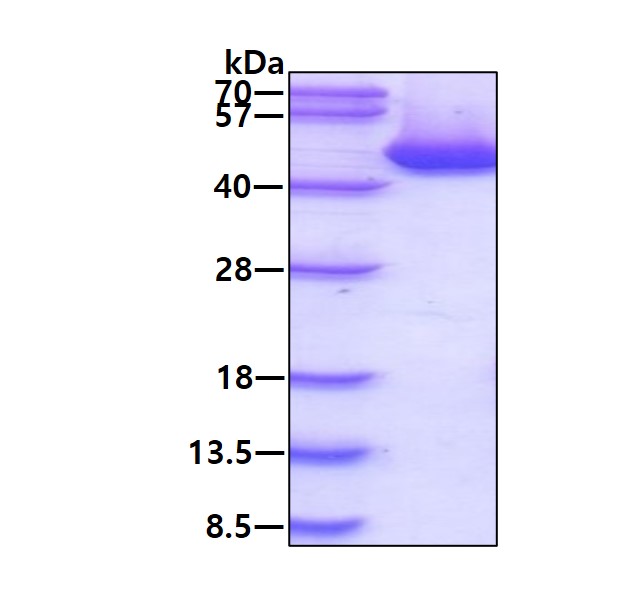
| Applications | SDS-PAGE |
| Host | E.coli |
| Note | STRICTLY FOR FURTHER SCIENTIFIC RESEARCH USE ONLY (RUO). MUST NOT TO BE USED IN DIAGNOSTIC OR THERAPEUTIC APPLICATIONS. |
Product Properties
| Concentration | 1 mg/mL |
| Formulation | Liquid in 20mM Tris-HCl buffer (pH 8.0) containing 2mM DTT, 10% Glycerol, 100mM NaCl |
| Storage Instruction | For short term storage, keep at +2C to +8C for up to 1 week. For long term storage, aliquot and store at-20C, and avoid repeat freeze-thaw cycles. |
Target Information
| Gene Symbol | CTH |
| Gene ID | 1491 |
| Uniprot ID | CGL_HUMAN |
| Accession Number | NP_001893.2 |
| Immunogen | Human |
| Immunogen Region | 1-405aa |
| Immunogen Sequence |
Additional Info
| Tissue Specificity | Highly expressed in liver. Also in muscle and lower expression in most tissues except heart, pituitary gland, spleen, thymus, and vascular tissue, where it is hardly detected. |
| Function | Catalyzes the last step in the trans-sulfuration pathway from L-methionine to L-cysteine in a pyridoxal-5'-phosphate (PLP)-dependent manner, which consists on cleaving the L,L-cystathionine molecule into L-cysteine, ammonia and 2-oxobutanoate. Part of the L-cysteine derived from the trans-sulfuration pathway is utilized for biosynthesis of the ubiquitous antioxidant glutathione. Besides its role in the conversion of L-cystathionine into L-cysteine, it utilizes L-cysteine and L-homocysteine as substrates (at much lower rates than L,L-cystathionine) to produce the endogenous gaseous signaling molecule hydrogen sulfide (H2S). In vitro, it converts two L-cysteine molecules into lanthionine and H2S, also two L-homocysteine molecules to homolanthionine and H2S, which can be particularly relevant under conditions of severe hyperhomocysteinemia (which is a risk factor for cardiovascular disease, diabetes, and Alzheimer's disease). Lanthionine and homolanthionine are structural homologs of L,L-cystathionine that differ by the absence or presence of an extra methylene group, respectively. Acts as a cysteine-protein sulfhydrase by mediating sulfhydration of target proteins: sulfhydration consists of converting -SH groups into -SSH on specific cysteine residues of target proteins such as GAPDH, PTPN1 and NF-kappa-B subunit RELA, thereby regulating their function. By generating the gasotransmitter H2S, it participates in a number of physiological processes such as vasodilation, bone protection, and inflammation (Probable). Plays an essential role in myogenesis by contributing to the biogenesis of H2S in skeletal muscle tissue. Can also accept homoserine as substrate. Catalyzes the elimination of selenocystathionine (which can be derived from the diet) to yield selenocysteine, ammonia and 2-oxobutanoate. |
| Protein Name | Cystathionine Gamma-LyaseCglCseCysteine DesulfhydraseCysteine-Protein SulfhydraseGamma-CystathionaseHomocysteine Desulfhydrase |
| Database Links | Reactome: R-HSA-1614558Reactome: R-HSA-1614603Reactome: R-HSA-2408508 |
| Cellular Localisation | Cytoplasm |
| Alternative Protein Names | Cystathionine Gamma-Lyase proteinCgl proteinCse proteinCysteine Desulfhydrase proteinCysteine-Protein Sulfhydrase proteinGamma-Cystathionase proteinHomocysteine Desulfhydrase proteinCTH protein |
Information sourced from Uniprot.org