

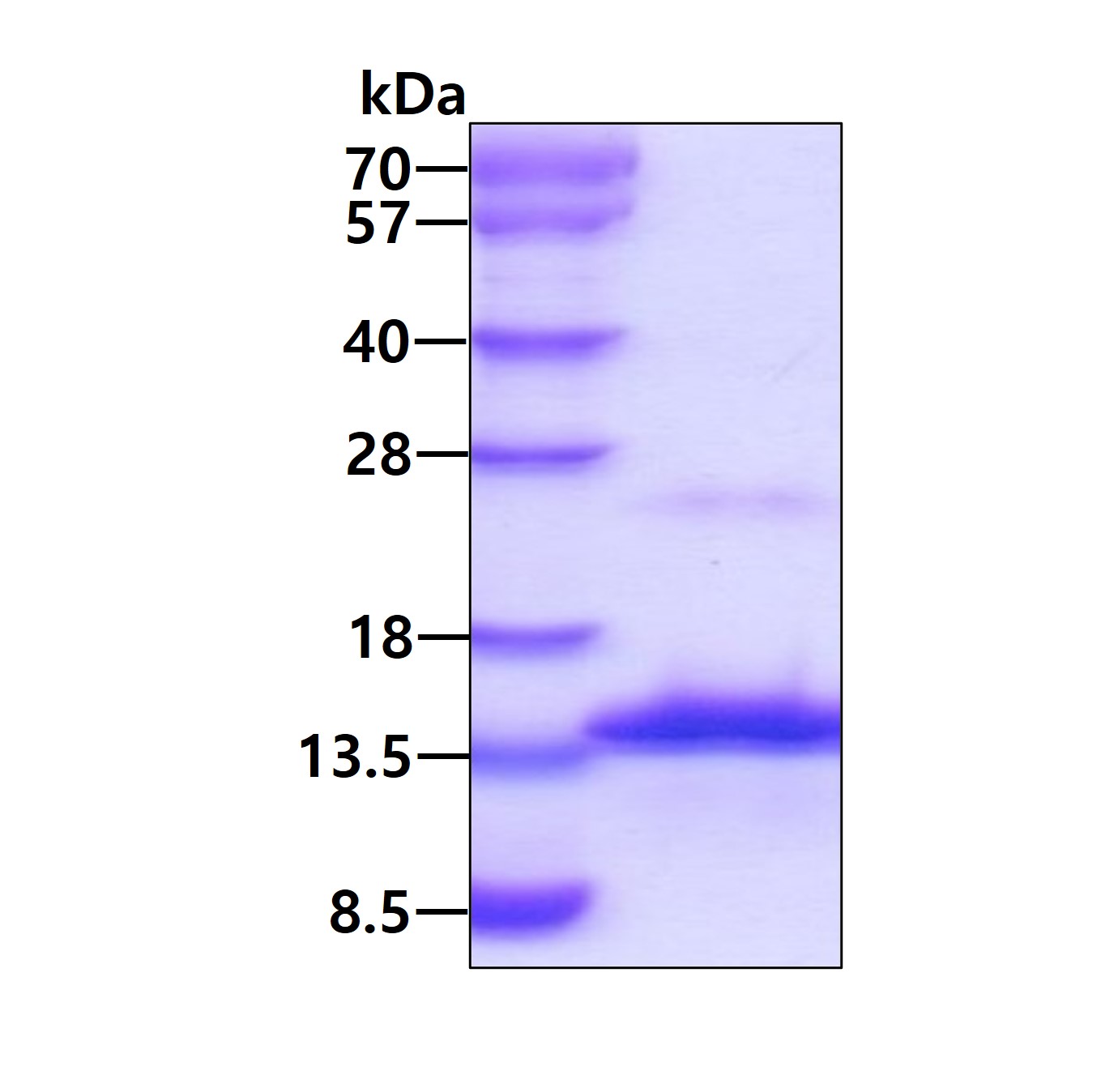

Human CISD1 protein (Recombinant) (His-Tag) (STJP017830)
SPECIFICATIONS
HostE.coli
ImmunogenHuman
General Information
| Short Description | Recombinant-Human CISD1-His-Tag protein was developed from e.coli and has a target region of His-Tag. For use in research applications. |
| Applications | SDS-PAGE |
| Host | E.coli |
| Note | STRICTLY FOR FURTHER SCIENTIFIC RESEARCH USE ONLY (RUO). MUST NOT TO BE USED IN DIAGNOSTIC OR THERAPEUTIC APPLICATIONS. |
Product Properties
| Concentration | 0.5 mg/mL |
| Formulation | Liquid in 20mM Tris-HCl buffer (pH 8.0) containing 0.15M NaCl, 10% Glycerol, 1mM DTT |
| Storage Instruction | For short term storage, keep at +2C to +8C for up to 1 week. For long term storage, aliquot and store at-20C, and avoid repeat freeze-thaw cycles. |
Target Information
| Gene Symbol | CISD1 |
| Gene ID | 55847 |
| Uniprot ID | CISD1_HUMAN |
| Accession Number | NP_060934 |
| Immunogen | Human |
| Immunogen Region | 32-108aa |
| Immunogen Sequence |
Additional Info
| Tissue Specificity | Expression is reduced in cells derived from cystic fibrosis patients. |
| Post Translational Modifications | Ubiquitinated by PRKN during mitophagy, leading to its degradation and enhancement of mitophagy. Deubiquitinated by USP30. |
| Function | L-cysteine transaminase that catalyzes the reversible transfer of the amino group from L-cysteine to the alpha-keto acid 2-oxoglutarate to respectively form 2-oxo-3-sulfanylpropanoate and L-glutamate. The catalytic cycle occurs in the presence of pyridoxal 5'-phosphate (PLP) cofactor that facilitates transamination by initially forming an internal aldimine with the epsilon-amino group of active site Lys-55 residue on the enzyme (PLP-enzyme aldimine), subsequently displaced by formation of an external aldimine with the substrate amino group (PLP-L-cysteine aldimine). The external aldimine is further deprotonated to form a carbanion intermediate, which in the presence of 2-oxoglutarate regenerates PLP yielding final products 2-oxo-3-sulfanylpropanoate and L-glutamate. The proton transfer in carbanion intermediate is suggested to be controlled by the active site lysine residue, whereas PLP stabilizes carbanion structure through electron delocalization, also known as the electron sink effect. Plays a key role in regulating maximal capacity for electron transport and oxidative phosphorylation. May be involved in iron-sulfur cluster shuttling and/or in redox reactions. Can transfer the 2Fe-2S cluster to an apo-acceptor protein only when in the oxidation state, likely serving as a redox sensor that regulates mitochondrial iron-sulfur cluster assembly and iron trafficking upon oxidative stress. |
| Protein Name | Cdgsh Iron-Sulfur Domain-Containing Protein 1Cysteine Transaminase Cisd1Mitoneet |
| Database Links | |
| Cellular Localisation | Mitochondrion Outer MembraneSingle-Pass Type Iii Membrane Protein |
| Alternative Protein Names | Cdgsh Iron-Sulfur Domain-Containing Protein 1 proteinCysteine Transaminase Cisd1 proteinMitoneet proteinCISD1 proteinC10orf70 proteinZCD1 proteinMDS029 protein |
Information sourced from Uniprot.org