

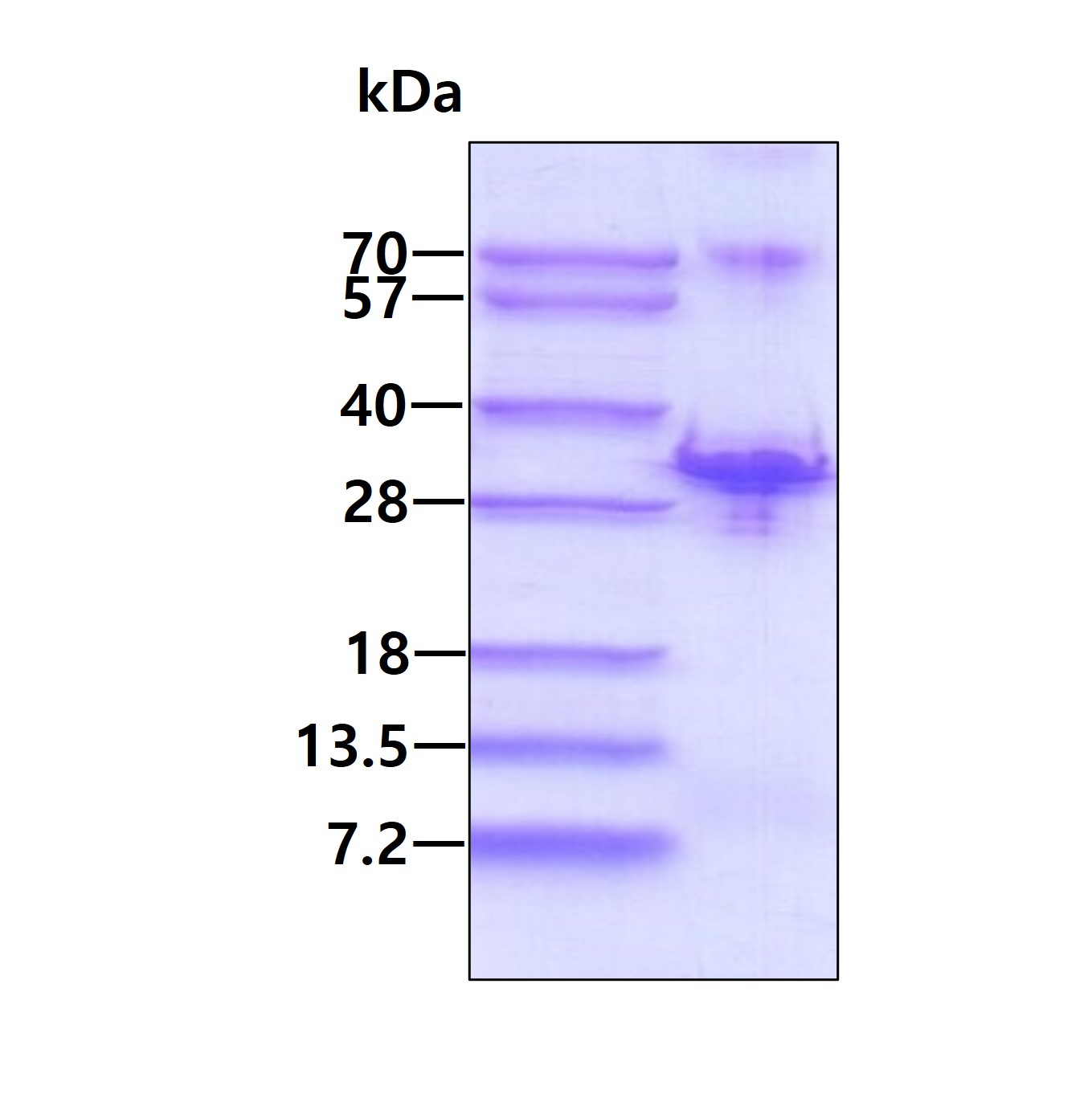

Human CHMP1A protein (Recombinant) (His-Tag) (STJP017948)
SPECIFICATIONS
HostE.coli
ImmunogenHuman
General Information
| Short Description | Recombinant-Human CHMP1A-His-Tag protein was developed from e.coli and has a target region of His-Tag. For use in research applications. |
| Applications | SDS-PAGE |
| Host | E.coli |
| Note | STRICTLY FOR FURTHER SCIENTIFIC RESEARCH USE ONLY (RUO). MUST NOT TO BE USED IN DIAGNOSTIC OR THERAPEUTIC APPLICATIONS. |
Product Properties
| Concentration | 0.25 mg/mL |
| Formulation | Liquid in 20mM Tris-HCl buffer (pH 8.0) containing 0.1M NaCl, 20% Glycerol, 1mM DTT |
| Storage Instruction | For short term storage, keep at +2C to +8C for up to 1 week. For long term storage, aliquot and store at-20C, and avoid repeat freeze-thaw cycles. |
Target Information
| Gene Symbol | CHMP1A |
| Gene ID | 5119 |
| Uniprot ID | CHM1A_HUMAN |
| Accession Number | NP_002759.2 |
| Immunogen | Human |
| Immunogen Region | 1-196aa |
| Immunogen Sequence |
Additional Info
| Tissue Specificity | Expressed in placenta, cultured skin fibroblasts and in osteoblast cell line MG-63. |
| Function | Probable peripherally associated component of the endosomal sorting required for transport complex III (ESCRT-III) which is involved in multivesicular bodies (MVBs) formation and sorting of endosomal cargo proteins into MVBs. MVBs contain intraluminal vesicles (ILVs) that are generated by invagination and scission from the limiting membrane of the endosome and mostly are delivered to lysosomes enabling degradation of membrane proteins, such as stimulated growth factor receptors, lysosomal enzymes and lipids. The MVB pathway appears to require the sequential function of ESCRT-O, -I,-II and -III complexes. ESCRT-III proteins mostly dissociate from the invaginating membrane before the ILV is released. The ESCRT machinery also functions in topologically equivalent membrane fission events, such as the terminal stages of cytokinesis and the budding of enveloped viruses (HIV-1 and other lentiviruses). ESCRT-III proteins are believed to mediate the necessary vesicle extrusion and/or membrane fission activities, possibly in conjunction with the AAA ATPase VPS4. Involved in cytokinesis. Involved in recruiting VPS4A and/or VPS4B to the midbody of dividing cells. May also be involved in chromosome condensation. Targets the Polycomb group (PcG) protein BMI1/PCGF4 to regions of condensed chromatin. May play a role in stable cell cycle progression and in PcG gene silencing. |
| Protein Name | Charged Multivesicular Body Protein 1aChromatin-Modifying Protein 1aChmp1aVacuolar Protein Sorting-Associated Protein 46-1Vps46-1Hvps46-1 |
| Database Links | Reactome: R-HSA-9610379 |
| Cellular Localisation | CytoplasmEndosome MembranePeripheral Membrane ProteinNucleus MatrixThe Cytoplasmic Form Is Partially Membrane-Associated And Localizes To Early EndosomesThe Nuclear Form Remains Associated With The Chromosome Scaffold During MitosisOn OverexpressionIt Localizes To Nuclear Bodies Characterized By Nuclease-Resistant Condensed Chromatin |
| Alternative Protein Names | Charged Multivesicular Body Protein 1a proteinChromatin-Modifying Protein 1a proteinChmp1a proteinVacuolar Protein Sorting-Associated Protein 46-1 proteinVps46-1 proteinHvps46-1 proteinCHMP1A proteinCHMP1 proteinKIAA0047 proteinPCOLN3 proteinPRSM1 protein |
Information sourced from Uniprot.org