

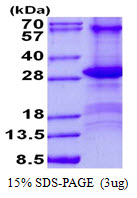

Human CD84/SLAMF5 protein (Recombinant) (His-Tag) (STJP017843)
SPECIFICATIONS
HostE.coli
ImmunogenHuman
General Information
| Short Description | Recombinant-Human CD84/SLAMF5-His-Tag protein was developed from e.coli and has a target region of His-Tag. For use in research applications. |
| Applications | SDS-PAGE/Denatured |
| Host | E.coli |
| Note | STRICTLY FOR FURTHER SCIENTIFIC RESEARCH USE ONLY (RUO). MUST NOT TO BE USED IN DIAGNOSTIC OR THERAPEUTIC APPLICATIONS. |
Product Properties
| Concentration | 1 mg/mL |
| Formulation | Liquid in 20mM Tris-HCl buffer (pH 8.0) containing 0.4M urea, 10% Glycerol |
| Storage Instruction | For short term storage, keep at +2C to +8C for up to 1 week. For long term storage, aliquot and store at-20C, and avoid repeat freeze-thaw cycles. |
Target Information
| Gene Symbol | CD84 |
| Gene ID | 8832 |
| Uniprot ID | SLAF5_HUMAN |
| Accession Number | NP_001171808 |
| Immunogen | Human |
| Immunogen Region | 22-225aa |
| Immunogen Sequence | MGSSHHHHHH SSGLVPRGSH MGSHMKDSEI FTVNGILGES VTFPVNIQEP RQVKIIAWTS KTSVAYVTPG DSETAPVVTV THRNYYERIH ALGPNYNLVI SDLRMEDAGD YKADINTQAD PYTTTKRYNL QIYRRLGKPK ITQSLMASVN STCNVTLTCS VEKEEKNVTY NWSPLGEEGN VLQIFQTPED QELTYTCTAQ NPVSNNSDSI SARQLCADIA MGFRTHHT |
Additional Info
| Tissue Specificity | Predominantly expressed in hematopoietic tissues, such as lymph node, spleen and peripheral leukocytes. Expressed in macrophages, B-cells, monocytes, platelets, thymocytes, T-cells and dendritic cells. Highly expressed in memory T-cells. Expressed in mast cells. |
| Post Translational Modifications | Phosphorylated by tyrosine-protein kinase LCK on tyrosine residues following ligation induced by agonist monoclonal antibody. The association with SH2D1A is dependent of tyrosine phosphorylation of its cytoplasmic domain. Phosphorylated on Tyr-296 and Tyr-316 following platelet aggregation. Phosphorylated on tyrosine residues upon high affinity immunoglobulin epsilon receptor aggregation in mast cells. N-glycosylated. |
| Function | Self-ligand receptor of the signaling lymphocytic activation molecule (SLAM) family. SLAM receptors triggered by homo- or heterotypic cell-cell interactions are modulating the activation and differentiation of a wide variety of immune cells and thus are involved in the regulation and interconnection of both innate and adaptive immune response. Activities are controlled by presence or absence of small cytoplasmic adapter proteins, SH2D1A/SAP and/or SH2D1B/EAT-2. Can mediate natural killer (NK) cell cytotoxicity dependent on SH2D1A and SH2D1B. Increases proliferative responses of activated T-cells and SH2D1A/SAP does not seem be required for this process. Homophilic interactions enhance interferon gamma/IFNG secretion in lymphocytes and induce platelet stimulation via a SH2D1A-dependent pathway. May serve as a marker for hematopoietic progenitor cells Required for a prolonged T-cell:B-cell contact, optimal T follicular helper function, and germinal center formation. In germinal centers involved in maintaining B-cell tolerance and in preventing autoimmunity. In mast cells negatively regulates high affinity immunoglobulin epsilon receptor signaling.independent of SH2D1A and SH2D1B but implicating FES and PTPN6/SHP-1. In macrophages enhances LPS-induced MAPK phosphorylation and NF-kappaB activation and modulates LPS-induced cytokine secretion.involving ITSM 2. Positively regulates macroautophagy in primary dendritic cells via stabilization of IRF8.inhibits TRIM21-mediated proteasomal degradation of IRF8. |
| Protein Name | Slam Family Member 5Cell Surface Antigen Max.3Hly9-BetaLeukocyte Differentiation Antigen Cd84Signaling Lymphocytic Activation Molecule 5Cd Antigen Cd84 |
| Database Links | Reactome: R-HSA-202733 |
| Cellular Localisation | Cell MembraneSingle-Pass Type I Membrane Protein |
| Alternative Protein Names | Slam Family Member 5 proteinCell Surface Antigen Max.3 proteinHly9-Beta proteinLeukocyte Differentiation Antigen Cd84 proteinSignaling Lymphocytic Activation Molecule 5 proteinCd Antigen Cd84 proteinCD84 proteinSLAMF5 protein |
Information sourced from Uniprot.org