

Human CD59 protein (Recombinant) (His-Tag) (STJP018362)
SPECIFICATIONS
HostE.coli
ImmunogenHuman
General Information
| Short Description | Recombinant-Human CD59-His-Tag protein was developed from e.coli and has a target region of His-Tag. For use in research applications. |
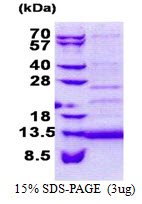
| Applications | SDS-PAGE |
| Host | E.coli |
| Note | STRICTLY FOR FURTHER SCIENTIFIC RESEARCH USE ONLY (RUO). MUST NOT TO BE USED IN DIAGNOSTIC OR THERAPEUTIC APPLICATIONS. |
Product Properties
| Concentration | 0.5 mg/mL |
| Formulation | Liquid in 20mM Tris-HCl buffer (pH 8.0) containing 0.15M NaCl, 10% Glycerol, 1mM DTT |
| Storage Instruction | For short term storage, keep at +2C to +8C for up to 1 week. For long term storage, aliquot and store at-20C, and avoid repeat freeze-thaw cycles. |
Target Information
| Gene Symbol | CD59 |
| Gene ID | 966 |
| Uniprot ID | CD59_HUMAN |
| Accession Number | NP_000602 |
| Immunogen | Human |
| Immunogen Region | 26-102aa |
| Immunogen Sequence | MGSSHHHHHH SSGLVPRGSH MGSLQCYNCP NPTADCKTAV NCSSDFDACL ITKAGLQVYN KCWKFEHCNF NDVTTRLREN ELTYYCCKKD LCNFNEQLEN |
Additional Info
| Post Translational Modifications | N- and O-glycosylated. The N-glycosylation mainly consists of a family of biantennary complex-type structures with and without lactosamine extensions and outer arm fucose residues. Also significant amounts of triantennary complexes (22%). Variable sialylation also present in the Asn-43 oligosaccharide. The predominant O-glycans are mono-sialylated forms of the disaccharide, Gal-beta-1,3GalNAc, and their sites of attachment are probably on Thr-76 and Thr-77. The GPI-anchor of soluble urinary CD59 has no inositol-associated phospholipid, but is composed of seven different GPI-anchor variants of one or more monosaccharide units. Major variants contain sialic acid, mannose and glucosamine. Sialic acid linked to an N-acetylhexosamine-galactose arm is present in two variants. Glycated. Glycation is found in diabetic subjects, but only at minimal levels in nondiabetic subjects. Glycated CD59 lacks MAC-inhibitory function and confers to vascular complications of diabetes. |
| Function | Potent inhibitor of the complement membrane attack complex (MAC) action, which protects human cells from damage during complement activation. Acts by binding to the beta-haipins of C8 (C8A and C8B) components of the assembling MAC, forming an intermolecular beta-sheet that prevents incorporation of the multiple copies of C9 required for complete formation of the osmolytic pore. The soluble form from urine retains its specific complement binding activity, but exhibits greatly reduced ability to inhibit complement membrane attack complex (MAC) assembly on cell membranes. |
| Protein Name | Cd59 Glycoprotein1f5 Antigen20 Kda Homologous Restriction FactorHrf-20Hrf20Mac-Inhibitory ProteinMac-IpMem43 AntigenMembrane Attack Complex Inhibition FactorMacifMembrane Inhibitor Of Reactive LysisMirlProtectinCd Antigen Cd59 |
| Database Links | Reactome: R-HSA-204005Reactome: R-HSA-5694530Reactome: R-HSA-6798695Reactome: R-HSA-6807878Reactome: R-HSA-977606 |
| Cellular Localisation | Cell MembraneLipid-AnchorGpi-AnchorSecretedLocalizes To The Cell SurfaceSoluble Form Found In A Number Of Tissues |
| Alternative Protein Names | Cd59 Glycoprotein1f5 Antigen protein20 Kda Homologous Restriction Factor proteinHrf-20 proteinHrf20 proteinMac-Inhibitory Protein proteinMac-Ip proteinMem43 Antigen proteinMembrane Attack Complex Inhibition Factor proteinMacif proteinMembrane Inhibitor Of Reactive Lysis proteinMirl proteinProtectin proteinCd Antigen Cd59 proteinCD59 proteinMIC11 proteinMIN1 proteinMIN2 proteinMIN3 proteinMSK21 protein |
Information sourced from Uniprot.org