
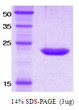
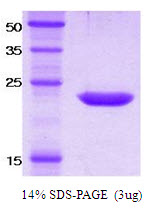

Human CD158i/KIR2DS4 protein (Recombinant) (No-Tag) (STJP019694)
SPECIFICATIONS
HostE.coli
ImmunogenHuman
General Information
| Short Description | Recombinant-Human CD158i/KIR2DS4-No-Tag protein was developed from e.coli and has a target region of No-Tag. For use in research applications. |
| Applications | SDS-PAGE |
| Host | E.coli |
| Note | STRICTLY FOR FURTHER SCIENTIFIC RESEARCH USE ONLY (RUO). MUST NOT TO BE USED IN DIAGNOSTIC OR THERAPEUTIC APPLICATIONS. |
Product Properties
| Concentration | 1 mg/mL |
| Formulation | Liquid in 20mM Tris-HCl buffer (pH 7.5) |
| Storage Instruction | For short term storage, keep at +2C to +8C for up to 1 week. For long term storage, aliquot and store at-20C, and avoid repeat freeze-thaw cycles. |
Target Information
| Gene Symbol | KIR2DS4 |
| Gene ID | 3809 |
| Uniprot ID | KI2S4_HUMAN |
| Accession Number | NP_036446 |
| Immunogen | Human |
| Immunogen Region | 23-223aa |
| Immunogen Sequence | MEGVHRKPSF LALPGHLVKS EETVILQCWS DVMFEHFLLH REGKFNNTLH LIGEHHDGVS KANFSIGPMM PVLAGTYRCY GSVPHSPYQL SAPSDPLDMV IIGLYEKPSL SAQPGPTVQA GENVTLSCSS RSSYDMYHLS REGEAHERRL PAVRSINGTF QADFPLGPAT HGGTYRCFGS FRDAPYEWSN SSDPLLVSVT GN |
Additional Info
| Function | Receptor on natural killer (NK) cells for HLA-C alleles. Does not inhibit the activity of NK cells. |
| Protein Name | Killer Cell Immunoglobulin-Like Receptor 2ds4Cd158 Antigen-Like Family Member INatural Killer-Associated Transcript 8Nkat-8P58 Natural Killer Cell Receptor Clones Cl-39/Cl-17P58 Nk Receptor Cl-39/Cl-17Cd Antigen Cd158i |
| Database Links | Reactome: R-HSA-2172127 |
| Cellular Localisation | Cell MembraneSingle-Pass Type I Membrane Protein |
| Alternative Protein Names | Killer Cell Immunoglobulin-Like Receptor 2ds4 proteinCd158 Antigen-Like Family Member I proteinNatural Killer-Associated Transcript 8 proteinNkat-8 proteinP58 Natural Killer Cell Receptor Clones Cl-39/Cl-17 proteinP58 Nk Receptor Cl-39/Cl-17 proteinCd Antigen Cd158i proteinKIR2DS4 proteinCD158I proteinKKA3 proteinNKAT8 protein |
Information sourced from Uniprot.org