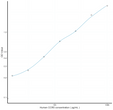
This CCR5 Sandwich ELISA Kit is an in-vitro enzyme-linked immunosorbent assay for the measurement of samples in human tissue homogenates, cell lysates or other biological fluids..
Applications
ELISA
Reactivity
Human
Sensitivity
6.5pg/mL
Detection Limit
15.6-1000pg/mL
Note
STRICTLY FOR FURTHER SCIENTIFIC RESEARCH USE ONLY (RUO). MUST NOT TO BE USED IN DIAGNOSTIC OR THERAPEUTIC APPLICATIONS.
Product Properties
Storage Instruction
Store the unopened kit in the fridge at 2-8°C for up to 6 months. Once opened store individual kit contents according to components table provided with the kit.
tissue homogenates, cell lysates or other biological fluids.
Additional Info
Tissue Specificity
Highly expressed in spleen, thymus, in the myeloid cell line THP-1, in the promyeloblastic cell line KG-1a and on CD4+ and CD8+ T-cells. Medium levels in peripheral blood leukocytes and in small intestine. Low levels in ovary and lung.
Post Translational Modifications
Sulfated on at least 2 of the N-terminal tyrosines. Sulfation contributes to the efficiency of HIV-1 entry and is required for efficient binding of the chemokines, CCL3 and CCL4. O-glycosylated, but not N-glycosylated. Ser-6 appears to be the major site even if Ser-7 may be also O-glycosylated. Also sialylated glycans present which contribute to chemokine binding. Thr-16 and Ser-17 may also be glycosylated and, if so, with small moieties such as a T-antigen. Palmitoylation in the C-terminal is important for cell surface expression, and to a lesser extent, for HIV entry. Phosphorylation on serine residues in the C-terminal is stimulated by binding CC chemokines especially by APO-RANTES.
Function
Receptor for a number of inflammatory CC-chemokines including CCL3/MIP-1-alpha, CCL4/MIP-1-beta and RANTES and subsequently transduces a signal by increasing the intracellular calcium ion level. May play a role in the control of granulocytic lineage proliferation or differentiation. Participates in T-lymphocyte migration to the infection site by acting as a chemotactic receptor. (Microbial infection) Acts as a coreceptor (CD4 being the primary receptor) of human immunodeficiency virus-1/HIV-1.
Protein Name
C-C Chemokine Receptor Type 5C-C Ckr-5Cc-Ckr-5Ccr-5Ccr5Chemr13Hiv-1 Fusion CoreceptorCd Antigen Cd195