

Human CCND2 protein (Recombinant) (His-Tag) (STJP017465)
SPECIFICATIONS
HostE.coli
ImmunogenHuman
General Information
| Short Description | Recombinant-Human CCND2-His-Tag protein was developed from e.coli and has a target region of His-Tag. For use in research applications. |
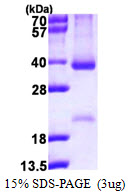
| Applications | SDS-PAGE |
| Host | E.coli |
| Note | STRICTLY FOR FURTHER SCIENTIFIC RESEARCH USE ONLY (RUO). MUST NOT TO BE USED IN DIAGNOSTIC OR THERAPEUTIC APPLICATIONS. |
Product Properties
| Concentration | 1 mg/mL |
| Formulation | Liquid in 20mM Tris-HCl buffer (pH 8.0) containing 10% Glycerol, 2mM DTT, 1M urea. |
| Storage Instruction | For short term storage, keep at +2C to +8C for up to 1 week. For long term storage, aliquot and store at-20C, and avoid repeat freeze-thaw cycles. |
Target Information
| Gene Symbol | CCND2 |
| Gene ID | 894 |
| Uniprot ID | CCND2_HUMAN |
| Accession Number | NP_001750 |
| Immunogen | Human |
| Immunogen Region | 1-289aa |
| Immunogen Sequence | MGSSHHHHHH SSGLVPRGSH MGSHMELLCH EVDPVRRAVR DRNLLRDDRV LQNLLTIEER YLPQCSYFKC VQKDIQPYMR RMVATWMLEV CEEQKCEEEV FPLAMNYLDR FLAGVPTPKS HLQLLGAVCM FLASKLKETS PLTAEKLCIY TDNSIKPQEL LEWELVVLGK LKWNLAAVTP HDFIEHILRK LPQQREKLSL IRKHAQTFIA LCATDFKFAM YPPSMIAT |
Additional Info
| Post Translational Modifications | Phosphorylation at Thr-280 by MAP kinases is required for ubiquitination and degradation by the DCX(AMBRA1) complex. Ubiquitinated by the DCX(AMBRA1) complex during the transition from G1 to S cell phase, leading to its degradation: ubiquitination is dependent on Thr-280 phosphorylation. The DCX(AMBRA1) complex represents the major regulator of CCND2 stability during the G1/S transition. Polyubiquitinated by the SCF(FBXL2) complex, leading to proteasomal degradation. |
| Function | Regulatory component of the cyclin D2-CDK4 (DC) complex that phosphorylates and inhibits members of the retinoblastoma (RB) protein family including RB1 and regulates the cell-cycle during G(1)/S transition. Phosphorylation of RB1 allows dissociation of the transcription factor E2F from the RB/E2F complex and the subsequent transcription of E2F target genes which are responsible for the progression through the G(1) phase. Hypophosphorylates RB1 in early G(1) phase. Cyclin D-CDK4 complexes are major integrators of various mitogenenic and antimitogenic signals. |
| Protein Name | G1/S-Specific Cyclin-D2 |
| Database Links | Reactome: R-HSA-69231Reactome: R-HSA-8934593Reactome: R-HSA-9661069Reactome: R-HSA-9754119 |
| Cellular Localisation | NucleusCytoplasmNucleus MembraneCyclin D-Cdk4 Complexes Accumulate At The Nuclear Membrane And Are Then Translocated Into The Nucleus Through Interaction With Kip/Cip Family MembersIsoform 2: Cytoplasm |
| Alternative Protein Names | G1/S-Specific Cyclin-D2 proteinCCND2 protein |
Information sourced from Uniprot.org