

Human BMP-4 (monomer) protein (Recombinant) (No-Tag) (STJP019577)
SPECIFICATIONS
HostE.coli
ImmunogenHuman
General Information
| Short Description | Recombinant-Human BMP-4 (monomer)-No-Tag protein was developed from e.coli and has a target region of No-Tag. For use in research applications. |
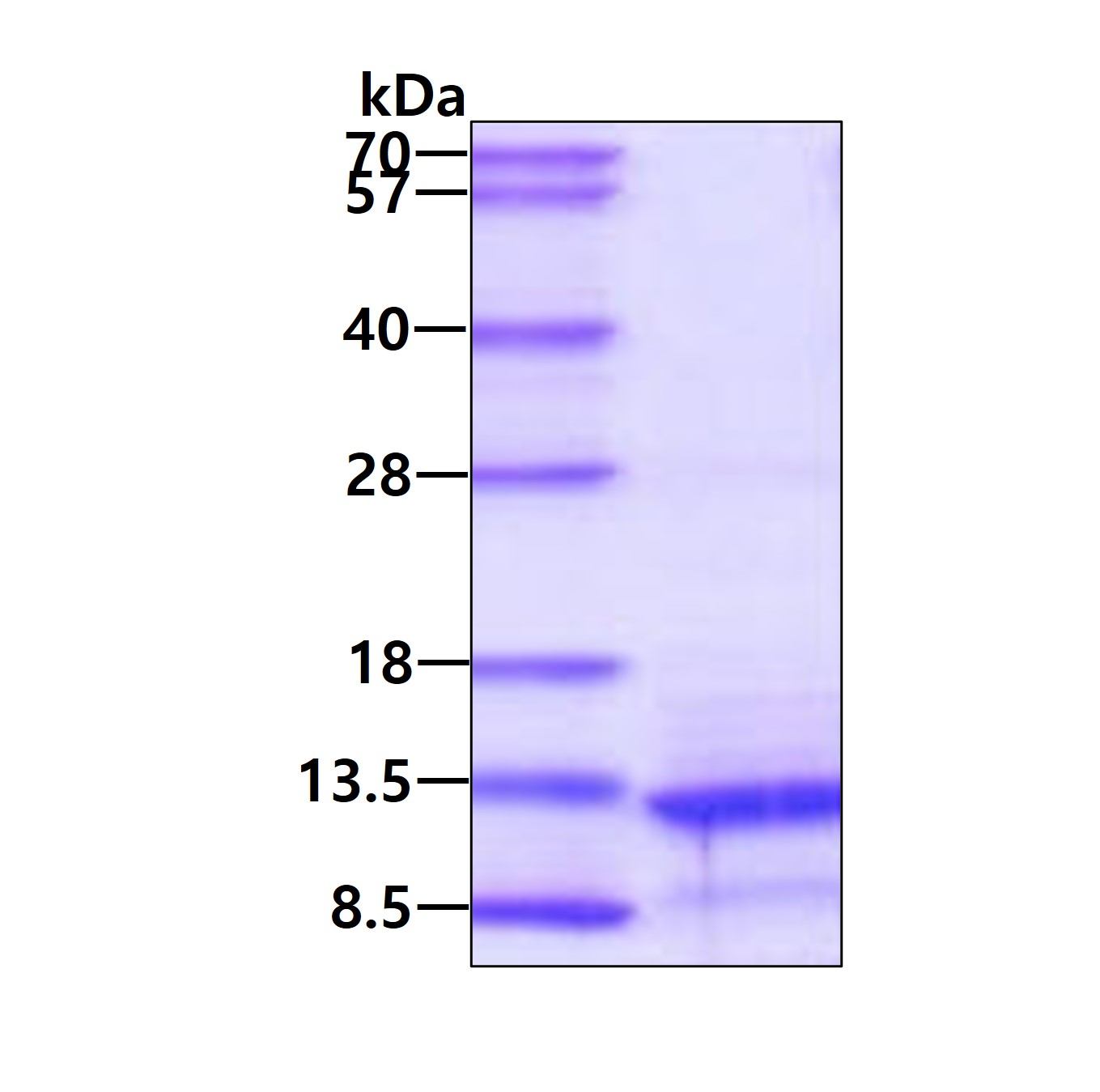
| Applications | SDS-PAGE |
| Host | E.coli |
| Note | STRICTLY FOR FURTHER SCIENTIFIC RESEARCH USE ONLY (RUO). MUST NOT TO BE USED IN DIAGNOSTIC OR THERAPEUTIC APPLICATIONS. |
Product Properties
| Concentration | 0.5 mg/mL |
| Formulation | Liquid in 10mM Sodium Citrate buffer (pH 3.5) containing 10% Glycerol |
| Storage Instruction | For short term storage, keep at +2C to +8C for up to 1 week. For long term storage, aliquot and store at-20C, and avoid repeat freeze-thaw cycles. |
| Endotoxin | < 1 EU per 1ug of protein (determined by LAL method) |
Target Information
| Gene Symbol | BMP4 |
| Gene ID | 652 |
| Uniprot ID | BMP4_HUMAN |
| Accession Number | NP_001193.2 |
| Immunogen | Human |
| Immunogen Region | 293-408aa |
| Immunogen Sequence | MSPKHHSQRA RKKNKNCRRH SLYVDFSDVG WNDWIVAPPG YQAFYCHGDC PFPLADHLNS TNHAIVQTLV NSVNSSIPKA CCVPTELSAI SMLYLDEYDK VVLKNYQEMV VEGCGCR |
Additional Info
| Tissue Specificity | Expressed in the lung and lower levels seen in the kidney. Present also in normal and neoplastic prostate tissues, and prostate cancer cell lines. |
| Function | Growth factor of the TGF-beta superfamily that plays essential roles in many developmental processes, including neurogenesis, vascular development, angiogenesis and osteogenesis. Acts in concert with PTHLH/PTHRP to stimulate ductal outgrowth during embryonic mammary development and to inhibit hair follicle induction. Initiates the canonical BMP signaling cascade by associating with type I receptor BMPR1A and type II receptor BMPR2. Once all three components are bound together in a complex at the cell surface, BMPR2 phosphorylates and activates BMPR1A. In turn, BMPR1A propagates signal by phosphorylating SMAD1/5/8 that travel to the nucleus and act as activators and repressors of transcription of target genes. Positively regulates the expression of odontogenic development regulator MSX1 via inducing the IPO7-mediated import of SMAD1 to the nucleus. Required for MSX1-mediated mesenchymal molar tooth bud development beyond the bud stage, via promoting Wnt signaling. Acts as a positive regulator of odontoblast differentiation during mesenchymal tooth germ formation, expression is repressed during the bell stage by MSX1-mediated inhibition of CTNNB1 signaling. Able to induce its own expression in dental mesenchymal cells and also in the neighboring dental epithelial cells via an MSX1-mediated pathway. Can also signal through non-canonical BMP pathways such as ERK/MAP kinase, PI3K/Akt, or SRC cascades. For example, induces SRC phosphorylation which, in turn, activates VEGFR2, leading to an angiogenic response. |
| Protein Name | Bone Morphogenetic Protein 4Bmp-4Bone Morphogenetic Protein 2bBmp-2b |
| Database Links | Reactome: R-HSA-2129379Reactome: R-HSA-381426Reactome: R-HSA-8957275Reactome: R-HSA-9754189Reactome: R-HSA-9758920Reactome: R-HSA-9761174Reactome: R-HSA-9793380Reactome: R-HSA-9827857Reactome: R-HSA-9830364Reactome: R-HSA-9830674Reactome: R-HSA-9834899 |
| Cellular Localisation | SecretedExtracellular SpaceExtracellular Matrix |
| Alternative Protein Names | Bone Morphogenetic Protein 4 proteinBmp-4 proteinBone Morphogenetic Protein 2b proteinBmp-2b proteinBMP4 proteinBMP2B proteinDVR4 protein |
Information sourced from Uniprot.org