

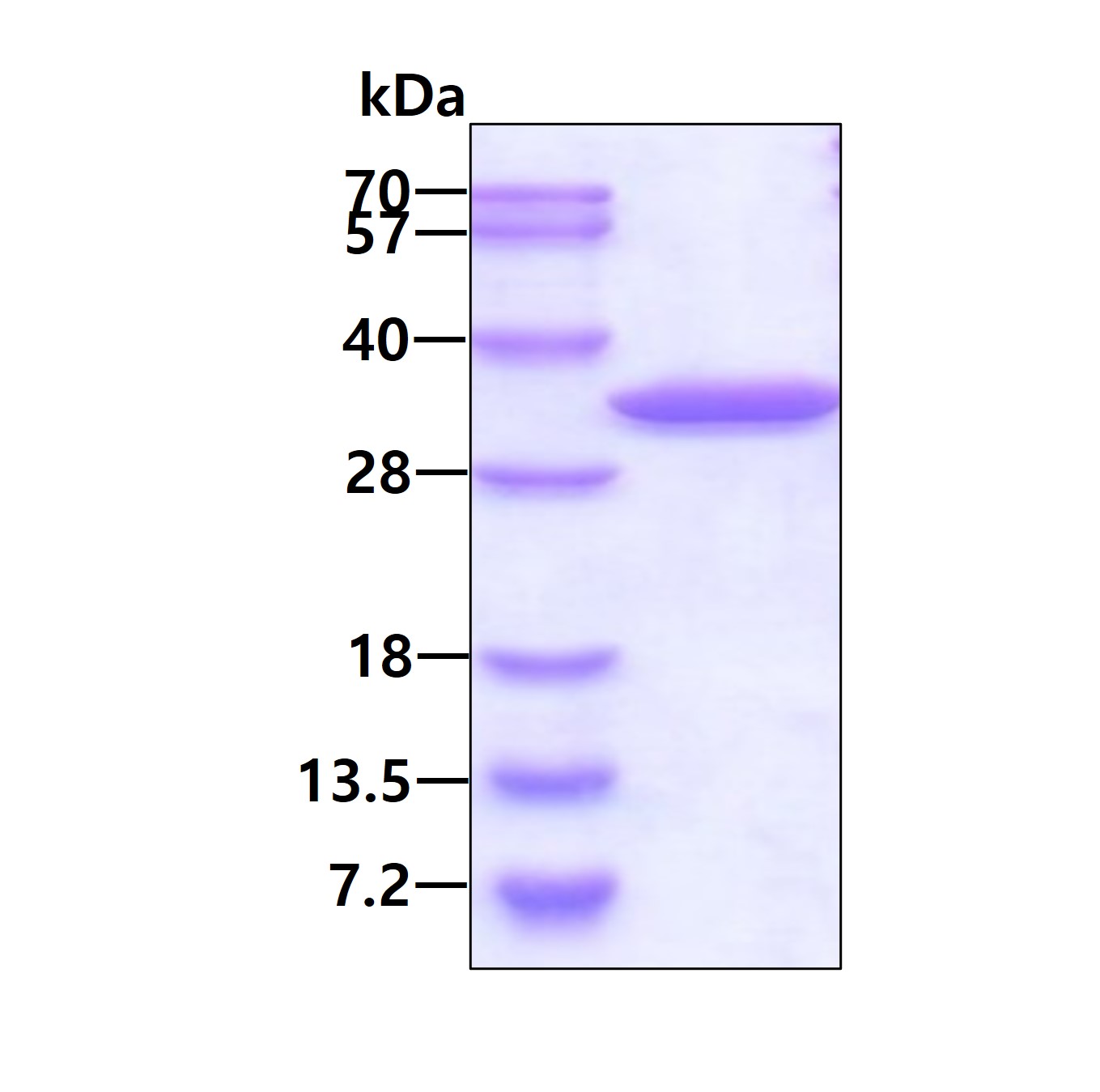

Human AUH protein (Recombinant) (His-Tag) (STJP016976)
SPECIFICATIONS
HostE.coli
ImmunogenHuman
General Information
| Short Description | Recombinant-Human AUH-His-Tag protein was developed from e.coli and has a target region of His-Tag. For use in research applications. |
| Applications | SDS-PAGE |
| Host | E.coli |
| Note | STRICTLY FOR FURTHER SCIENTIFIC RESEARCH USE ONLY (RUO). MUST NOT TO BE USED IN DIAGNOSTIC OR THERAPEUTIC APPLICATIONS. |
Product Properties
| Concentration | 1 mg/mL |
| Formulation | Liquid in 20mM Tris-HCl buffer (pH 8.0) containing 20% Glycerol, 0.1M NaCl, 1mM DTT |
| Storage Instruction | For short term storage, keep at +2C to +8C for up to 1 week. For long term storage, aliquot and store at-20C, and avoid repeat freeze-thaw cycles. |
Target Information
| Gene Symbol | AUH |
| Gene ID | 549 |
| Uniprot ID | AUHM_HUMAN |
| Accession Number | NP_001689 |
| Immunogen | Human |
| Immunogen Region | 68-339aa |
| Immunogen Sequence |
Additional Info
| Function | Catalyzes the fifth step in the leucine degradation pathway, the reversible hydration of 3-methylglutaconyl-CoA (3-MG-CoA) to 3-hydroxy-3-methylglutaryl-CoA (HMG-CoA). Can catalyze the reverse reaction but at a much lower rate in vitro. HMG-CoA is then quickly degraded by another enzyme (such as HMG-CoA lyase) to give acetyl-CoA and acetoacetate. Uses other substrates such as (2E)-glutaconyl-CoA efficiently in vitro, and to a lesser extent 3-methylcrotonyl-CoA (3-methyl-(2E)-butenoyl-CoA), crotonyl-CoA ((2E)-butenoyl-CoA) and 3-hydroxybutanoyl-CoA (the missing carboxylate reduces affinity to the active site). Originally it was identified as an RNA-binding protein as it binds to AU-rich elements (AREs) in vitro. AREs direct rapid RNA degradation and mRNA deadenylation. Might have itaconyl-CoA hydratase activity, converting itaconyl-CoA into citramalyl-CoA in the C5-dicarboxylate catabolism pathway. The C5-dicarboxylate catabolism pathway is required to detoxify itaconate, an antimicrobial metabolite and immunomodulator produced by macrophages during certain infections, that can act as a vitamin B12-poisoning metabolite. |
| Protein Name | Methylglutaconyl-Coa Hydratase - Mitochondrial3-Mg-Coa HydrataseAu-Specific Rna-Binding Enoyl-Coa HydrataseAu-Binding Protein/Enoyl-Coa HydrataseItaconyl-Coa Hydratase |
| Database Links | Reactome: R-HSA-70895Reactome: R-HSA-9914274 |
| Cellular Localisation | Mitochondrion |
| Alternative Protein Names | Methylglutaconyl-Coa Hydratase - Mitochondrial protein3-Mg-Coa Hydratase proteinAu-Specific Rna-Binding Enoyl-Coa Hydratase proteinAu-Binding Protein/Enoyl-Coa Hydratase proteinItaconyl-Coa Hydratase proteinAUH protein |
Information sourced from Uniprot.org