

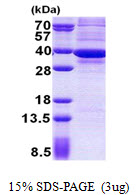

Human ATP5C1 protein (Recombinant) (His-Tag) (STJP018244)
SPECIFICATIONS
HostE.coli
ImmunogenHuman
General Information
| Short Description | Recombinant-Human ATP5C1-His-Tag protein was developed from e.coli and has a target region of His-Tag. For use in research applications. |
| Applications | SDS-PAGE/Denatured |
| Host | E.coli |
| Note | STRICTLY FOR FURTHER SCIENTIFIC RESEARCH USE ONLY (RUO). MUST NOT TO BE USED IN DIAGNOSTIC OR THERAPEUTIC APPLICATIONS. |
Product Properties
| Concentration | 0.5 mg/mL |
| Formulation | Liquid in 20mM Tris-HCl buffer (pH 8.0) containing 0.4M urea, 10% Glycerol |
| Storage Instruction | For short term storage, keep at +2C to +8C for up to 1 week. For long term storage, aliquot and store at-20C, and avoid repeat freeze-thaw cycles. |
Target Information
| Gene Symbol | ATP5F1C |
| Gene ID | 509 |
| Uniprot ID | ATPG_HUMAN |
| Accession Number | NP_001001973 |
| Immunogen | Human |
| Immunogen Region | 26-298aa |
| Immunogen Sequence | MGSSHHHHHH SSGLVPRGSH MGSATLKDIT RRLKSIKNIQ KITKSMKMVA AAKYARAERE LKPARIYGLG SLALYEKADI KGPEDKKKHL LIGVSSDRGL CGAIHSSIAK QMKSEVATLT AAGKEVMLVG IGDKIRGILY RTHSDQFLVA FKEVGRKPPT FGDASVIALE LLNSGYEFDE GSIIFNKFRS VISYKTEEKP IFSLNTVASA DSMSIYDDID ADVLQNYQ |
Additional Info
| Tissue Specificity | Isoform Heart is expressed specifically in the heart and skeletal muscle, which require rapid energy supply. Isoform Liver is expressed in the brain, liver and kidney. Isoform Heart and Isoform Liver are expressed in the skin, intestine, stomach and aorta. |
| Function | Subunit gamma, of the mitochondrial membrane ATP synthase complex (F(1)F(0) ATP synthase or Complex V) that produces ATP from ADP in the presence of a proton gradient across the membrane which is generated by electron transport complexes of the respiratory chain. ATP synthase complex consist of a soluble F(1) head domain - the catalytic core - and a membrane F(1) domain - the membrane proton channel. These two domains are linked by a central stalk rotating inside the F(1) region and a stationary peripheral stalk. During catalysis, ATP synthesis in the catalytic domain of F(1) is coupled via a rotary mechanism of the central stalk subunits to proton translocation (Probable). In vivo, can only synthesize ATP although its ATP hydrolase activity can be activated artificially in vitro. With the central stalk subunit delta, is essential for the biogenesis of F(1) catalytic part of the ATP synthase complex namely in the formation of F1 assembly intermediate. |
| Protein Name | Atp Synthase F(1 Complex Subunit Gamma - MitochondrialAtp Synthase F1 Subunit GammaF-Atpase Gamma Subunit |
| Database Links | Reactome: R-HSA-163210Reactome: R-HSA-8949613Reactome: R-HSA-9837999 |
| Cellular Localisation | Mitochondrion Inner MembranePeripheral Membrane ProteinMatrix Side |
| Alternative Protein Names | Atp Synthase F(1 Complex Subunit Gamma - Mitochondrial proteinAtp Synthase F1 Subunit Gamma proteinF-Atpase Gamma Subunit proteinATP5F1C proteinATP5C proteinATP5C1 proteinATP5CL1 protein |
Information sourced from Uniprot.org